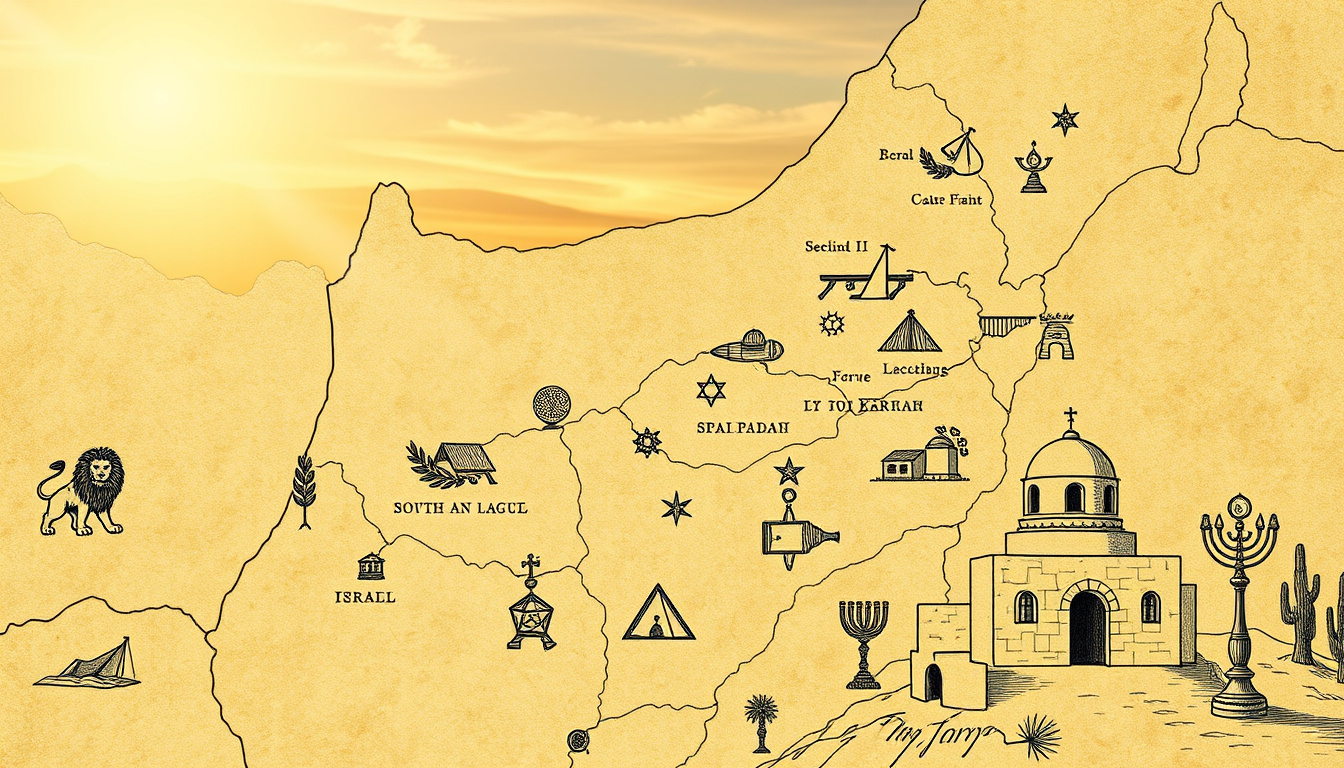
Few biblical topics spark as much curiosity as the 12 tribes of Israel. The story of Jacob’s twelve sons and their descendants has shaped religious identities, fueled historical debates, and inspired modern claims of lineage, while historical records, archaeology, and contemporary scholarship reveal a nuanced picture.
Number of tribes: 12 (or 13 including Levi) ·
Origin: Sons of Jacob (Israel) ·
Tribes with known continuity: Judah and Benjamin ·
Major historical event: Assyrian exile of 10 northern tribes (722 BCE) ·
Notable omission: Tribe of Dan omitted in Revelation 7
Quick snapshot
- Jacob had 12 sons who became tribal founders (Britannica)
- Assyria conquered the northern kingdom in 721 BCE (Britannica)
- Jesus was from the tribe of Judah (Britannica)
- Dan is omitted from the tribal list in Revelation 7 (Britannica)
- Exact fate of the ten lost tribes (Britannica)
- Whether any modern groups are authentic descendants (Jewish Voice)
- Reasons for Dan’s omission in Revelation (Britannica)
- Whether any northern tribes survived as distinct groups (Britannica)
- Kingdom division ~930 BCE (Britannica)
- Assyrian conquest of northern kingdom 721 BCE (Britannica)
- Babylonian exile of Judah 586 BCE (Britannica)
- Genetic studies may clarify descendant groups (Jewish Voice)
- Claims from Lemba, Bnei Menashe, and Beta Israel remain contested (Aish)
- Scholarly debate over Dan’s omission continues (Britannica)
Five key facts provide a foundation for understanding the tribes’ origins and survival.
| Fact | Details |
|---|---|
| Total tribes | 12 (or 13 including Levi) |
| Biblical source | Genesis 49, Exodus 1, Numbers 1, Revelation 7 |
| Surviving tribes today | Judah and Benjamin (as Jewish people) |
| Notable missing tribe | Dan (omitted in Revelation) |
| Jesus’ tribe | Judah |
| Number of lost tribes | 10 (northern kingdom) |
| Assyrian exile date | 722–721 BCE |
| Babylonian exile date | 586 BCE |
Do all 12 Tribes of Israel exist today?
The short answer is no — but the full picture is more nuanced. Two tribes, Judah and Benjamin, maintained a continuous identity through the Babylonian exile and into the Jewish people. The ten tribes of the northern kingdom were deported by Assyria and gradually assimilated into other populations (Britannica).
The Ten Lost Tribes
- The biblical tradition lists Asher, Dan, Ephraim, Gad, Issachar, Manasseh, Naphtali, Reuben, Simeon, and Zebulun as the ten northern tribes (Britannica).
- Assyrian conquest around 721 BCE scattered these groups; many were deported and intermarried (Wikipedia).
- The term “lost tribes” is a later historical label, not a biblical term (Britannica).
The implication: The tribes’ legacy continues through faith and tradition, but their physical trace remains elusive.
Modern Claims of Lineage
- The Lemba people of southern Africa claim descent from ancient Israelites, with some Y-chromosome studies showing potential links (Jewish Voice).
- Bnei Menashe of northeastern India trace their ancestry to the tribe of Manasseh (Aish).
- Beta Israel (Ethiopian Jews) have been linked in tradition to the tribe of Dan (Aish).
Genetic and Historical Evidence
- Genetic studies suggest shared ancestry among Jewish populations, but tracing specific tribal lines is extremely difficult (Jewish Voice).
- Exile and intermarriage disrupted genealogical records, making tribal affiliation nearly impossible to verify (Jewish Voice).
Without a continuous written record or reliable DNA markers for specific tribes, claims of descent from lost tribes remain in the realm of tradition and faith — not verifiable history.
What tribe of Jews was Jesus from?
Both New Testament genealogies place Jesus in the tribe of Judah.
Jesus’ Lineage in the Gospels
- Matthew 1 traces Jesus’ ancestry through David to Abraham, emphasizing the royal line of Judah (Britannica).
- Luke 3 also traces through David, though with a different genealogy, reinforcing the Judahite connection (Britannica).
The Tribe of Judah and the Davidic Line
- The messianic prophecy in Genesis 49:10 — “The scepter shall not depart from Judah” — is central to Jewish and Christian expectations (Britannica).
- Jesus is repeatedly called “Son of David” in the Gospels, confirming his Judahite lineage (Britannica).
The Role of the Tribe of Benjamin?
- Some traditions note that Paul the Apostle was from Benjamin (Romans 11:1), but no tradition links Jesus to Benjamin.
The implication: Jesus’ identification with Judah is biblically unambiguous. This reinforces the tribe’s central role in Jewish messianic tradition.
Why is Dan removed from the 12 tribes?
In Revelation 7, the list of tribes sealed by God includes no mention of Dan. This omission has puzzled readers for centuries.
The Omission of Dan in the Book of Revelation
- Revelation 7 lists 12,000 sealed from each of 12 tribes, but Dan is absent. Instead, Levi is included and Joseph (represented by Ephraim and Manasseh) appears (Britannica).
- This is the only biblical list that explicitly omits Dan.
Possible Reasons: Idolatry, Size, or Sin
- Ancient commentators suggested Dan was associated with idolatry (Judges 18) and therefore excluded (Britannica).
- Another theory holds that Dan was seen as a small tribe that merged into others.
- Some Christian traditions link Dan to the Antichrist because of ambiguous references in Genesis 49:17 — “Dan shall be a serpent by the way” — and Jeremiah 8:16.
The takeaway: There is no single accepted explanation. Multiple scholarly and theological interpretations exist, and the omission likely reflects early Christian views on Dan’s perceived apostasy.
Do Muslims come from the 12 tribes of Israel?
No — the 12 tribes are the descendants of Jacob (Israel), while Muslims trace their lineage through Ishmael, Abraham’s other son.
The Ishmaelites and Abrahamic Lineage
- Ishmael is considered a prophet in Islam and the ancestor of many Arab tribes (Study.com).
- The tribes of Israel are specifically the 12 sons of Jacob, not Ishmael’s descendants.
Claims of Arab Descent from Ishmael
- Many Muslims believe that Arabs descend from Ishmael through his son Kedar, but this is a genealogical tradition, not a claim to membership in the 12 tribes.
The Connection to the Twelve Tribes
- Some hadith traditions suggest that the lost tribes intermarried with Arab populations, but there is no historical evidence supporting this (Study.com).
- The two lineages — through Jacob and through Ishmael — are separate branches of Abraham’s family.
This distinction is critical for understanding modern identity claims: Muslims do not claim descent from the 12 tribes, but from Ishmael, which is a different line within the Abrahamic tradition.
The pattern: The two lines of Abraham’s family remain distinct, with no historical overlap traced to the tribes.
Who came first, Palestinians or Jews?
This question is often debated in modern political contexts, but the historical evidence points to a clear timeline.
Historical Presence of Israelites in Canaan
- Archaeological and textual evidence places the Israelites (ancestors of the Jewish people) in the highlands of Canaan from around 1200 BCE (Britannica).
- The name “Israel” appears on the Merneptah Stele (1208 BCE), confirming an Israelite presence in the region.
The Philistines and the Term ‘Palestinian’
- The Philistines — unrelated to modern Palestinians — were Aegean settlers who arrived around the same time (Britannica).
- The Roman emperor Hadrian renamed Judea as “Syria Palaestina” in 135 CE after the Bar Kokhba revolt, giving rise to the name Palestine.
Modern Political Claims
- The term “Palestinian” today refers to Arab inhabitants of the region, many of whom are descended from people who have lived there for centuries, but the name’s origin is Roman.
- Jewish continuous presence in the land — through the kingdoms of Israel and Judah, the Babylonian exile, and subsequent diaspora — is historically documented.
The pattern: Both peoples have deep historical roots in the land, but the Israelite/Jewish presence predates the Roman-era name Palestine by over a thousand years.
Twelve Tribes at a Glance
Nine tribes, each with a distinct territory and role, form the core of Israel’s traditional structure.
| Tribe | Meaning of Name | Territory (approximate) | Notable Fact |
|---|---|---|---|
| Reuben | “See, a son” | East of Jordan | Firstborn, lost birthright due to transgression |
| Simeon | “Heard” | Southern Canaan | Absorbed into Judah early |
| Levi | “Attached” | No territory (priestly) | Priestly tribe, scattered among others |
| Judah | “Praise” | Southern highlands | Royal tribe, Davidic line |
| Dan | “Judge” | Coastal plain, then north | Omitted from Revelation 7 |
| Naphtali | “Wrestling” | Upper Galilee | Blessed with swiftness (Genesis 49:21) |
| Gad | “Troop” | East of Jordan | Known as warriors |
| Asher | “Happy” | Western Galilee | Blessed with rich produce |
| Issachar | “Reward” | Lower Galilee | Known for wisdom in timing |
| Zebulun | “Dwelling” | Central Galilee | Blessed with sea trade |
| Joseph (Ephraim & Manasseh) | “He will add” | Central highlands | Split into two half-tribes |
| Benjamin | “Son of the right hand” | Near Jerusalem | Smallest tribe, loyal to Judah |
Confirmed Facts vs. What Remains Unclear
Confirmed facts
- Jacob had 12 sons who became tribal founders
- Assyria conquered the northern kingdom in 721 BCE
- Jesus was from the tribe of Judah
- Dan is omitted from Revelation 7
- Judah and Benjamin survived as identifiable Jewish tribes
What’s unclear
- Exact fate of the ten lost tribes
- Authenticity of modern descendant claims
- Reasons for Dan’s omission in Revelation
- Whether any northern tribes survived as distinct groups
“The ten tribes of the northern kingdom were deported by the Assyrians and gradually assimilated into the surrounding populations, leaving no continuous historical record.”
— Britannica (authoritative encyclopedia)
“Tribal affiliation after the exile became difficult to maintain because intermarriage and displacement disrupted genealogical records.”
— Jewish Voice (missionary organization focused on Jewish heritage)
The 12 tribes of Israel are both a historical reality and a living tradition. For Jews today, the lineage of Judah and Benjamin is carried forward through cultural and religious identity. For Christians, the tribes provide a framework for messianic prophecy. For anyone exploring modern claims — from the Lemba to the Bnei Menashe — the evidence remains fragmentary. The lesson: tribal identity in ancient Israel was fluid, and after 2,700 years, tracing a direct line to a specific son of Jacob is nearly impossible. For the reader seeking clarity, the honest answer is that scholars know some things for certain, but many questions remain open.
thecatholicthing.org, study.com, bartehrman.com, reddit.com, overviewbible.com, study.com, lifehopeandtruth.com, jewinthecity.com
For a more detailed look at their names and modern legacy, see this overview of the 12 tribes of Israel.
Frequently asked questions
What are the names of the 12 tribes in order?
The 12 sons of Jacob (in birth order) are Reuben, Simeon, Levi, Judah, Dan, Naphtali, Gad, Asher, Issachar, Zebulun, Joseph, and Benjamin. Joseph is often replaced by his two sons Ephraim and Manasseh in tribal lists.
What is the tribe of Levi known for?
Levi was the priestly tribe. They received no territorial inheritance; instead, they served in the Tabernacle and later the Temple. Moses and Aaron were Levites.
Do the Rastafari believe they are one of the 12 tribes?
Some Rastafari identify with the tribe of Judah, viewing Haile Selassie as the Lion of Judah. However, this is a spiritual identification, not a genealogical claim.
How did the 12 tribes split into two kingdoms?
After Solomon’s death around 930 BCE, ten northern tribes rebelled against Rehoboam and formed the kingdom of Israel. Only Judah and Benjamin remained loyal, forming the kingdom of Judah.
What is the significance of the tribe of Judah in Judaism?
Judah is the royal tribe — King David and his descendants came from Judah. The messianic hope in Judaism centers on a future king from the house of David, hence the tribe of Judah.
Are there any genetic tests to prove tribal descent?
No reliable genetic test can identify a specific tribe. While Y-chromosome studies can indicate shared ancestry among some Jewish groups, tribal affiliation is based on tradition and written records, not DNA.
Related reading
- Isaiah 41:10: Meaning, 5 Promises, and Daily Application — A biblical verse analysis that explores themes of divine reassurance, relevant to understanding the covenantal context of the tribes.
- Te Pūtahi Māori o Manurewa: Māori Immersion School in Manurewa — A look at how another culture, the Māori, maintain tribal identity through education, offering a modern parallel to ancient tribal preservation.