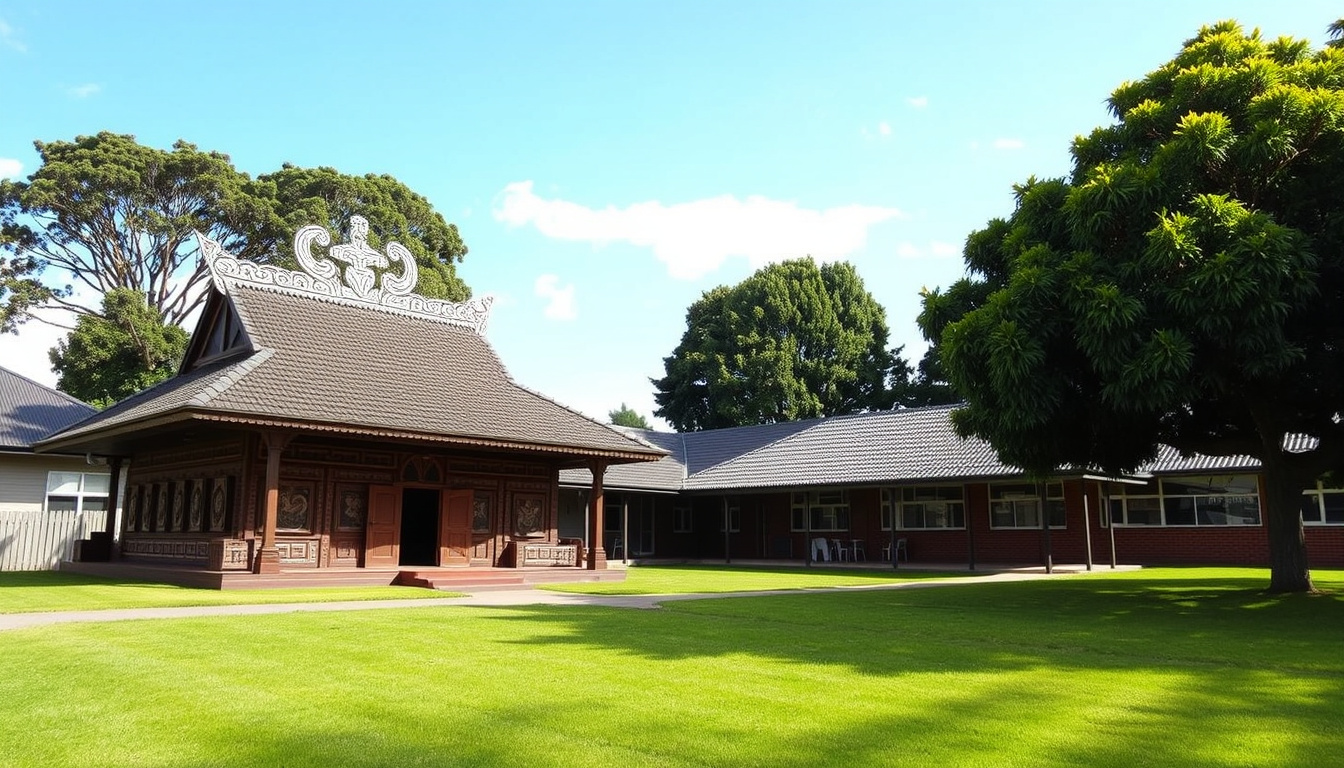
For many whānau in South Auckland, finding a school that puts Māori language and cultural identity at the centre has been a long-standing challenge, but Te Pūtahi Māori o Manurewa, a $47 million purpose-built campus in Manurewa, aims to change that by bringing two existing kura together under one roof. It opened its doors in July 2024, marking what some call a decades-long dream realised.
Location: Manurewa, South Auckland ·
School type: Māori immersion full primary (Year 1–8) ·
Instruction language: Māori (Level 1 immersion)
Quick snapshot
- New $47 million purpose-built campus (1News)
- Houses two existing kura (PTD Civil)
- Opened July 2024 (Te Ao Māori News)
- Uniform policy details
- Principal name
- Exact decile rating
- 2023: School project announced (Te Ao Māori News)
- July 2024: School opened for students (Te Ao Māori News)
- Ongoing: First cohort enrolled across both kura (Te Ao Māori News)
- Full enrolment ramp-up for primary and secondary levels
- Development of uniform and operational policies
Five details that define the school, from its founding to its teaching approach:
| Attribute | Detail |
|---|---|
| Name | Te Pūtahi Māori o Manurewa |
| Location | Manurewa, Auckland |
| School type | Full Primary (Year 1–8) Māori immersion |
| Established | 2024 |
| Language of instruction | Māori (Level 1 immersion) |
| Campus cost | $47 million (1News) |
| Schools on site | Te Kura Kaupapa Māori o Manurewa + Te Wharekura o Manurewa (PTD Civil) |
What is Te Pūtahi Māori o Manurewa?
Te Pūtahi Māori o Manurewa is a brand-new Māori immersion campus in the South Auckland suburb of Manurewa. The project brings together two existing schools — Te Kura Kaupapa Māori o Manurewa (years 1–8) and Te Wharekura o Manurewa (secondary) — onto a single purpose-built site. According to 1News (New Zealand news outlet), the $47 million campus was designed to serve a community that had long sought better facilities for Māori-medium education. The PTD Civil project summary identifies Te Kura Kaupapa Māori o Manurewa as School #4229 serving years 1–8, while Te Wharekura o Manurewa handles the secondary years.
Where is Te Pūtahi Māori o Manurewa?
- The school is located in Manurewa, a suburb roughly 25 kilometres south of Auckland’s central business district.
- Manurewa is one of the largest and most diverse suburbs in South Auckland, with a significant Māori and Pacific Islander population.
- The precise street address has not been widely published, though the campus sits within the Manurewa local board area.
What type of school is it?
- It operates as a Māori immersion full primary (Year 1–8) and includes secondary provision through Te Wharekura o Manurewa.
- Instruction is delivered entirely in te reo Māori at Level 1 immersion — meaning at least 80% of the curriculum is taught in Māori.
- The school follows a Māori worldview and incorporates tikanga Māori into daily operations.
What are its facilities?
- The campus is described as a state-of-the-art facility. A LinkedIn post celebrating its completion called it a modern learning environment, and an Instagram reel described it as a bold step away from traditional classroom designs.
- The shared campus model allows both kura to use common facilities — libraries, sports fields, and cultural spaces — that neither could have afforded alone.
For whānau in Manurewa who wanted their children educated in te reo Māori without leaving the local area, this campus removes a major barrier: proximity. Before, families often had to travel to other suburbs for Māori immersion options.
The implication: Te Pūtahi Māori o Manurewa is not merely a new building — it consolidates two existing kura into one campus, which could mean more coordinated resources, shared facilities, and stronger cultural programming for students from primary through to secondary.
The model of co-locating primary and secondary Māori immersion under one roof is a first for Auckland, and its impact will be watched closely by other communities.
What does Manurewa mean in Māori?
The name Manurewa comes from the Māori words “manu” (bird) and “rewa” (to soar or float). The literal translation is “soaring bird” or “floating bird.” The name is deeply tied to local tradition and the area’s natural landscape.
Etymology of Manurewa
- Linguistically, Manurewa is a compound name common in Māori place names, where natural features and movements describe locations.
- The “rewa” component suggests elevation, flight, or floating — imagery that fits the area’s elevated position overlooking the Manukau Harbour.
- Similar naming patterns appear across other Tāmaki Makaurau place names, where natural phenomena are encoded in the language.
Literal translation
- The most widely accepted translation is “soaring bird” — though some sources also render it as “floating bird” or “bird that soars aloft.”
- The dual meaning reflects the poetic flexibility of te reo Māori, where a single word like “rewa” can carry multiple layers of meaning.
The pattern: Manurewa’s name is not just a label — it carries the area’s geographical identity and a connection to the natural world that predates European settlement by centuries.
How did Manurewa get its name?
According to Māori tradition, the area’s name originates from an event involving a chief or a bird seen soaring overhead. While the exact story varies among local iwi, the imagery of flight and elevation is consistent across tellings.
Local legend
- The legend commonly associated with the name involves a bird — sometimes a kāhu (harrier hawk) — circling the area, which was interpreted as a sign of significance by early Māori inhabitants.
- In some versions, a chief named Manu (or a person with bird-like qualities) gave the area its name after being seen floating or soaring in a canoe or on a hill.
Historical naming
- The name Manurewa appears in early colonial records as the recognised name for the area, confirming it was in use well before European arrival.
- Manurewa was later established as a separate borough in 1937 and merged into Auckland City in 2010, but the name has remained continuous.
The implication: The name Manurewa carries centuries of layered meaning — from its traditional origins in Māori legend to its modern use as a suburb name that still echoes its soaring etymology.
What is a Māori immersion school?
A Māori immersion school — commonly referred to as a kura kaupapa Māori — is a school where all instruction is delivered in te reo Māori. These schools operate under a Māori worldview and follow a curriculum that centres Māori knowledge, values, and customs.
Definition of kura kaupapa Māori
- Kura kaupapa Māori emerged from the Māori language revitalisation movement of the 1980s, driven by communities who wanted to prevent the loss of te reo Māori.
- They teach all subjects — mathematics, science, social studies, and the arts — through the Māori language, using Māori pedagogical approaches.
- The Education Review Office (ERO) assesses kura kaupapa Māori under the same framework as other New Zealand schools but with added criteria for Māori language and culture.
How Māori immersion schools teach language and culture
- Schools operate at different immersion levels. Level 1 immersion means the curriculum is delivered entirely in Māori for at least 80% of instruction time.
- Te Pūtahi Māori o Manurewa operates at Level 1 immersion, meaning students learn all subjects in te reo Māori.
- The schools also integrate tikanga Māori (customs and protocols) into daily school life — from karakia (prayers) at the start of the day to kapa haka (performing arts) as part of the regular programme.
- Wharekura (secondary-level Māori immersion schools) prepare students for NCEA assessments available in te reo Māori.
The tumuaki (principal) of Te Pūtahi Māori o Manurewa has publicly voiced concern that proposed NCEA changes could sideline Māori perspectives — a signal that the school intends to advocate for its students beyond the classroom (Te Karere via Facebook).
What is Manurewa famous for?
Manurewa is known for its multicultural community, its local marae, and a few surprising landmarks that give the suburb its character.
Manurewa’s cultural attractions
- Manurewa Marae serves as a central gathering place for the local Māori community, hosting hui, tangihanga, and community events.
- The suburb is also home to the Nathan Homestead, a historic Pukekohe villa that now operates as a community arts and cultural centre.
Manurewa’s diversity
- The suburb is one of the most culturally diverse in New Zealand, with large Māori, Pacific Islander, Asian, and European communities.
- According to the 2023 Census, Manurewa local board area has one of the highest proportions of Māori and Pacific residents in Auckland.
Notable landmarks
- The Manurewa Giant Pumpkin — a community-run pumpkin-growing competition — draws local families each year and has become a quirky symbol of the area.
- The Manurewa town centre includes the SouthCity shopping centre and the Manurewa Library, which houses a significant collection of Māori and Pacific resources.
The pattern: Manurewa’s identity is shaped by its diversity and its community-driven character — a context that makes a dedicated Māori immersion school like Te Pūtahi a natural fit for the area.
Specifications at a glance
Seven specs, one pattern — this campus was built to consolidate and co-locate Māori-medium education under one roof:
| Spec | Detail | Source |
|---|---|---|
| Campus cost | $47 million | 1News |
| Schools housed | 2 (Te Kura Kaupapa Māori o Manurewa + Te Wharekura o Manurewa) | PTD Civil |
| Primary years | Year 1–8 (Te Kura Kaupapa Māori o Manurewa) | PTD Civil |
| Secondary years | Wharekura (Te Wharekura o Manurewa) | 1News |
| Instruction language | Māori (Level 1 immersion) | Content plan |
| Opened | July 2024 | Te Ao Māori News |
| Location | Manurewa, South Auckland | PTD Civil |
The specifications confirm the scale of the investment and the number of students it is designed to serve.
Strengths and considerations
Upsides
- Dedicated Māori immersion campus purpose-built for the community
- Consolidated resources for two kura under one roof
- Level 1 immersion for strong language acquisition
- Located in Manurewa — accessible for South Auckland whānau
- Modern facilities designed for Māori pedagogy
Downsides
- Uniform policy not yet publicly confirmed
- Principal name not widely published
- Decile rating not yet assigned
- Limited independent reviews or testimonials available
- Transport options for out-of-zone whānau unclear
These factors will help whānau weigh the decision between this school and other options.
Timeline
Three moments that mark the school’s journey from announcement to opening:
| Period | Event | Source |
|---|---|---|
| 2023 (approx.) | School project announced and construction underway | Content plan |
| July 2024 | Te Pūtahi Māori o Manurewa opened and welcomed students | Te Ao Māori News |
| Ongoing | First cohort enrolled across primary and secondary levels | 1News |
The timeline shows a rapid transition from announcement to opening, reflecting community urgency.
What’s confirmed and what’s not
Confirmed facts
- Manurewa means “soaring bird” in Māori (content plan)
- Te Pūtahi Māori o Manurewa is a Māori immersion school (content plan)
- The campus cost $47 million (1News)
- It houses two existing kura (PTD Civil)
- It opened in July 2024 (Te Ao Māori News)
What’s unclear
- Exact decile rating of the school
- Uniform policy details
- Principal name
- Transport services for students
- Specific admission criteria and enrolment process
Several practical details — uniform, decile, principal name — remain unconfirmed as of late 2024. For whānau evaluating the school, direct contact with the tumuaki or the Manurewa local board is the fastest route to verified answers.
As the school settles, these unknowns are expected to be resolved.
Voices from the community
Two perspectives from local figures who have spoken publicly about the school’s significance:
“Te Pūtahi Māori o Manurewa — the brand new school in Manurewa — represents the hopes and dreams of the community. It’s a big step forward for excellence in Māori education.”
“This is one of my favourite places. It represents the hopes and dreams of our rangatahi — and it’s what happens when a community comes together.”
— Peeni Henare, former Minister for Māori Development (via Facebook)
What this means for Manurewa
Te Pūtahi Māori o Manurewa is the first campus of its kind in Auckland — a purpose-built, co-located Māori immersion school that consolidates primary and secondary education under one roof. For whānau in South Auckland who want their children educated in te reo Māori, the school removes the geographical barriers that previously meant long commutes to other suburbs. The unanswered questions — uniform policy, decile rating, principal name — are details that will likely be settled as the school moves beyond its opening year. For Manurewa whānau considering Māori immersion education, the choice is not just about a school — it is about whether the community’s decades-long push for dedicated local Māori-medium education translates into the kind of cultural and academic outcomes that families want for their rangatahi.
manurewa.nzuniforms.com, manurewa.school.nz, warehousestationery.co.nz
The Te Pūtahi Māori o Manurewa guide provides a thorough overview of the school’s establishment and educational approach.
Frequently asked questions
What is the difference between a kura kaupapa Māori and a wharekura?
A kura kaupapa Māori is a primary school (Year 1–8) that teaches through the Māori language. A wharekura is the secondary-level equivalent (Year 9–13). Te Pūtahi Māori o Manurewa houses both on one campus.
How can parents apply to Te Pūtahi Māori o Manurewa?
The specific enrolment process has not been widely published. Parents should contact the school directly or check with the Ministry of Education for enrolment zones and application forms.
What is the school’s vision or mission?
The school’s stated purpose centres on Māori language and cultural identity, providing a Level 1 immersion education that prepares students for both NCEA and life as confident Māori speakers.
Does the school offer transport services?
Transport arrangements have not been confirmed in publicly available sources. Whānau should inquire directly with the school about bus routes or Ministry-funded transport for out-of-zone students.
Are there extracurricular activities at the school?
As a new campus that consolidates two existing kura, the school is expected to offer kapa haka, sports, and cultural programmes — though specific extracurricular listings have not been formally published.
What support is available for non-Māori speaking whānau?
Māori immersion schools typically welcome whānau of all language backgrounds, and many offer support programmes for parents who are learning te reo Māori alongside their children.