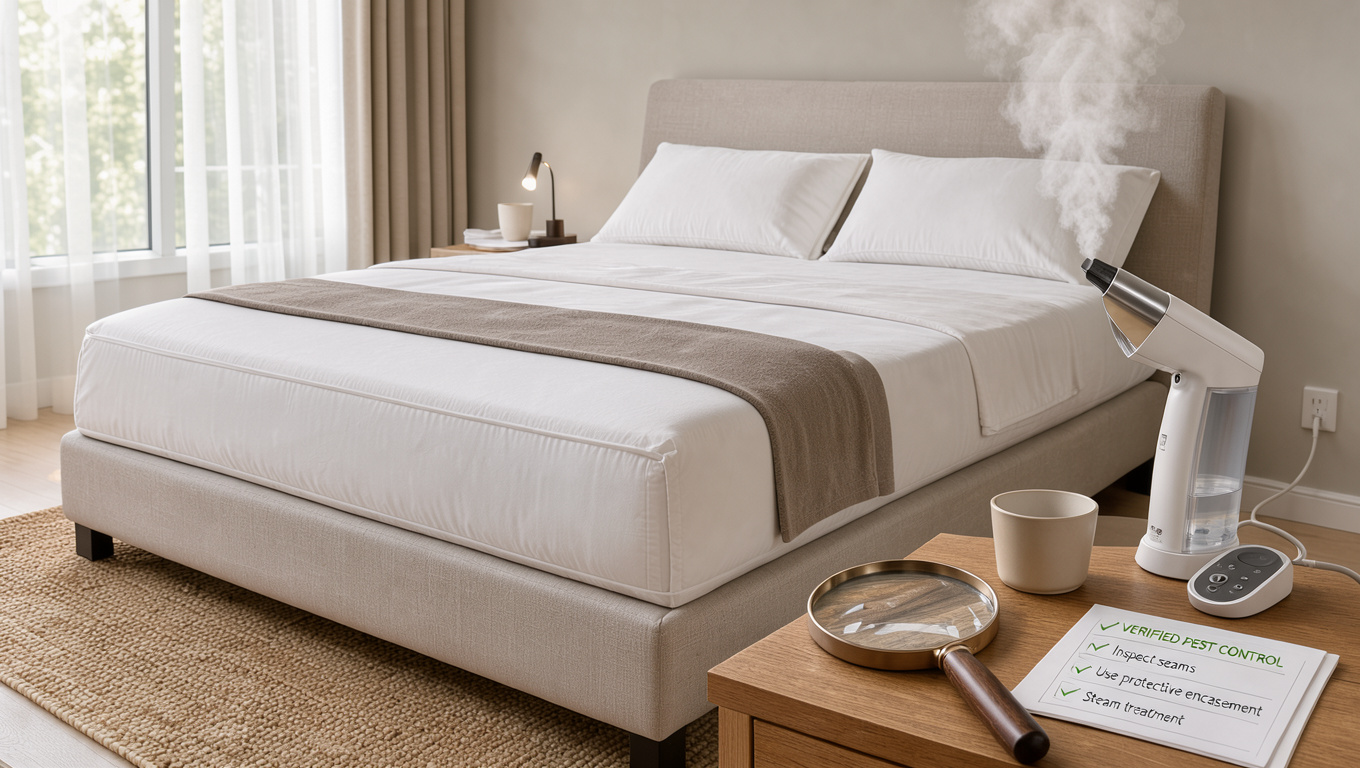
Heat, freezing, and encasement only work under specific temperatures, durations, and conditions, and several popular shortcuts have no verified support. Federal and university sources set these thresholds, and they do not always agree, so each number below carries its source.
Lethal body temperature: 45°C (113°F) · Freezing: 0°F for at least 4 days · Mattress encasement: one year · Monitoring interval: every 7 days
Heat
- Heating to at least 120°F (49°C) for 90 minutes kills eggs, according to US EPA integrated pest management guidance.
Freezing
- Items held at 0°F for at least 4 days in a sealed bag, per US EPA do-it-yourself control guidance.
Follow-up
- Purdue University Extension recommends at least one follow-up inspection 10 to 21 days after each control effort, per Purdue University Extension bed bug control guidance.
The table below lists the core thresholds and the agency behind each one. Read the source column first, because the sources set different numbers for the same method.
| Method | Verified condition | Source |
|---|---|---|
| Clothes dryer | High heat for 30 minutes | US EPA |
| Dryer (alternate) | 125°F for 20 minutes | Cornell University IPM |
| Heat, items or areas | 120°F for 90 minutes | US EPA |
| Freezing, items | 0°F for at least 4 days | US EPA |
| Steam | At least 130°F, without forceful airflow | US EPA |
| Whole-room dry heat | 140°F for 2 hours, or 130°F for 3 hours | Georgia Department of Public Health |
Most of these numbers describe what a professional can reach in a room. Few describe what a homeowner can reach with a kitchen appliance.
How do you get rid of bed bugs out of your bed?
Start with the bedding, because it is the easiest item to treat. The steps below follow the order the sources support.
- Wash and then dry bedding and clothing on high heat for 30 minutes. The US EPA says washing alone generally does not kill bed bugs.
- Encase the mattress and box spring. Purdue University Extension says covers at least 0.08 mm thick should stay on for a minimum of one year.
- Vacuum seams and crevices with a crevice tool. Purdue notes that eggs are stuck tightly to surfaces, and a HEPA vacuum removes over 99% of particles above 0.3 micron.
- Freeze small items in sealed bags at 0°F for at least 4 days. Verify the temperature with a thermometer, as the US EPA advises.
- Check the bed area about every 7 days for signs of activity after treatment, per US EPA guidance.
- Schedule a follow-up inspection 10 to 21 days after each control effort, as Purdue Extension recommends.
“Don’t just wash them — at least 30 minutes in the dryer is what does the work, killing bed bugs in every life stage, eggs included.”
Joel Miller, owner, Miller Pest Solutions
Mattress sprays are a separate question. The supplied sources do not verify any spray product for mattresses. New Mexico Department of Health guidance says the most effective control combines chemical measures with heat treatment carried out by a Pest Management Professional. Insecticides are the most common approach, but they may need repeat rounds.
What can I spray on my mattress for bed bugs?
No spray is verified here for home use. The supplied evidence does not name a product or label that a homeowner can apply safely to a mattress. Use the product label and the regulator’s approved-use list, and treat any spray as one step inside a plan that includes a professional.
How do you find a bed bug nest?
Detection comes before treatment. Interceptor traps placed under bed legs can show whether activity continues, and the Bedding Bird guide, citing EPA advice, recommends checking them at least every 7 days. That source carries low confidence, so treat the interval as a working rule, not a verified threshold.
How to trick bed bugs out of hiding?
None of the supplied sources verify a method for luring bed bugs out of hiding. Claims about baits or scents appear in popular guides without the temperature, duration, or product data that federal and university sources attach to other methods. Treat them as unverified.
Do bed bugs live in carpet?
The supplied sources do not address carpet or hair as harborage. Do not treat carpet as a confirmed nest without inspection evidence. Vacuuming can reduce numbers, but Terminix states that DIY steps like washing, drying, and vacuuming reduce numbers and will not fully remove hidden bugs or eggs.
Can bedbugs live in your hair?
The supplied sources do not cover hair. No verified claim is made here either way.
What kills bed bugs instantly?
No verified source supports an overnight or instant home fix. Cornell University IPM says temperatures over 125°F kill bed bugs and eggs instantly, but that figure applies to sustained heat in a controlled setting, not a household fix. Freezing is slower. Cornell says it must be maintained for 2 weeks or more, while the US EPA lists 4 days at 0°F.
Does a cold room keep bed bugs away?
The supplied sources do not establish that a cool room controls bed bugs. Health Canada’s freezing guidance applies to items at -19°C for 4 days, not to room temperature. A cool room is not a verified treatment.
How soon will you know if you brought bed bugs home?
Checks, not bites, give the clearest signal. Monitor after treatment, and do not assume a clean night means the problem is gone. The Albuquerque municipal guidance recommends re-evaluation if more bugs appear after two weeks.
What is the timeline of the bed bug life cycle?
The supplied research does not provide a verified life-cycle timeline. Use inspection intervals, not a life-cycle clock, to judge progress.
“If you place your mattress in a good encasement that completely surrounds it — and another around the boxspring — there’s no need to treat those items.”
Pollack, quoted expert (role not specified in source)
When should a professional take over?
Health Canada advises hiring a licensed professional pest control operator when bed bugs are present, and says heat treatments should be left to professionals. The City of Albuquerque advises professional consultation because full extermination is difficult. Whole-room heat remediation, which Everyday Health says heats an area to about 130°F in usually one treatment, requires professional equipment. Fumigation requires leaving the building for a few days and takes about three weeks overall.
Heat does not leave residual protection, so sealing off reinfestation sources matters as much as the treatment itself. The US EPA warns that property owners must take steps to avoid reintroducing bed bugs after heat.
Related reading: pest control treatment options · bedding stores guide
healthline.com, canada.ca, extension.umn.edu, cabq.gov, health.yahoo.com, nmhealth.org, epa.gov, extension.entm.purdue.edu, terminix.com, homesandgardens.com
Frequently Asked Questions
Does steam kill bed bugs?
Steam can, under conditions. The US EPA says a steam cleaner should emit at least 130°F without forceful airflow that could scatter bugs. Health Canada says steam cleaners generally emit at least 100°C and prefers dry steam or low-vapour steamers to limit moisture and mould risk.
Does vacuuming remove bed bugs?
Vacuuming reduces numbers but does not clear hidden eggs. Purdue Extension says eggs are hard to dislodge, and a crevice tool helps. A HEPA vacuum removes over 99% of particles above 0.3 micron. Terminix notes that vacuuming alone will not fully remove hidden bugs or eggs.
Is a household freezer cold enough?
It may not be. The US EPA warns that home freezers may not be cold enough to reliably kill bed bugs and recommends a thermometer. Maine’s NYS IPM guidance says household freezing is not guaranteed to work.
How long does a mattress encasement stay on?
The US EPA recommends leaving it on for one year. Purdue Extension specifies covers at least 0.08 mm thick for a minimum of one year. The encasement must be strong enough to last that long without tearing.
How long does a dryer treatment take?
The US EPA recommends 30 minutes in a hot dryer. Cornell University IPM recommends 125°F for 20 minutes. The two figures differ, so use the hotter setting and the longer time when in doubt.
Is fumigation faster than heat?
Not according to Everyday Health. It reports that fumigation requires leaving the building for a few days and takes about three weeks overall, while whole-room heat usually takes one treatment.