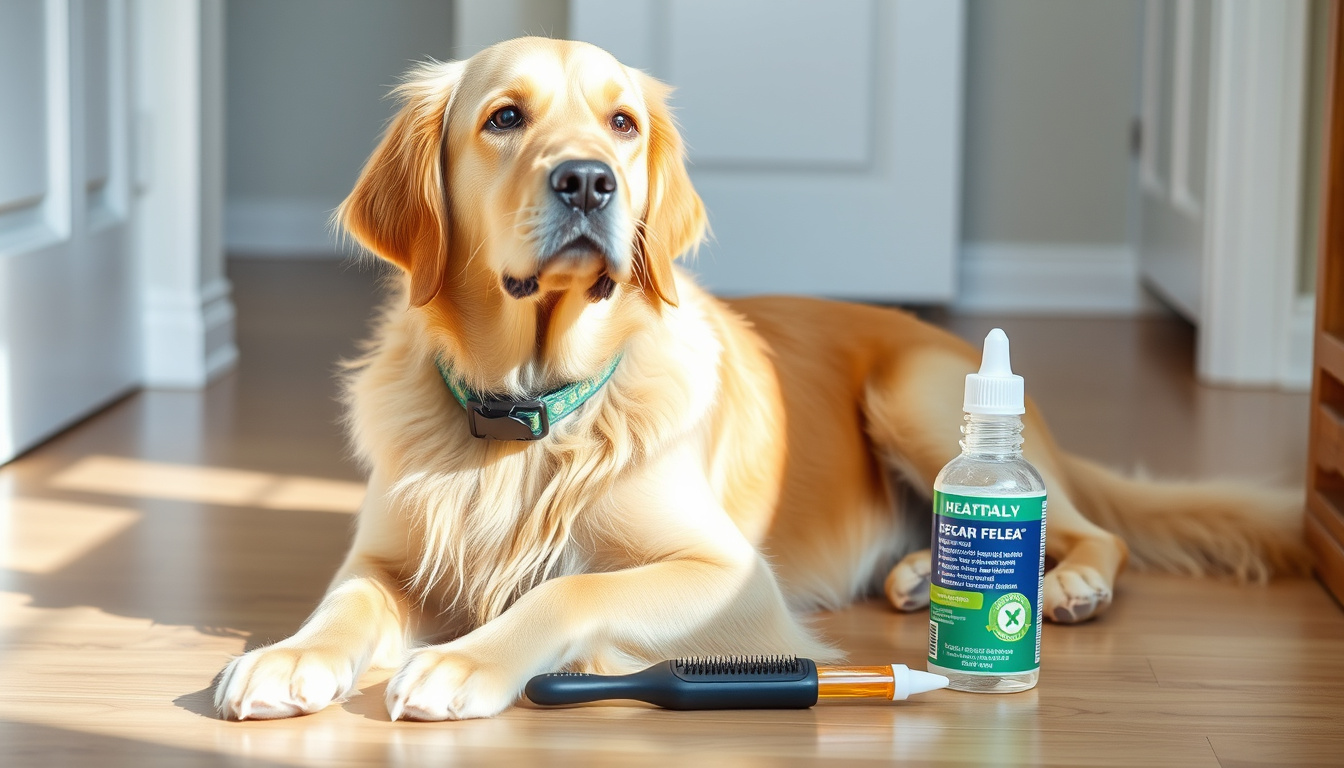
Fleas are not just an annoyance for Irish dog owners; a single female can lay up to 50 eggs per day, and without proper treatment a small problem becomes an infestation fast. The route back to a comfortable dog runs through vet-recommended medication and disciplined home cleaning.
Flea eggs per day: up to 50 ·
Flea life cycle (egg to adult): 2 to 3 weeks ·
Average cost of a flea treatment: €15–€50 per dose ·
Fleas can jump: up to 150 times their body length ·
Recommended treatment frequency: monthly
Quick snapshot
- Monthly flea treatment prevents infestation (Dogs Trust Ireland (canine welfare charity))
- Hot water (>54°C) kills fleas and eggs (Auburn Vets (Irish veterinary practice))
- Capstar kills adult fleas within 30 minutes (Decs Pets (Irish pet retailer))
- Long-term safety of some natural remedies such as essential oils and diatomaceous earth
- Exact effectiveness of DIY flea traps compared to professional treatments
- How well OTC supermarket brands compare with prescription flea products in head-to-head trials
- Flea eggs hatch in 2–12 days, meaning new fleas emerge rapidly after treatment (Auburn Vets)
- Adult fleas can live 2–3 months on a host, requiring sustained treatment (Auburn Vets)
- Continue preventative flea treatment throughout the dog’s life (Auburn Vets)
- Vacuum daily for 2 weeks after treatment to remove eggs and pupae (Auburn Vets)
The numbers behind flea control decisions point to one conclusion: timing and environmental cleaning matter as much as the product you choose.
| Fact | Value |
|---|---|
| Adult flea lifespan on host | 2–3 months |
| Flea eggs hatch | 2–12 days |
| Fleas can jump | up to 33 cm |
| Recommended post-treatment cleaning | Vacuum daily for 2 weeks |
What is the most effective treatment for dog fleas?
Spot-on treatments
- Spot-on liquids are applied to the skin between the shoulder blades. Glen Vets (Kilkenny veterinary practice) reports that these typically protect for 1 to 2 months, depending on the brand and whether the dog swims or is bathed.
- Cottage Vet Kildare notes most spot-on products protect for one month, while Moss Vet Hospital specifies Frontline is applied once every 2 months, and Stronghold and Advocate are applied monthly.
- Some products also repel or kill ticks, according to MSD Animal Health Republic of Ireland (veterinary pharmaceutical leader).
Oral tablets
- Dogs Trust Ireland (canine welfare charity) explains that flea treatments come as oral tablets or topical liquids applied to the skin. Oral tablets, such as Bravecto and Capstar, are often prescription-only.
- Cottage Vet Kildare states Bravecto tablets prevent fleas for 12 weeks — a longer window than most spot-ons.
- Decs Pets (Irish pet retailer) says oral flea tablets work fastest, killing adult fleas within 24 hours.
Flea collars
- MSD Animal Health Republic of Ireland (veterinary pharmaceutical leader) lists collars among the available product forms, alongside spot-ons, shampoos, dips, injections, powders, sprays, and oral medications.
- Decs Pets (Irish pet retailer) reports flea collars can provide 6 to 8 months of continuous protection, with active ingredients diffusing over the fur.
- Water-resistant varieties exist, but collars generally act more slowly than oral tablets.
What will kill fleas immediately on dogs?
Fast-acting oral medications (Capstar)
- Decs Pets (Irish pet retailer) says Capstar (nitenpyram) kills adult fleas within 24 hours, and veterinary guidance confirms it starts working within 30 minutes. It is available as an oral tablet and is often used for immediate relief.
- Capstar is not a long-term preventive; it kills adult fleas for about 24 hours and does not affect eggs or larvae.
Topical spot-ons with rapid kill
- Spot-on treatments containing imidacloprid or fipronil start killing fleas within hours, though full elimination takes 1–2 days. Glen Vets (Kilkenny veterinary practice) confirms that prescription spot-ons are the most effective choice for most dogs.
What kills fleas in 30 minutes?
- Only Capstar and similar nitenpyram-based oral medications reliably kill fleas within 30 minutes. Flea combs and shampoos can remove fleas instantly during bathing but have no residual effect.
- Primrose Hill Vets (Dublin veterinary practice) states that spot-ons and tablets are preferred for long-term control, while shampoos are useful for initial cleanup.
Can I treat fleas without going to the vet?
Over-the-counter products
- Glen Vets (Kilkenny veterinary practice) warns that pet-shop or supermarket flea products may not work as well as prescription-only medicines. OTC spot-ons and collars are widely available, but their efficacy varies significantly.
- Decs Pets (Irish pet retailer) notes that OTC spot-ons provide 4 to 8 weeks of protection, but formulation quality matters.
Natural remedies
- Diatomaceous earth, essential oils, and vinegar solutions are often recommended online, but Auburn Vets (Irish veterinary practice) emphasises that successful flea control requires treating both the dog and the environment with proven methods.
- The long-term safety of some natural remedies remains unclear, and they are not a replacement for vet-approved treatments in moderate to severe infestations.
When to see a vet
- Heavy infestations, allergic reactions (flea allergy dermatitis), or signs of anaemia (pale gums, lethargy) require veterinary care. Blackrock Vets (Dublin veterinary practice) recommends treating dogs for fleas on a monthly basis, especially during higher-risk periods.
- Auburn Vets (Irish veterinary practice) advises continuing preventative treatment throughout the dog’s life to prevent recurrence.
What do fleas absolutely hate?
Essential oils (citronella, lavender, cedarwood)
- Fleas dislike strong smells like citronella, lavender, and cedarwood. Some dog owners use diluted essential oil sprays as a mild deterrent. However, MSD Animal Health Republic of Ireland (veterinary pharmaceutical leader) notes that registered flea products are the most reliable form of prevention.
- Essential oils should never be applied undiluted to dogs, as some can be toxic — especially tea tree oil.
Diatomaceous earth
- Diatomaceous earth (food-grade) dehydrates fleas by absorbing the waxy layer of their exoskeleton. It can be sprinkled on carpets and bedding, but Auburn Vets (Irish veterinary practice) recommends an environmental flea spray such as Indorex for immature fleas missed during vacuuming.
- Inhalation of diatomaceous earth dust can irritate lungs, so it must be used with caution around pets and people.
Vinegar solutions
- Apple cider vinegar is sometimes used as a rinse or diluted spray due to its strong smell and acidity. While it may offer mild repellent effects, it is not a standalone treatment and does not kill fleas or eggs.
- Glen Vets (Kilkenny veterinary practice) cautions that relying on home remedies instead of proven flea medicines can allow infestations to worsen.
Will fleas go away on their own?
Flea life cycle
- Adult fleas live only a few days off a host but can survive 2–3 months on the animal. Eggs hatch in 2–12 days, and larvae can pupate and remain dormant for months in carpets and bedding.
- Without treatment, the flea population grows exponentially — one female can lay up to 50 eggs per day.
Infestation persistence
- Auburn Vets (Irish veterinary practice) states that successful flea control requires treating both the dog and the environment, because eggs and larvae in the home cause reinfestation.
- Fleas do not go away on their own. Without intervention, the life cycle continues indefinitely.
Need for treatment
- Blackrock Vets (Dublin veterinary practice) recommends monthly flea treatment as a preventive measure, especially during warmer months when flea activity peaks.
- Auburn Vets (Irish veterinary practice) advises continuing preventative treatment throughout the dog’s life.
How often should I wash bedding with fleas?
Frequency
- Auburn Vets (Irish veterinary practice) recommends vacuuming and washing bedding to reduce flea eggs, pupae, and flea dirt. Wash dog bedding at least once a week during an active infestation.
Temperature
- Hot water (above 54°C) kills fleas and eggs. A full washing machine cycle with detergent and hot water is sufficient to eliminate fleas on bedding.
Can fleas live in your bed?
- Yes. Fleas can live in bedding, mattresses, and carpets. They jump onto dogs to feed but spend significant time in the environment. Auburn Vets (Irish veterinary practice) recommends an environmental spray such as Indorex for areas missed by vacuuming.
Is it safe to sleep with a dog with fleas?
- Sleeping with a flea-infested dog may lead to bites on humans, especially around the ankles and legs. Some people develop allergic reactions to flea saliva. It is safer to treat the dog and clean bedding before co-sleeping.
Do fleas survive in the washing machine?
- Fleas cannot survive a washing machine cycle with detergent and hot water (above 54°C). Cold water may not kill all stages, so always use a hot wash for infested bedding.
Can fleas crawl out of a vacuum?
- Vacuuming removes up to 90% of flea eggs and many adults, but some can escape the vacuum bag. Auburn Vets (Irish veterinary practice) recommends emptying the vacuum canister or bag promptly into an outdoor bin to prevent re-infestation.
Irish dog owners who skip environmental cleaning often see fleas return within days — because eggs and pupae in carpets and bedding survive treatment on the dog alone. The combination of a vet-approved product on the dog and thorough home cleaning is what breaks the cycle.
Comparison: spot-ons, tablets, and collars
Three product categories dominate the Irish market, and the trade-off is between speed, duration, and convenience.
| Treatment type | Duration of protection | Prescription required? | Speed of action | Key products (examples) |
|---|---|---|---|---|
| Spot-on treatments | 1–2 months (brand-dependent) | Some OTC, some prescription | 24–48 hours | Frontline, Advocate, Stronghold |
| Oral tablets | 24 hours (Capstar) to 12 weeks (Bravecto) | Often prescription-only | 30 minutes to 24 hours | Capstar, Bravecto |
| Flea collars | 6–8 months | OTC | Several days to weeks | Seresto |
Glen Vets (Kilkenny veterinary practice) states prescription-only flea medicines from a vet or pharmacy are usually the most effective. Moss Vet Hospital adds that treatment frequency may vary by manufacturer recommendations and summer risk.
Upsides
- Spot-ons are easy to apply and widely available
- Oral tablets provide the fastest kill — Capstar works in 30 minutes
- Flea collars offer longest duration (6–8 months) with minimal effort
- Prescription treatments from a vet are backed by efficacy data (Glen Vets (Kilkenny veterinary practice))
- Bravecto protects for 12 weeks, reducing dosing frequency (Cottage Vet Kildare)
Downsides
- OTC spot-ons from supermarkets may be less effective (Glen Vets (Kilkenny veterinary practice))
- Oral tablets require a vet visit in many cases
- Collars act slowly — not ideal for active infestations
- Some dogs experience skin reactions or digestive upset
- Costs vary from €15 to €50 per dose, adding up over the year
The pattern: a product’s speed and duration determine its role — tablets for emergencies, spot-ons for monthly discipline, collars for owners who struggle to remember doses.
Step-by-step guide: how to treat fleas on dogs
Treating fleas effectively involves three steps: choose the right treatment, apply it correctly, and clean the environment. Skipping any step leaves the door open for reinfestation.
-
Step 1: Choose a vet-recommended treatment
- Consult your vet or use an Irish veterinary guidance source to select a product. Glen Vets (Kilkenny veterinary practice) highlights that prescription-only medicines are typically the most effective.
- Consider your dog’s weight, age, and any existing health conditions — some products are not suitable for puppies or dogs with epilepsy.
- For immediate kill, ask your vet about Capstar (nitenpyram) tablets.
-
Step 2: Apply the treatment correctly
- For spot-ons: part the fur between the shoulder blades and apply directly to the skin, not on the coat. Glen Vets (Kilkenny veterinary practice) notes that swimming or bathing can shorten the protection period.
- For oral tablets: follow the dosing schedule — Bravecto every 12 weeks, Capstar as a single dose for immediate relief.
- For collars: fasten snugly but not tightly; cut off any excess length to prevent chewing.
- Mark your calendar with the next dose date. Monthly treatment is the standard recommendation from Irish vets (Blackrock Vets (Dublin veterinary practice)).
-
Step 3: Treat the environment
- Vacuum all carpets, sofas, and dog bedding daily for at least 2 weeks. Auburn Vets (Irish veterinary practice) states this reduces flea eggs, pupae, and flea dirt significantly.
- Wash dog bedding and human bedding (if the dog sleeps on it) in hot water above 54°C weekly.
- Use an environmental flea spray such as Indorex, as recommended by Auburn Vets (Irish veterinary practice), to kill immature fleas that vacuuming may miss.
- Empty the vacuum canister or bag into an outdoor bin immediately after each use.
Treating the dog without cleaning the environment is like mopping a floor while the tap is still running. Auburn Vets (Irish veterinary practice) warns that flea eggs and pupae survive in carpets and bedding, so environmental control is not optional — it is the difference between a one-week fix and a long-term solution.
That sequence is what turns a one-off treatment into a completed job.
What we know — and what’s still uncertain
Confirmed facts
- Monthly flea treatment prevents infestation when used consistently (Dogs Trust Ireland (canine welfare charity))
- Hot water (above 54°C) kills fleas and eggs in bedding (Auburn Vets (Irish veterinary practice))
- Capstar kills adult fleas within 30 minutes (Decs Pets (Irish pet retailer))
- Prescription flea treatments from a vet are usually the most effective option (Glen Vets (Kilkenny veterinary practice))
- Treating both the dog and the environment is essential for breaking the flea life cycle (Auburn Vets (Irish veterinary practice))
What’s still unclear
- Long-term safety of natural remedies like essential oils and diatomaceous earth when used repeatedly
- Exact effectiveness of DIY flea traps compared to commercial environmental sprays
- How well OTC supermarket brands perform in head-to-head trials against prescription products
The takeaway from the gaps is the same as from the confirmed evidence: rely on registered products, and treat natural methods as experiments, not a plan.
What the experts say
“It’s important to use flea medicine regularly to get rid of dog fleas.”
— Veterinary advisor, Dogs Trust Ireland (canine welfare charity)
“Flea treatments should be combined with environmental control.”
— PetMD veterinary review
Irish dog owners face a simple trade-off: pay €15–€50 per month for a vet-recommended product and combine it with weekly hot-water washes and daily vacuuming, or risk spending more later on treating a full-blown infestation that affects both the dog and the household.
For dog owners in Ireland, the choice is clear: buy a prescription flea treatment from your vet, mark the monthly or quarterly dose on your calendar, and clean the environment with the same discipline you treat the dog. Skip any one of those three actions and the fleas will be back — because in the flea life cycle, 2 weeks of neglect undoes 3 months of prevention.
Related reading: Immigration Medical Near Me: Costs & Clinics in Ireland · Best Sandwich Shops Near Me: Ireland’s Top Spots & Delivery Tips
Frequently asked questions
Can fleas transmit diseases to dogs?
Yes. Fleas can transmit tapeworms (Dipylidium caninum) and cause flea allergy dermatitis. In severe cases, heavy infestations can lead to anaemia, especially in puppies. MSD Animal Health Republic of Ireland notes that some flea products also control ticks, which carry additional diseases.
How long does flea treatment take to work?
It depends on the product. Capstar kills adult fleas within 30 minutes, spot-ons take 24–48 hours to reach full effect, and collars can take several days to build up protection. Decs Pets reports oral tablets work fastest overall.
What is the best flea collar for dogs?
Seresto is one of the most widely recommended collars, providing up to 8 months of protection. MSD Animal Health Republic of Ireland lists collars as a valid product form, though their slower action makes them better for prevention than treatment of active infestations.
Can I use human flea treatment on my dog?
No. Human flea products contain ingredients that can be toxic to dogs. Always use veterinary-approved products specifically formulated for canines. Glen Vets advises sticking to prescription or OTC products labelled for dogs.
How do I know if my dog still has fleas after treatment?
Look for flea dirt (black specks) in the fur — wipe a damp white paper towel through the coat; if it turns red, it is flea dirt. Excessive scratching, red skin, and visible fleas moving on the belly or tail base are signs treatment may need repeating or that environmental cleaning was insufficient.
Are all flea treatments safe for puppies?
No. Many products specify a minimum age and weight — typically 8 weeks and 1–2 kg. Some oral tablets are not approved for puppies. Always check the label and consult a vet before treating a puppy. Primrose Hill Vets advises discussing age-appropriate options with your vet.