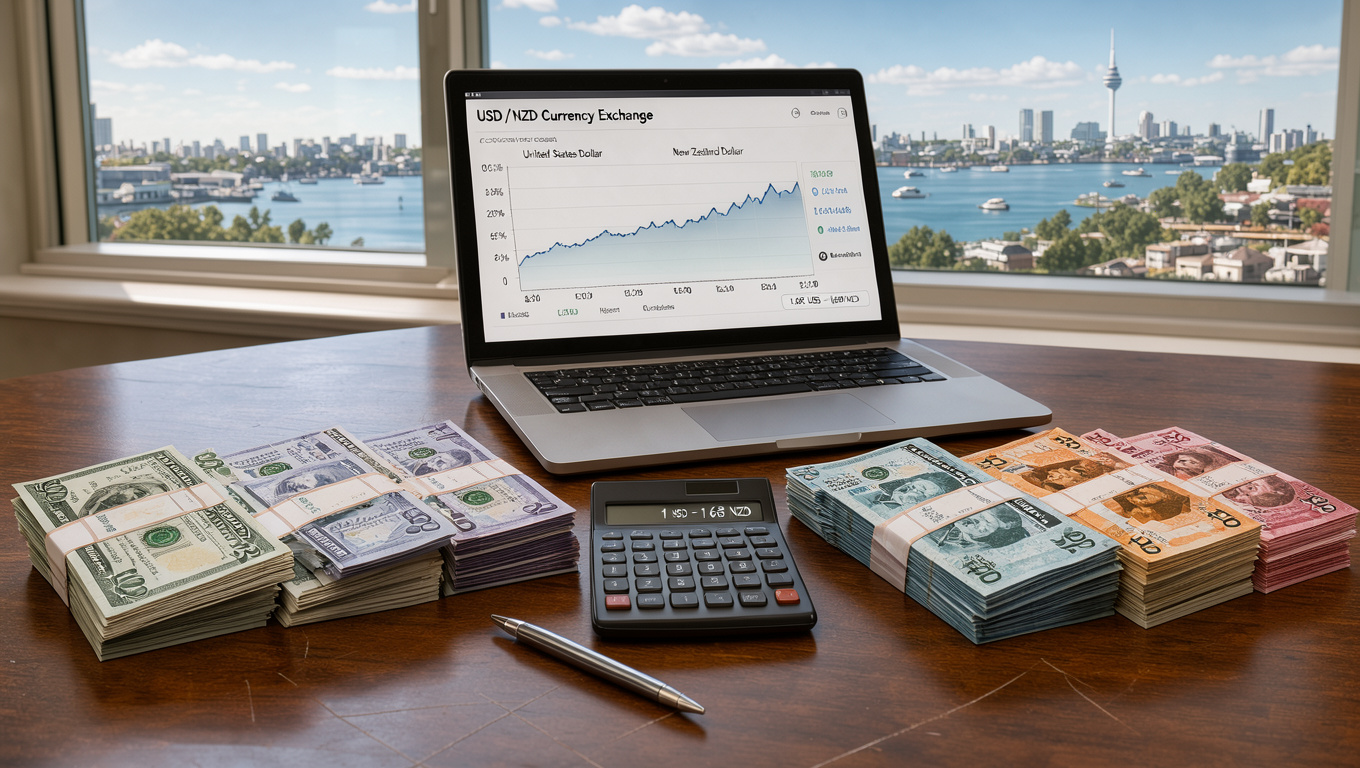
A 43 USD conversion looks like simple arithmetic, but the answer shifts with the site and the date. Across the sources retrieved for this guide, one US dollar ranged from 1.66 NZD in a Revolut (fintech bank, 2025 snapshot) table to 1.8039 NZD in a CalculatorLib (ECB-based cross rate) reference, so 43 USD converts to a range, not one number.
Newest dated quote: 1 USD = 1.8023 NZD (Mconvert (currency converter), 2026-11-08) · 43 USD range: about 71.38 to 77.57 NZD (calculated from the quotes in this guide) · Reverse quote: 1 NZD = 0.55943036 USD (Xe (currency converter), 2026-11-09) · Evidence span: 2025-01-04 to 2026-11-09 (Currency.rate.today (currency converter), earliest page)
Quick snapshot
- Xe lists 1 NZD at 0.55943036 USD on 2026-11-09 (Xe (currency converter)). (CurrencyHub (currency converter))
- CurrencyHub lists 1 USD = 1.727700 NZD on a page dated 2026-07-25 (CurrencyHub (currency converter)).
- ForexRates.net says its live USD/NZD rate self-updates every few seconds, so any snapshot ages quickly (ForexRates.net (live forex data)).
- Sonic Wallet notes that most banks and card providers add a markup, so a converter figure is not the cash figure (Sonic Wallet (crypto and fintech wallet)).
- No retrieved source carries today’s date. (ForexRates.net (live forex data))
- A 2025 example reportedly gives 43 USD as 76.72 NZD (Currency.rate.today (currency converter), dated 2025-01-04).
- Wise’s 1.742 NZD quote from 2026-06-19 sits about 0.06 NZD per USD below the 2026-11 quotes (Wise (transfer provider, US page)).
- Verify any rate against several sources before acting on it, as ForexRates.net advises (ForexRates.net (live forex data)).
- Treat a bank or card quote as the final figure before you pay.
Six figures sit in the table below. The key point is that the 2026 quotes cluster near 1.80 NZD per USD, while the earliest figure is noticeably lower.
| Quoted rate | Date | Value |
|---|---|---|
| Mconvert (currency converter) | 2026-11-08 | 1 USD = 1.8023 NZD |
| CurrencyHub (currency converter) | 2026-07-25 (page date) | 1 USD = 1.727700 NZD |
| Wise (transfer provider, US page) | 2026-06-19 | 1 USD = 1.742 NZD |
| Currency.rate.today (currency converter) | 2025-01-04 | 43 USD reportedly = 76.72 NZD |
| 43 USD at the Wise quote (calculated) | 2026-06-19 | about 74.91 NZD |
| 43 USD at the Mconvert quote (calculated) | 2026-11-08 | about 77.50 NZD |
How much is $50 US dollars in New Zealand dollars?
The question uses $50, but the method is the same for 43 USD, and the rate you choose decides the answer. Quotes in this research run from 1.66 to 1.8039 NZD per dollar, so the arithmetic gives a range rather than a single figure.
How to convert 43 USD to NZD step by step
- Pick a converter that shows its date and says whether it uses a mid-market or retail rate.
- Multiply 43 by the rate. At 1.777961105 NZD per USD from Forbes Advisor (financial media), dated 2026-11-04, 43 USD comes to about 76.45 NZD.
- Check the same amount against a second dated quote, then ask your bank or card provider for its own figure.
- Subtract any markup from the result, because Sonic Wallet notes that most banks and card providers add one.
Which rate applies to 43 USD today?
- No retrieved source carries today’s date, so the newest dated quote becomes the working reference.
- A mid-market rate is a midpoint between buy and sell prices, not the rate a bank pays you.
Six dated quotes, one pattern: the 2026 figures sit between roughly 1.74 and 1.80 NZD per USD, and the 2025 quote sits well below them.
| Source | Date | 1 USD in NZD | 43 USD (calculated) |
|---|---|---|---|
| Revolut (fintech bank, 2025 snapshot) | 2025-05-25 | 1.66 | about 71.38 NZD |
| Wise (transfer provider, US page) | 2026-06-19 | 1.742 | about 74.91 NZD |
| Forbes Advisor (financial media) | 2026-11-04 | 1.777961105 | about 76.45 NZD |
| Mconvert (currency converter) | 2026-11-08 | 1.8023 | about 77.50 NZD |
| Calconi (currency converter citing ECB rates) | 2026-11-06 | 1.804 | about 77.57 NZD |
| CalculatorLib (ECB-based cross rate) | 2026-11-06 | 1.8039 | about 77.57 NZD |
The implication: a 43 USD conversion checked against the 2025 quote and the newest 2026 quote differs by about 6 NZD, so the date on a quote counts as much as the rate itself.
A traveller budgeting 43 USD should use the newest dated quote, because the 2025 figure would understate the cost by about 6 NZD against the Calconi quote of 1.804 NZD per USD.
Travelex NZ (foreign exchange retailer) states that its online rates are a guide only, so the figure your bank or card provider quotes is the one that governs a real transfer.
What is $10,000 NZD in USD?
The reverse direction shows the quote problem more sharply. Xe lists 1 NZD at 0.55943036 USD on 2026-11-09, which puts 10,000 NZD at about 5,594.30 USD. Forbes Advisor lists 1 NZD at 0.562442 USD as of 2026-11-04, which gives about 5,624.42 USD for the same amount.
The European Central Bank publishes euro reference rates once per business day around 16:00 CET, and a USD/NZD figure is a cross rate calculated from them rather than published directly (CalculatorLib (ECB-based cross rate)).
How to convert NZD back to USD
- Use the NZD-to-USD quote when a source publishes one, rather than inverting a USD-to-NZD figure by hand.
- Multiply the NZD amount by that quote. 10,000 NZD at the Xe quote gives about 5,594.30 USD.
- Confirm both dates before comparing, because the two quotes in this section differ by about 30 USD on 10,000 NZD.
Why the reverse rate is not a simple inverse
- Inverting the Calconi quote of 1.804 NZD per USD gives about 0.55432 USD per NZD, which sits about 0.005 below the Xe quote.
- Inverting the Xe figure returns 1.78753, which matches Xe’s own USD-to-NZD table, so the two Xe figures agree with each other.
The implication: a reverse conversion is only as current as its timestamp, so match the dates before you trust a gap between two quotes.
No Reserve Bank of New Zealand or Federal Reserve series was retrieved, so none of these figures is anchored to an official reference. Nor were IMF, Bank for International Settlements or investor-protection pages retrieved, which keeps the strength, stability and cost-of-living sections qualitative.
The pattern: every reverse figure here carries the timestamp of its own source, so no single number settles the question.
Is the NZD a strong currency?
The sources in this research do not rank the New Zealand dollar against other currencies, so this section cannot deliver a verdict on strength. Read as a pair, the quotes point one way: 1 USD was 1.66 NZD in the 2025 Revolut figure and about 1.80 NZD in the 2026 quotes, so one US dollar bought more NZD by late 2026.
Which currencies are strongest, and by what measure?
- A bilateral rate against the dollar answers a narrow question, while a trade-weighted index answers a broader one.
- Each measure can rank the same currency differently, so any headline ranking needs its method stated.
Which currencies are weakest?
- No weakest-currency ranking was retrieved, so this article names none.
The trade-off: a single pair tells you what converting 43 USD costs, but it cannot tell you whether the NZD is strong overall.
Is it cheaper to live in NZ or the US?
An exchange rate answers a different question. It shows what one dollar converts into, not what rent, groceries or a takeaway cost on either side of the Pacific.
What country is $1 worth the most?
- Purchasing power parity (PPP) compares what a currency buys inside each country, which is the measure that answers this question.
- A strong exchange rate does not by itself mean lower living costs in the other country.
- No PPP dataset was retrieved for this research, so this article states no price-level comparison.
The implication: someone moving money to New Zealand should read a converter as a transfer cost, not as a cost-of-living measure.
Is the Euro or the dollar more stable?
Stability has no single answer. Exchange rate volatility, inflation history and reserve status each measure something different, so each can crown a different currency.
How stability gets measured
- Exchange rate volatility: how far the rate moves over a period.
- Inflation record: how prices have changed inside each currency area.
- Reserve status: how much of the world’s official reserve money each currency holds.
No IMF reserve-composition data was retrieved, so this article does not rank the dollar against the euro on reserve share.
What if the dollar collapses?
- The collapse premise is hypothetical, and no source in this research supports it.
- Savings advice for that scenario should come from a government regulator’s investor guidance, and none was retrieved for this piece.
The catch: any answer to a collapse question is conditional, and the evidence here does not point to a specific safe asset.
Confirmed facts
- Revolut (fintech bank, 2025 snapshot) lists 1 USD = 1.66 NZD dated 2025-05-25.
- CurrencyHub (currency converter) lists 25 USD = 43.1925 NZD on a page dated 2026-07-25.
- ForexRates.net (live forex data) says its live USD/NZD rate self-updates every few seconds.
- Currency.rate.today (currency converter) states that it uses the mid-market rate.
What’s unclear
- Today’s live USD to NZD rate, since no retrieved source carries today’s date.
- Bank, card and transfer fees on a real 43 USD conversion, because no provider fee schedule was retrieved.
- Whether the 2025 and 2026 quotes use the same method and timestamp.
- Whether the 2025 example of 43 USD at 76.72 NZD still reflects current rates.
- How NZD strength and cost of living compare, since no source covering either was retrieved.
“Most banks and card providers do not give you this rate; they add a markup instead of, or as well as, a fee.”
Sonic Wallet (crypto and fintech wallet)
“The online exchange rates provided by this Currency Converter are intended as a guide only and should not be used for transactional purposes.”
Travelex NZ (foreign exchange retailer)
A bank or card provider that adds fees or margins gives you less than the mid-market figure, so any converter result is a ceiling, not a promise (Travelex NZ (foreign exchange retailer)). Quotes from 2025 and 2026 already differ by about 6 NZD on 43 USD, which is why the source matters as much as the number. Anyone holding 43 USD who needs NZD this week should request a dated quote from their bank or card provider, because a converter figure can overstate what actually lands in the account.
Related reading: 95 USD to NZD: live exchange rate and conversion guide · how to read ANZ exchange rate graphs (wholesale vs customer rates)
wise.com, sonicwallet.com, travelex.co.nz, wise.com, wise.com, wise.com
Frequently asked questions
Is 43 USD the same as 43 NZD?
No. At the Xe quote of 0.55943036 USD per NZD dated 2026-11-09, 43 NZD is worth about 24.06 USD, far less than 43 USD.
How often do USD to NZD exchange rates change?
Converter update speeds differ. The European Central Bank publishes its euro reference rates once per business day around 16:00 CET, and the cross rate shown earlier is calculated from those reference rates.
Do banks or card issuers add fees to a USD to NZD conversion?
Yes. As the Sonic Wallet quote above sets out, most banks and card providers add a markup, instead of or as well as a fee, so the amount you receive sits below the mid-market figure.
Which source should I use to check the current USD to NZD rate?
Use a source that dates its rate and states whether it shows a mid-market or bank rate. Then compare it with the quote from your bank or card provider before you convert.
Why do converter results for 43 USD differ between websites?
Each site uses its own date, rate type and markup. The 2025 quote of 1.66 NZD per USD sits about 8 percent below the 2026 figures in the table, so the timestamp explains much of the gap.