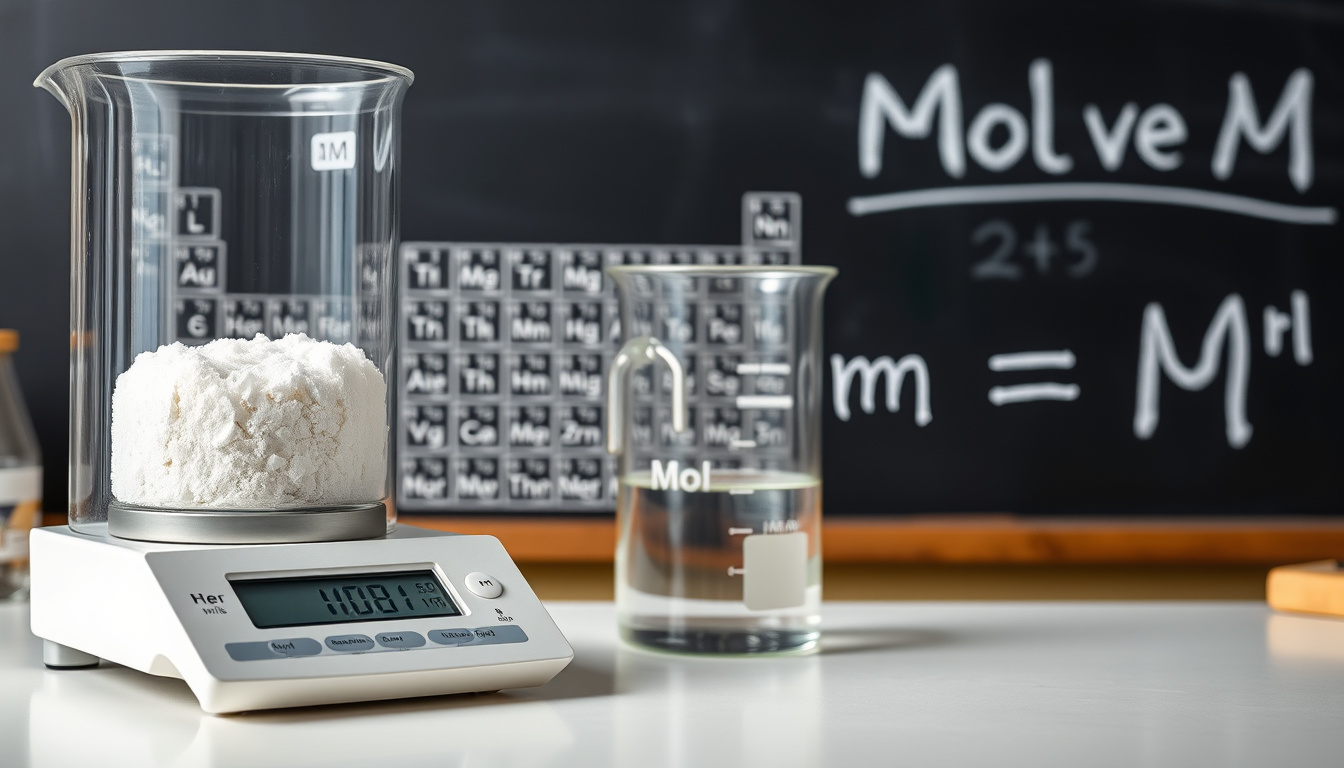
Anyone who has weighed a powder and wondered how many moles are actually in the beaker knows the feeling: the math looks small, but the number changes everything. The formula n = m/M — amount equals mass divided by molar mass — is the standard route from a weighing dish to a mole count. A single mole, about 6.022 × 10²³ particles, is the unit that makes that conversion work in real labs (Florida State University Chemistry (university chemistry resource)).
Molar mass of water: 18.015 g/mol · Avogadro’s number: 6.022 × 10²³ · Mole formula: n = m / M · Common uses: Stoichiometry and solution chemistry
Quick snapshot
- n = m/M converts mass to moles (BBC Bitesize (UK curriculum guide))
- Molar mass is the mass of one mole of a substance (Chemistry LibreTexts (open-access chemistry resource))
- The symbol M can mean molar mass or molarity depending on the formula. (Georgia State University HyperPhysics (university physics resource))
- w/v and v/v are concentration labels, not mole formulas (Khan Academy (education platform))
- n=mv without unit context cannot tell you which M is meant. (Wikipedia (volume percent explanation))
- Historically, the mole was defined as the amount containing the same number of entities as atoms in exactly 12 grams of carbon-12 (Wikipedia (general encyclopedia))
- The teaching of n=m/M has stayed stable across chemistry curricula. (Royal Society of Chemistry (professional chemistry body))
- After mass-to-mole conversion, the next step is using the mole ratio in a balanced equation. (Pearson (education publisher))
- In solution work, reach for concentration units such as w/v or v/v instead of treating every formula as a mass-to-mole shortcut. (MIT OpenCourseWare (university chemistry course))
Eight entries, one pattern: every value in this area is a ratio with units attached — read the units and the formula becomes obvious.
| Quantity | Value / relationship |
|---|---|
| Mole formula | n = m / M (University of Cambridge (university research resource)) |
| Mass from moles | m = n × M (University of Waterloo (university chemistry resource)) |
| Molar mass definition | Mass in grams of one mole of a substance (OpenStax Chemistry (open-access textbook)) |
| NaCl worked example | 10.0 g ÷ 58.44 g·mol⁻¹ = 0.171 mol (MIT OpenCourseWare (university chemistry course)) |
| NaCl molar mass | 58.44 g·mol⁻¹ (UCSD Chemistry (university chemistry resource)) |
| w/v meaning | Mass of solute in volume of solution, e.g. oral liquids (U.S. Food and Drug Administration (federal drug regulator)) |
| v/v meaning | Volume of solute in volume of solution, e.g. alcohol (Wikipedia (general encyclopedia)) |
| w/w meaning | Mass of solute in mass of solution, e.g. creams (ASHP (professional pharmacy society)) |
What is n/m/m used for?
This is the formula you use whenever a balance gives you grams and the reaction equation needs moles. Molar mass supplies the conversion factor: it is the mass of one mole of a substance, usually read off the periodic table.
Definition of n, m, and M
- n — amount of substance, in moles (mol).
- m — mass of the sample, in grams (g).
- M — molar mass, in grams per mole (g/mol).
Those three units are the whole machinery. If the mass is in kilograms or the molar mass is in milligrams per mole, convert units before dividing, or the result will be off by factors of ten.
Common applications in stoichiometry
- Converting reagent masses into mole amounts for balanced equations.
- Calculating how many moles of product a given mass of reactant can form.
- Preparing solutions when you need a specific amount of solute.
Stoichiometry works in mole ratios, so n=m/M is the entry ticket from weighable quantities to reaction quantities.
Example: calculating moles of water
- Mass of sample: 36.03 g
- Molar mass of water: 18.015 g/mol
- n = 36.03 ÷ 18.015 = 2.00 mol
That 2.00 mol is what you would enter into a balanced equation, and it is why the formula is the first step in most lab calculations.
The implication: once you know a substance’s molar mass, any measured mass becomes a mole count in one division — that is the point of the formula.
How to get n from m and m?
There are three steps, and the order stays the same whether you are working with an element or a compound.
- Record the mass (m) in grams. This is the value from your balance.
- Find the molar mass (M) in g/mol. For a compound, add the atomic masses of each element in the formula using periodic table values.
- Divide mass by molar mass: n = m / M. Check the units — grams divided by grams per mole gives moles.
Worked example: 10.0 g of sodium chloride ÷ 58.44 g·mol⁻¹ = 0.171 mol (The Princeton Review (test preparation company)).
That 0.171 mol is the number a balanced equation actually cares about — not the mass in the pan, but the amount of substance behind it.
The catch: if the molar mass is wrong or the units are not grams, the conversion produces a mole count that looks plausible and is quietly unusable.
What is n mv in chemistry?
The shorthand “n=mv” is a source of confusion because the same letters appear in different contexts. In solution chemistry, the relationship is written n = c × V: moles equals concentration (mol/L) times volume (L). In n=m/M, the M is molar mass in g/mol; in n=cV, M is often used as the symbol for molarity in mol/L.
Difference between n=m/M and n=mv
- n=m/M — starting data: mass in grams.
- n=cV — starting data: concentration and volume.
- Units decide which formula to use; the letters alone cannot.
Molarity (M) definition
- Molarity is moles of solute per litre of solution (mol/L).
- A 1 M solution contains 1 mole of solute in every litre.
- Molarity is a concentration, not a mass.
When to use each formula
- Use n=m/M for solids, liquids, or gases measured by mass.
- Use n=cV for solutions when the label gives molarity and volume.
- Use w/v or v/v when the percentages are part of a protocol; they are not mole formulas.
The same letter M can mean grams per mole in one equation and moles per litre in another; readers who copy formulas without units end up using the wrong M.
The pattern: the deciding factor is always the unit you start with — grams call for molar mass, litres and mol/L call for concentration.
What does ‘W/V’ mean?
W/V is a concentration label, not a mole formula. It stands for weight/volume percentage and tells you how many grams of solute are in a given volume of solution. (Purdue University (university chemistry resource))
Definition of weight/volume percent
- w/v % = (grams of solute ÷ millilitres of solution) × 100
- Example: 0.5% w/v = 0.5 g of solute per 100 mL of solution
- Kingston University SciSkills lists w/v as the common format for dry reagents in percentage solutions
Common in pharmaceutical concentrations
- Oral liquids and reconstituted powders often use w/v strength.
- A w/v label does not tell you the number of moles; you need the solute’s molar mass to convert.
- It is not interchangeable with n=m/M.
For a pharmacist, 0.5% w/v is a dosing ratio; for a chemist, it is a starting point for a molarity calculation after you factor in molar mass.
The catch: a percentage label hides the mole count, so reading a drug label correctly means knowing whether the numerator is grams or millilitres.
What does ‘v/v’ mean in chemistry?
V/V stands for volume/volume percentage. It compares the volume of a liquid solute with the volume of the finished solution. (Kingston University SciSkills (university lab skills guide))
Definition of volume/volume percent
- v/v % = (mL of solute ÷ mL of solution) × 100
- Example: 5% v/v alcohol = 5 mL of ethanol per 100 mL of drink
- Kingston University SciSkills lists v/v as the common format for liquid reagents
Distinct from n=m/M and w/v
- n=m/M mixes grams and molar mass; v/v mixes only volumes.
- w/v uses grams in the numerator; v/v uses millilitres in both.
- A v/v percentage cannot be converted to moles without density and molar mass.
The trade-off: percentage labels make mixing easy, but they hide molar quantities — exactly why chemists switch to n=m/M or n=cV when the reaction calls for mole amounts.
What’s clear, and what’s easy to mix up
Most of the confusion around n=m/M is not about the arithmetic; it is about knowing which quantity a symbol stands for.
Confirmed facts
- n = m/M converts mass to moles (Georgia State University HyperPhysics (university physics resource))
- Molar mass is the mass of one mole of a substance (Wikipedia (general encyclopedia))
- One mole contains about 6.022 × 10²³ entities (National Institute of Standards and Technology (U.S. metrology institute))
Easy to mix up
- M as molar mass (g/mol) vs M as molarity (mol/L) (University of Minnesota (university chemistry resource))
- w/v vs w/w: grams per millilitre vs grams per gram (IUPAC Gold Book (international chemistry nomenclature authority))
- n=mv shorthand without unit context (Texas A&M University (university chemistry resource))
- Percentage labels such as 0.5% w/v that look like mole fractions but are not (Wikipedia (general encyclopedia))
The pattern: every formula in this area is a ratio; the units tell you what is being divided by what. Get the units straight and the math takes care of itself.
What the sources actually say
The standard relationship for calculating moles from mass is n = m/M, where n is amount in moles, m is mass, and M is molar mass.
The formula m = nM is used to calculate mass from moles and molar mass.
The pattern: the formula is stable, but the unit labels shift — that is where beginners get lost.
Summary
Mass-to-mole conversion is not a trick; it is a ratio. The formula n=m/M works when you have grams and molar mass, n=cV works when you have concentration and volume, and w/v and v/v labels work only for describing concentration, not for producing moles. The same conversion-factor thinking powers everyday unit conversions, from 184 cm in Feet: Exact Conversion and Common Questions Explained to 95 USD to NZD: Live Exchange Rate, Fees & Conversion Guide — but in chemistry the stake is a mole count, not a number of inches. For a student or lab worker, the choice is clear: check the units before you choose the formula, or the result will be a number with no chemical meaning.
chem.academy, chemistrystudent.com, buckeyeinternational.com, chem.libretexts.org
Frequently asked questions
What is the unit of molar mass?
Molar mass is expressed in grams per mole (g/mol). It tells you how many grams one mole of a substance weighs.
How do I find molar mass from the periodic table?
Add the atomic masses (in g/mol) of every atom in the chemical formula. For water, that is 2 × 1.008 g/mol for hydrogen plus 15.998 g/mol for oxygen.
Can I use n=m/M for compounds like H2O?
Yes. Once you have the compound’s molar mass, the same formula applies to elements, molecules, and ionic compounds.
What is the difference between molecular mass and molar mass?
Molecular mass is the mass of a single molecule, usually in atomic mass units; molar mass is the mass of one mole of that substance, in grams per mole.
How do I calculate mass from moles?
Rearrange the formula to m = n × M. Multiply the amount in moles by the molar mass to get grams.
What is the mole concept?
A mole is a counting unit equal to about 6.022 × 10²³ particles, defined through the number of atoms in 12 grams of carbon-12.
Why is n=m/M important in stoichiometry?
Balanced equations express reactions in moles, not grams. The formula converts a weighed mass into the mole amount that the equation requires.