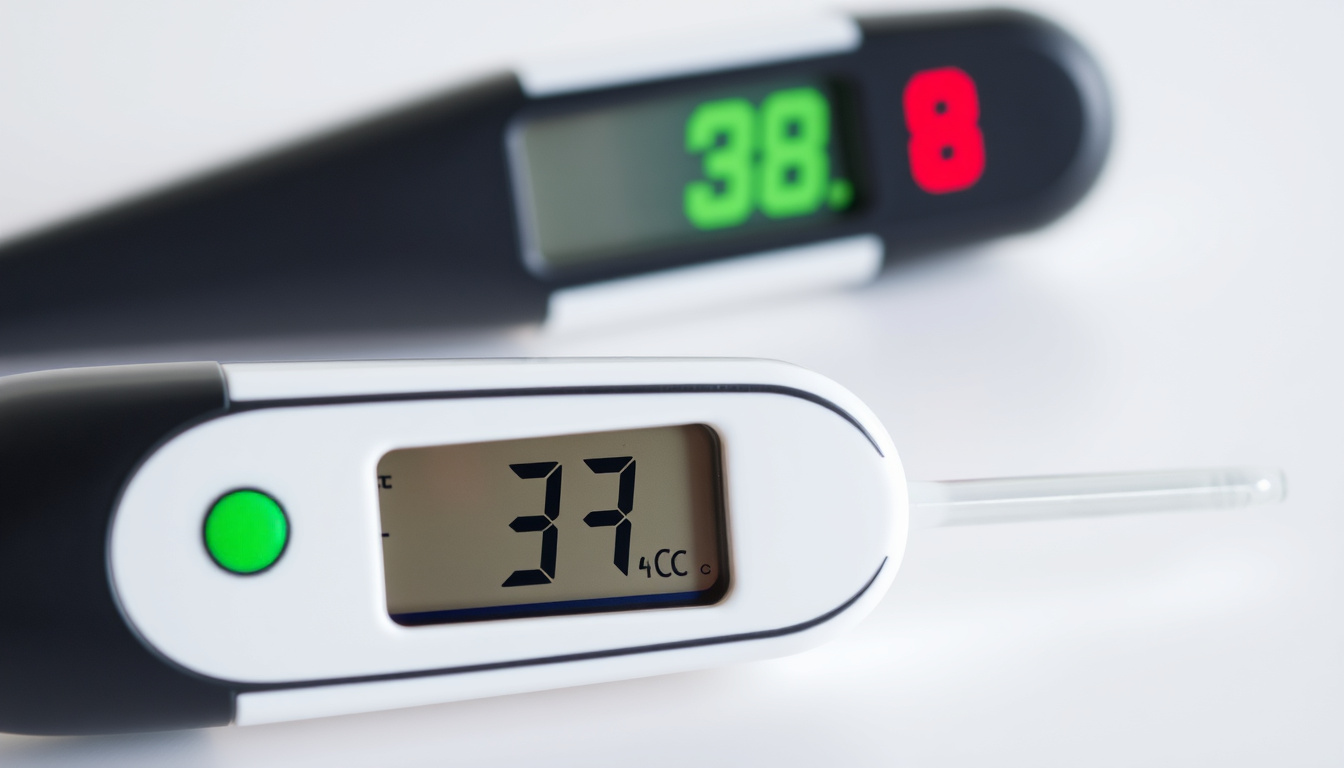
Anyone who has held a thermometer over a restless child at 2am knows the question: normal temperature, or fever? In New Zealand the answer starts with a clear number: 38°C, the fever threshold used by Health New Zealand (the national health authority). Yet the choice to seek help rests on symptoms as much as the reading, and knowing the difference between a normal reading, a fever, and a red flag changes what you do next.
Average normal body temperature: 37°C (98.6°F) for children and adults ·
Fever threshold in NZ: 38°C or higher (Health New Zealand) ·
Typical normal adult range: 36.1°C to 37.2°C ·
Child fever threshold: 38°C or higher (KidsHealth) ·
Fever role: Normal immune response to infection
Quick snapshot
- Normal body temperature for children and adults is about 37°C (Healthify NZ (NZ health information provider)).
- A fever is a temperature of 38°C or higher (Health New Zealand).
- Exactly what counts as “normal” varies by person and by time of day.
- No single thermometer number decides whether a specific person needs A&E — symptoms and medical history matter.
- See a healthcare provider if a fever lasts more than 3 days or the person is getting sicker (Health New Zealand).
- The 24-hour fever-free rule is the common benchmark for returning to school or daycare. (Health New Zealand)
- Watch for confusion, trouble breathing, a stiff neck, rash, or severe pain with a fever. (Health New Zealand emergency advice)
- Call 111 for an ambulance in a critical emergency (Health New Zealand emergency advice).
Nine numbers, one pattern: New Zealand’s fever guidance keeps drawing the same line — 38°C is where normal ends and fever begins.
| Measure | Value |
|---|---|
| Average normal temperature (children and adults) | About 37°C (Healthify NZ) |
| Fever threshold in NZ | 38°C or higher (Health New Zealand) |
| Typical normal adult range | 36.1–37.2°C |
| Child fever threshold | 38°C or higher (KidsHealth) |
| See a provider if | Fever is over 39°C, lasts more than 3 days, or the person is getting sicker (Health New Zealand) |
| Go to the emergency department for fever with | Hallucinations, vomiting, stiff neck, rash, rapid heart rate, or a fit/seizure (Health New Zealand) |
| Babies under 3 months | Fever means urgent medical assessment (KidsHealth) |
| Critical emergency | Call 111 for an ambulance (Health New Zealand) |
The repeated use of 38°C across child and adult guidance is the pattern worth remembering: the threshold does not shift with age, only the urgency around it does.
Is 37.2 a fever in NZ?
No. A reading of 37.2°C is common, and it sits inside the typical adult range. In New Zealand, fever is defined by a higher number: 38°C or more, according to Health New Zealand (the national health authority).
- Normal body temperature for children and adults is about 37°C (Healthify NZ).
- The typical normal adult range is roughly 36.1–37.2°C.
- A fever starts at 38°C or higher — the same threshold Whānau Āwhina Plunket (child health service) uses for children.
The practical takeaway: 37.2°C is not a fever in NZ, and treatment targets comfort, not the reading.
Is a temperature of 37.5 high?
- 37.5°C is above the 37°C average but below the 38°C fever threshold.
- Body temperature rises later in the day and after activity, so a single 37.5 reading is rarely a concern on its own.
What this means: a 37.5 reading is above average, not a fever — the NZ threshold of 38°C is the line to watch.
Is 38.1 Celsius considered a fever?
- Yes — 38.1°C clears the 38°C fever threshold used in New Zealand (Health New Zealand).
- Treat the person’s comfort, watch fluid intake, and check for red flags rather than reaching for medicine just because the reading crossed a line.
The thermometer gives a clean 38°C line, yet the people behind those numbers differ: NZ guidance points to breathing, alertness, and hydration as the signals that decide urgency, not the fraction above 38.
The pattern: NZ’s child and adult guidance agree on 38°C, so any number below it is classified as normal temperature, even when it feels warm.
Is 35.4 a normal temperature for adults?
Not quite. 35.4°C sits below the typical normal adult range of 36.1–37.2°C, so it counts as a low reading rather than a normal one. Persistent readings below that range deserve assessment by a health professional.
- The typical normal adult range is about 36.1–37.2°C.
- Normal body temperature varies from person to person and at different times of day (Healthify NZ).
- Healthy adults can sit at the lower end of the range and stay perfectly well — the concern is a reading that drops out of it.
The distinction that matters: “normal” is a range, not a fixed point. An adult can be healthy at 36.2°C in the morning and 37.1°C by evening — what matters is how the person feels and whether the reading is drifting outside the usual band.
Is 35 a normal body temperature?
- 35°C is below the typical adult range and is considered abnormally low.
- A reading at or below 35°C is not normal and should be assessed promptly.
Once the reading drops below 35°C, the question stops being “is this normal?” and becomes “why is the body this cold?” — that distinction needs a clinician, not a second thermometer.
Is 36.5 a normal body temperature?
- Yes — 36.5°C sits within the 36.1–37.2°C typical adult range.
- It is also close to the 37°C average Healthify NZ gives for children and adults.
The catch: 36.5°C is unremarkable on its own, but a person who usually runs 37.2°C and suddenly drops to 36.6°C with symptoms deserves the same attention as a person spiking a fever.
What temperature to go to A&E?
There is no single temperature that sends every person to the emergency department in New Zealand. The decision is driven by symptoms, age, and how the person is coping — with the thermometer as one input, not the verdict.
- Seek urgent care for fever with confusion or unusual drowsiness, trouble breathing, a stiff neck, a skin rash, or severe pain (Health New Zealand).
- Go to the emergency department for fever with hallucinations, vomiting, a rapid heart rate, or a fit or seizure (Health New Zealand).
- For children, being hard to wake, not drinking, or vomiting and not keeping fluids down are urgent-care signals (KidsHealth – Is My Child Sick?).
- Call 111 for an ambulance in a critical emergency (Health New Zealand – which health service to use).
Should I go to the hospital if my fever is 39?
- A 39°C reading is a fever, but many adults can be managed at home if they are well hydrated and otherwise stable.
- Health New Zealand’s advice is to contact a healthcare provider once a high fever goes over 39°C, so a phone call is the safer default (Health New Zealand).
What this means: a 39°C fever is a signal to check in with a professional, not a guaranteed hospital trip — but the check-in should happen.
What is the highest temperature you can have before going to the hospital?
- NZ guidance does not set a “highest temperature” number for hospital attendance; symptoms decide.
- Temperatures above 40°C can indicate serious illness and need urgent medical assessment.
The rule of thumb: once the reading passes 40°C, stop comparing numbers and get medical assessment — the risk is no longer a matter of degree.
What temperature does your body start shutting down?
- There is no published NZ figure that marks a temperature where the body “shuts down”; fever is part of the immune response, not a switch.
- Very high fever — above 40°C, or any temperature with a seizure or altered behaviour — is an emergency signal, not a number to wait for (Health New Zealand).
For babies under three months, age overrides the thermometer: a fever at this age always needs urgent medical assessment, not home monitoring (KidsHealth).
How to bring down a temperature?
A fever is not an illness — it is a normal immune response to infection, and Health New Zealand frames it that way. Lowering the number is less important than keeping the person comfortable, hydrated, and watched.
- Drink plenty of fluids and rest.
- Wear light clothing and keep the room at a comfortable temperature.
- Paracetamol or ibuprofen can reduce fever-related discomfort, but they do not treat the underlying infection (Healthify NZ).
- Keep watching for confusion, trouble breathing, a stiff neck, or a rash — those signals matter more than the reading.
Is it OK to sleep with a fever?
- Yes, if the person is comfortable and hydrated — sleep supports recovery.
- Check on them during the night, especially children, and seek help if symptoms worsen.
The distinction that matters: sleeping through a fever is fine; becoming hard to wake is not. The first is recovery, the second is a red flag.
Should you let a fever run its course?
- Fever helps the immune system fight infection, so a low fever does not need to be suppressed for its own sake.
- Medication is for comfort: if the person is resting, drinking, and not distressed, letting the fever run is reasonable.
Paracetamol or ibuprofen will bring the number down for a few hours, but it can hide the pattern of an infection. Recording temperatures, rather than just treating them, is what tells you whether a fever is resolving or climbing.
What is the 24-hour fever rule?
The 24-hour fever rule is a return-to-school and return-to-childcare benchmark, not a medical treatment rule. It holds that a child should be fever-free for a full 24 hours without paracetamol or ibuprofen before heading back to class.
- It is commonly used to decide when children can return to school or daycare.
- The 24 hours count from the last feverish reading, and the count only starts once fever medicine is no longer being used.
- Check your school’s or early learning service’s exclusion guidance for the exact rule they apply.
The catch: the 24-hour rule protects other children from catching what the first child had. It is not a signal that a child is medically safe — a fever that keeps returning over several days still needs a healthcare provider, no matter how many fever-free hours have passed.
Home fever care: upsides and downsides
Most fevers in otherwise healthy people resolve at home. The trade-offs start when a single number — 38°C, 39°C, 40°C — starts to drive a decision that should be driven by symptoms, age, and history.
Upsides
- Fever is part of the immune response, so a low fever is helping the body fight the infection (Health New Zealand).
- Rest, fluids, and light clothing are low-risk and effective for most people.
- Paracetamol or ibuprofen can make a feverish person comfortable enough to rest and drink (Healthify NZ).
Downsides
- Fever medicines mask the number without treating the cause, which can hide whether an infection is resolving.
- A fever over 39°C means a healthcare provider should be involved (Health New Zealand).
- A fever lasting more than 3 days, or a person getting sicker, needs a provider (Health New Zealand).
- In babies under three months, home care is not the default — fever means urgent medical assessment (KidsHealth).
The balance tips one way for most previously healthy people — comfort care at home with clear review points — and the other way for babies, older adults, and anyone whose symptoms look serious.
Step-by-step: managing a fever at home
The sequence below works for children and adults alike, with one hard exception: babies under three months skip straight to medical assessment.
- Confirm the temperature. Use a reliable thermometer — 38°C or higher is a fever (Health New Zealand).
- Dress lightly. Layers and heavy blankets trap heat; light clothing and a comfortable room help the body regulate.
- Offer fluids regularly. Small, frequent sips are easier than large glasses.
- Rest, and use medicine for comfort only. Paracetamol or ibuprofen can help if the person is miserable, but they do not fix the infection (Healthify NZ).
- Watch the red flags. Confusion, trouble breathing, a stiff neck, a rash, a rapid heart rate, or a seizure are urgent-care signals (Health New Zealand).
- Set a review point. If the fever passes 39°C, lasts more than 3 days, or the person is getting sicker, contact a healthcare provider (Health New Zealand).
The pattern: every step keeps returning to the same rule — treat the person, not the number. A child sipping water and sleeping through a 38.9°C fever can be managed at home; the same child at 37.5°C with trouble breathing cannot.
What’s confirmed and what’s still unclear
Confirmed facts
- Normal body temperature is about 37°C for children and adults (Healthify NZ).
- Fever is 38°C or higher in New Zealand (Health New Zealand).
- Fever is part of the immune response to infection (Health New Zealand).
- A baby under 3 months with a fever needs urgent medical assessment (KidsHealth).
What’s unclear
- Exactly what is “normal” varies by person and time of day, so published ranges do not fit every body.
- The precise temperature that requires A&E for a given person depends on symptoms, age, and medical history.
- The best timing for fever medicine depends on individual comfort and risk factors, not just the reading.
- NZ sources give little specific guidance on low temperatures such as 35.4°C, which makes persistent low readings harder to interpret.
What this means: the confirmed facts anchor the 38°C line, while the open questions circle the same gap — individual variation. No number replaces a clinical assessment.
What the official guidance says
“A fever is when your body temperature is above 38.0°C.”
Health New Zealand — Fever guidance
“Normal body temperature for children and adults is about 37°C.”
Healthify NZ — Fever in adults
“A child with a fever who is under 3 months old needs urgent medical assessment.”
KidsHealth — Fever in children
“A normal temperature is around 37°C, and a fever is higher than 38°C.”
Four sources, one message: New Zealand’s fever guidance is consistent across the national health authority, a health information provider, a children’s health service, and a child-support charity — 38°C is the line, and symptoms carry the decision.
For New Zealand families, the thermometer is a starting point rather than a verdict. The 38°C threshold separates a normal temperature from a fever, but urgency comes from symptoms: confusion, trouble breathing, a stiff neck, rash, or a seizure mean urgent care, while a fever over 39°C — or one that lingers past three days — means contacting a healthcare provider. For parents, the rule is simple enough to hold at 2am: when a child looks seriously unwell, act on that, and call 111 or seek urgent help rather than waiting for the number to decide.
Related reading
- Weight Loss Surgery NZ — a practical guide for adults looking at surgical weight-management options.
- Just a Thought NZ — a free online CBT course available to people in New Zealand.
cpg.stjohn.org.nz, healthnz.govt.nz, healthnz.govt.nz, healthnz.govt.nz, bpac.org.nz, omronhealthcare-ap.com, healthnz.govt.nz, ponsonbydoctors.co.nz
Frequently asked questions
What is a normal temperature for a child in NZ?
Around 37°C. A fever is 38°C or higher, and a child under 3 months with a fever needs urgent medical assessment (KidsHealth).
What is a normal temperature range for an adult?
Most adults sit in the 36.1–37.2°C range, with about 37°C as the average. Individual variation is normal (Healthify NZ).
When should adults worry about a fever in NZ?
When a fever goes over 39°C, lasts more than 3 days, or is paired with confusion, trouble breathing, a stiff neck, a rash, or other red flags (Health New Zealand).
What temperature is too high for a child in NZ?
A temperature of 38°C or higher is a fever for children. Urgent assessment is needed for babies under 3 months, and any child with a fever plus trouble breathing, a stiff neck, rash, or a seizure needs urgent care (KidsHealth).
How long should a fever last before seeing a doctor?
See a healthcare provider if a fever lasts more than 3 days or the person seems to be getting sicker (Health New Zealand).