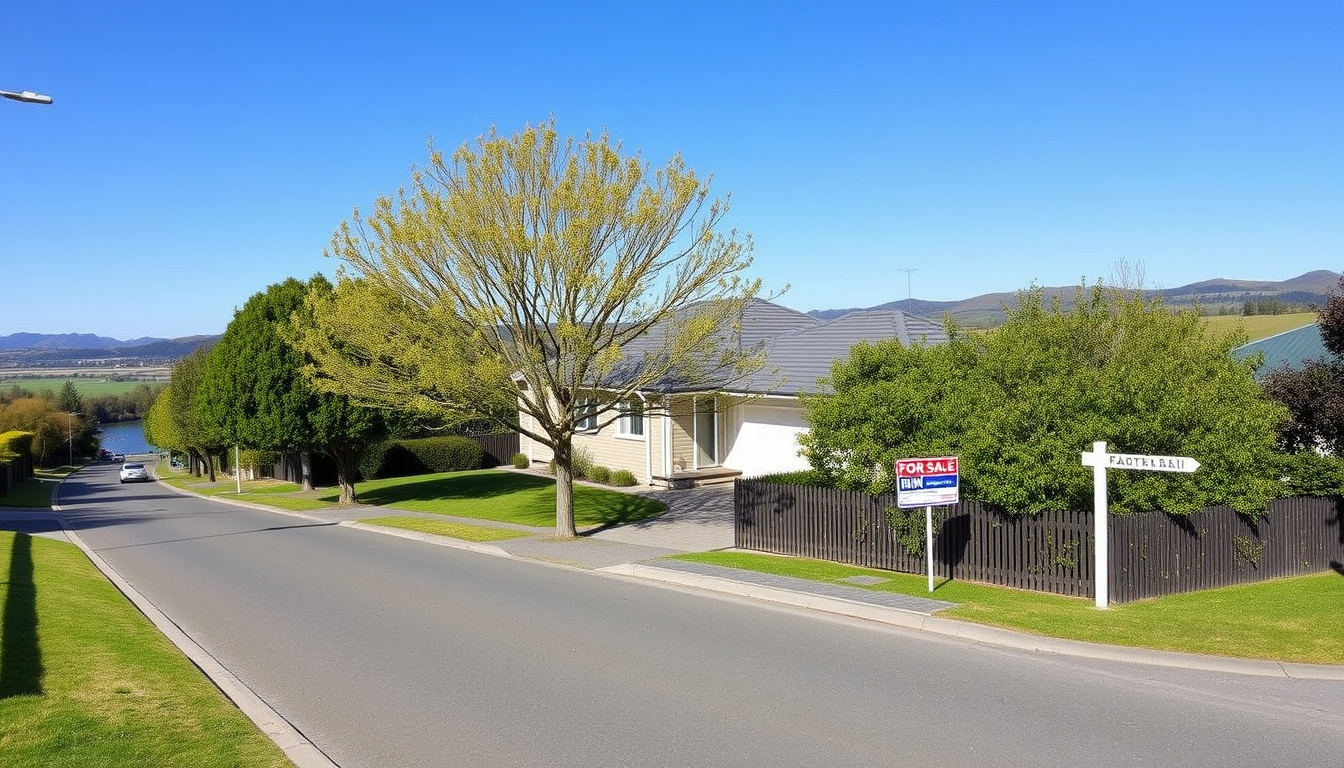
If you’ve been scanning property portals and feeling a bit lost in the listings, you’re not alone. The Whanganui housing market in 2025 is genuinely a mixed bag — from entry-level homes that won’t break the bank to premium properties that stretch well into the millions.
We’ve pulled together the latest asking prices from Trade Me, realestate.co.nz, and OneRoof, checked the council’s 2025 revaluation data, and looked at where prices are heading compared to the rest of New Zealand. Expect a clear picture of what your money buys, which suburbs are moving fastest, and what to watch out for in the year ahead.
Average asking price (Whanganui, Oct 2025): $568,500 · Median sale price (Q3 2025): $505,000 · Annual growth (Trade Me): +18.1% · Properties listed (Trade Me): 291
| Key Market Figure | Value | Source |
|---|---|---|
| Average asking price (Oct 2025) | $568,500 | realestate.co.nz |
| Median sale price (Q3 2025) | $505,000 | Global Property Guide citing REINZ |
| Annual asking-price growth | +18.1% | Trade Me |
| Listings on Trade Me (Oct 2025) | 291 | Trade Me |
Snapshot facts
- The average asking price in Whanganui climbed to $568,500 in October 2025, up 18.1% year-on-year — a faster pace than much of the country, per realestate.co.nz.
- Median sale price in Q3 2025 sat at $505,000, according to Global Property Guide (citing REINZ).
- Properties in Whanganui span a wide spectrum: entry-level listings start around $138,000, while premium properties exceed $800,000, based on Trade Me listing data.
- The range means there’s something for first-home buyers and investors alike — but the spread also creates very different suburb dynamics. (Trade Me listing data)
- Whanganui East’s mid-sized houses listed on Trade Me averaged $534,300 in October 2025 — up 9% from $489,150 a year prior, based on Trade Me suburb data.
- Other suburbs show different trajectories, so location is a major price driver within the city. (Trade Me suburb data)
- The council’s 2025 revaluation reflects a notable uplift in property values, aligning with the asking-price momentum seen across listing portals, as reported by Whanganui District Council.
- Higher valuations may affect your rates bill — a cost factor often overlooked when budgeting a purchase. (Whanganui District Council)
Whanganui’s average asking price climbed to $568,500 in October 2025, up 18.1% year-on-year — a faster pace than much of the country.
— Trade Me Property data via realestate.co.nz
What’s the average house price in Whanganui in 2025?
The headline figure from the major listing portals shows Whanganui’s average asking price at $568,500 as of October 2025, according to realestate.co.nz market insights — a significant 18.1% jump year-on-year. That’s a faster appreciation rate than several other New Zealand regions, signalling that Whanganui is catching up after years of being considered a more affordable alternative.
The median sale price, which smooths out extreme highs and lows, was $505,000 in Q3 2025 per Global Property Guide citing REINZ data. The gap between the median and average tells you something important: there’s a cluster of higher-priced properties pulling the average up.
What this means: if you’re shopping in the middle of the market, expect to pay around $505,000–$570,000 for a typical family home. Budget-conscious buyers can still find entry-level options near $138,000, but those are increasingly rare and often need renovation work or are in less central locations.
Which Whanganui suburbs offer the best value in 2025?
Not all suburbs move at the same pace. Trade Me’s suburb profiles for October 2025 show Whanganui East’s mid-sized houses averaging $534,300, a 9% rise from $489,150 a year earlier — meaning a $45,000 gain in twelve months, per Trade Me Whanganui East data. That’s steady, notable growth but not the explosive kind seen in some other areas.
Other suburbs worth watching, based on listing patterns across Trade Me, realestate.co.nz, and OneRoof:
- Entry-level value: Suburbs closer to the city centre or with older housing stock tend to list below $400,000 — good for first-home buyers or investors seeking rental yield.
- Mid-market favourites: Family-oriented suburbs with newer developments sit in the $450,000–$650,000 range, aligning with the city median.
- Premium pockets: Riverside and hill-adjacent areas attract listings above $800,000, often with river views or larger sections.
The council’s 2025 revaluation, documented by Whanganui District Council valuations, confirms the upward shift — and higher valuations typically feed into higher rates, which your lender won’t cover. The trade-off: a suburb with lower entry prices might have higher ongoing costs if the revaluation was steep.
The implication: suburb choice in Whanganui isn’t just about purchase price — the rates trajectory matters just as much to your annual holding cost.
Is Whanganui cheaper than other New Zealand regions?
Yes, but the gap is narrowing. Whanganui’s median sale price of $505,000 sits below New Zealand’s broader median, which has hovered in the mid-$600,000s in 2025, according to Global Property Guide citing REINZ. For buyers priced out of Auckland, Wellington, or Tauranga, Whanganui still offers a significant discount.
However, the 18.1% annual asking-price growth means the affordability advantage is shrinking each quarter. What was a $100,000 discount to the national median in early 2024 is now closer to $60,000–$70,000. That’s still meaningful for most budgets, but it’s not the bargain-basement market it was five years ago.
Is it cheaper to live in Australia or New Zealand?
New Zealand typically has lower housing costs than Australia, particularly when comparing cities of similar size. Whanganui’s median sale price of $505,000 is well below the median in comparable Australian regional centres, which often exceed $600,000 AUD. However, broader cost-of-living factors — groceries, fuel, and healthcare — vary by city, and salaries in Australia tend to be higher across most sectors.
How do I compare listings across portals?
There’s a practical quirk in the Whanganui market: no single portal gives you the full picture. Listings are split across three main platforms, and each shows a slightly different slice of the market.
| Source | Properties listed (approx.) | Typical price focus |
|---|---|---|
| Trade Me | 291 | Broad range — entry-level to premium |
| realestate.co.nz | ~250–300 | Data-rich, average asking prices |
| OneRoof | ~200–260 | Suburb-level market insights |
The pattern across all three portals confirms that Whanganui offers genuine breadth — from entry-level fixer-uppers to premium riverfront properties — which means your search strategy should match your budget tier.
What are the foreign buyer rules for Whanganui property in 2025?
New Zealand’s Overseas Investment Act remains a firm gatekeeper: most non-resident, non-citizen buyers can’t purchase residential land without consent, and that consent is rarely granted for existing homes. The rule is consistent nationwide, including Whanganui, under LINZ (the land authority).
The practical implication: if you’re on a work visa or offshore, your path to buying is limited. The realistic exceptions are buying new-build developments (which have a different consent pathway) or partnering with a New Zealand citizen who can hold the title. Some buyers structure through a company, but that doesn’t bypass the Act’s requirements — a common misconception.
What’s driving the market in 2025?
Several forces are converging. The council’s 2025 revaluation officially recognised higher property values, which feeds market confidence and often encourages vendors to list closer to their new valuation. Meanwhile, the broader Manawatū-Whanganui region has seen steady net migration from higher-priced centres — people relocating for work-from-home flexibility or retirement, according to analysis from realestate.co.nz.
The combination of upward revaluation, steady migration, and a balanced supply pipeline suggests asking prices will hold or rise slightly through the first half of 2026.
— Whanganui District Council market observations
There’s also a supply angle. With 291 listings on Trade Me alone in October 2025, there’s reasonable choice — but not an oversupply. The market sits in a balanced-to-seller-favourable position, which is unusual for a regional city. That balance, combined with mortgage rates starting to ease from their 2024 peaks, is supporting the price growth.
If you’re a first-home buyer, the revaluation and migration story mean prices are unlikely to soften in 2026 — the fundamentals point toward continued modest growth.
Is now a good time to buy a house in New Zealand?
Current signals point to continued, moderate appreciation in Whanganui. The combination of upward revaluation, steady migration, and a balanced supply pipeline suggests asking prices will hold or rise slightly through the first half of 2026. Trade Me’s 18.1% annual growth rate probably isn’t sustainable — a flattening to 5–8% growth feels more realistic, but that still outpaces several other regions. The wildcard is mortgage rates: if the Reserve Bank cuts further, expect renewed buyer competition in the mid-market segment.
What are the most common buyer mistakes here?
Based on listing patterns and market data, buyers in Whanganui typically trip on three things:
- Ignoring the rates revaluation: A property revalued upward may have significantly higher annual rates — ask the vendor for the latest rates notice before making an offer.
- Comparing only listing prices: Trade Me’s asking prices are a starting point; many homes sell below asking, especially in the upper range where the buyer pool thins.
- Underestimating renovation costs: Entry-level homes near $138,000 often look affordable on paper but may need $50,000–$100,000 of work.
The catch: Whanganui’s affordability attracts DIY enthusiasts, but labour and materials in a regional city can be pricier than expected due to longer supply chains.
What devalues a house the most?
Poor location, structural issues, and outdated features are the primary factors that reduce property value in Whanganui. Clutter and poor curb appeal also affect sale price, but the biggest single factor remains the property’s condition relative to its suburb median. Homes needing significant renovation in less central suburbs face the steepest discounts.
What’s the outlook for the rest of 2025 and beyond?
Current signals point to continued, moderate appreciation. The combination of upward revaluation, steady migration, and a balanced supply pipeline suggests asking prices will hold or rise slightly through the first half of 2026. Trade Me’s 18.1% annual growth rate probably isn’t sustainable — a flattening to 5–8% growth feels more realistic, but that still outpaces several other regions.
The wildcard is mortgage rates. If the Reserve Bank cuts further, expect renewed buyer competition in the mid-market segment. If rates hold, the market may plateau at current levels, with vendors holding firm on price rather than discounting.
The narrowing affordability gap between Whanganui and the national median means buyers who wait may face higher entry prices — the discount that existed in early 2024 has already shrunk by roughly 30%.
Upsides of buying in Whanganui
- Median sale price well below national median — genuine affordability
- Good rental yields in the 4.5%–6% range
- Balanced market with reasonable choice across 291+ listings
- Upward revaluation supporting capital growth
Downsides to consider
- Fast 18.1% price growth eroding the affordability gap
- Rates revaluation increasing annual holding costs
- Limited options for foreign buyers under the Overseas Investment Act
- Renovation costs can be higher due to regional supply chains
nzherald.co.nz, whanganui.govt.nz, pricemyproperty.co.nz, opespartners.co.nz, opespartners.co.nz, trademe.co.nz, oneroof.co.nz, auckland.bayleys.co.nz, propertybrokers.co.nz, nzherald.co.nz
Frequently asked questions
Is Whanganui a good place to buy an investment property in 2025?
Whanganui’s rental yields are reasonable — typically in the 4.5%–6% range, depending on the suburb and property type, based on listing and rental data from Trade Me. The low entry price (relative to national medians) improves gross yield. However, factor in the rates revaluation and potential future maintenance costs; the fast price appreciation in 2025 means future capital gains may be more modest.
What’s the difference between the average and median price in Whanganui?
The average asking price ($568,500) is pulled upward by high-end listings above $800,000. The median sale price ($505,000) better represents what a typical buyer actually pays — half of sales are below it. Use the median for budgeting and the average for understanding market sentiment.
Can I buy a house in Whanganui under $400,000?
Yes — entry-level homes near $138,000 exist, though they’re often in need of renovation or located in less central suburbs. A more realistic budget for a move-in-ready home is $450,000–$550,000, based on current listings across Trade Me and realestate.co.nz.
What are council rates like after the 2025 revaluation?
The revaluation increased official values in most suburbs, which typically raises rates for those properties. Exact figures depend on your specific property and the council’s final rate setting. Contact the Whanganui District Council directly for a precise estimate based on your target address.
Do I need a local buyer’s agent for Whanganui?
Not required, but a local agent can help you understand suburb differences, upcoming developments, and realistic asking prices. Given the fragmented listing landscape across Trade Me, realestate.co.nz, and OneRoof, an agent can save time by aggregating listings and negotiating on your behalf.