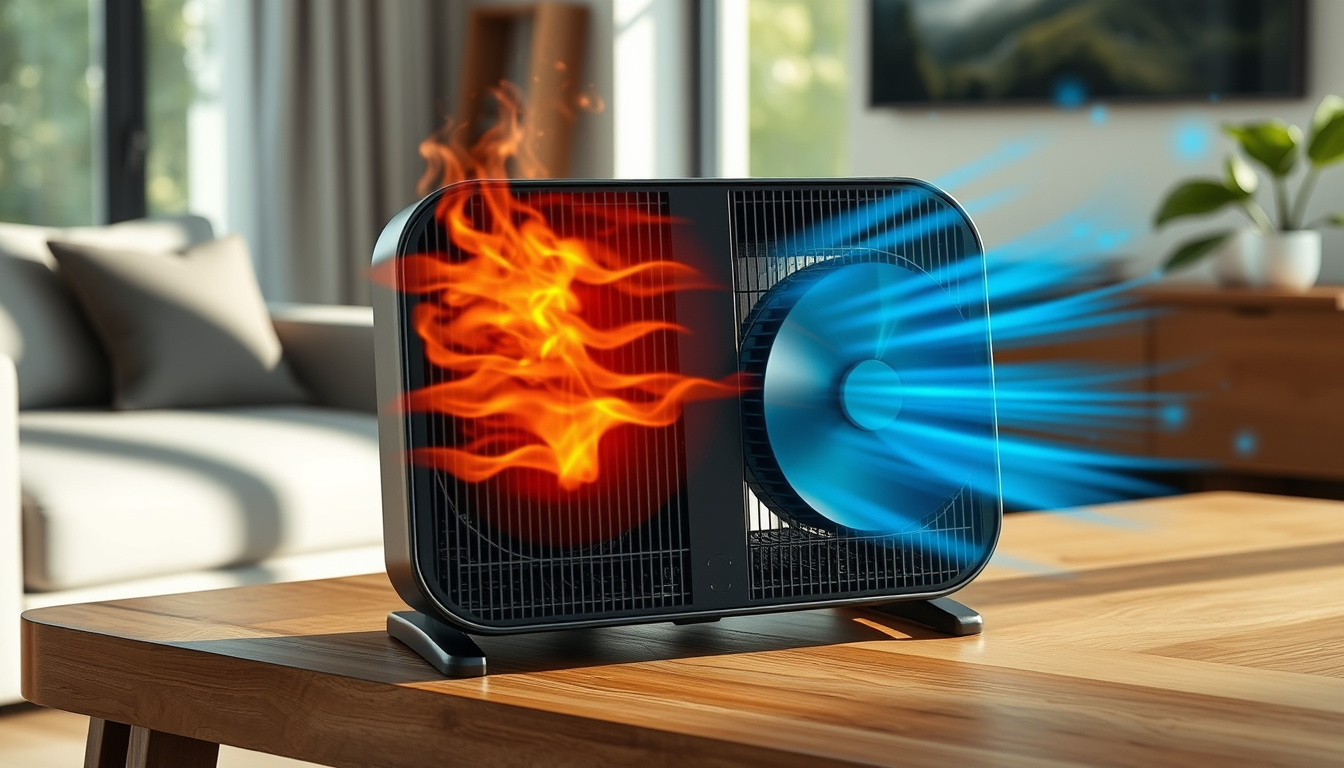
Anyone who has shivered through a damp Irish February, then tried to sleep through a humid July, knows the appeal of one machine that does both: dual-purpose heating and cooling fans promise year-round comfort from a single plug, and Irish retailers now sell everything from a €19.99 fan heater at Expert Ireland (appliance chain) to a €514.99 bladeless hot-and-cool model at Very Ireland (electronics retailer). This guide separates the genuinely useful combinations from marketing tricks, so you will finish with a shortlist that suits a bedroom, a home office, or a rented flat.
Fan energy per hour: 0.05–0.1 kWh ·
AC energy per hour: 0.5–1.5 kWh ·
Fan running cost: < $0.02 per hour ·
Wind chill effect: 3–8°F perceived drop
Quick snapshot
- Dyson’s Hot+Cool HF1 draws 30W–2250W and costs €429 in Ireland (ElectroCity Ireland (appliance retailer)).
- Very Ireland lists the Dyson AM09 at €514.99 — roughly €86 more than the HF1 (Very Ireland (electronics retailer)).
- Cold-blow mode on a fan heater is air circulation, not active refrigeration (Screwfix Ireland (trade supplier)).
- The practical fan-to-AC ratio depends on room size, insulation and humidity — Irish retailers list the machines, but no one publishes an equivalence formula (Expert Ireland, Very Ireland and other retailers).
- Budget fan heaters are holding their ground: the Warmlite WL44001 stays at €19.99 and the Dimplex DEUF2N at €29.95 with a three-year warranty (Expert Ireland (appliance chain)).
- Hybrids are expanding beyond heat and airflow: the Dyson HP1 adds an air purifier and is listed at €499 (ElectroCity Ireland (appliance retailer)).
Seven figures, one pattern: fans are cheap to run because they never fight the room’s temperature.
| Metric | Value | Note |
|---|---|---|
| Fan power consumption | 20–100 watts | Depends on speed and type |
| AC power consumption | 500–1500 watts | Window and portable units |
| Wind chill effect | Up to 8°F perceived drop | Feels cooler on skin |
| Cost per hour to run a fan | ~$0.01–0.02 | Based on a 20–100W draw |
| Cost per hour to run AC | $0.10–0.30 | Based on a 500–1500W draw |
| Combination fan heater price range (Ireland) | €19.99–€514.99 | Warmlite WL44001 to Dyson AM09 |
| Warranty example | 3 years | Dimplex DEUF2N upright fan heater |
What is the best heating and cooling fan?
If you are shopping in Ireland right now, the category is easier to decode than the marketing suggests. Bladeless hot-and-cool models from Dyson dominate the premium shelves, while De’Longhi, Dimplex and Warmlite handle the budget half with fan heaters that double as simple air circulators in summer. The “best” pick depends on one honest question: do you want a heater that also makes you feel cooler, or a machine that actually cools the room?
What is the best combination heater and cooling fan?
- Dyson Hot+Cool HF1 — the bladeless dual-mode flagship; €429 with a 30W–2250W range and a two-year warranty, as listed in the snapshot above.
- Dyson Hot+Cool HP1 — adds air purification to heating and cooling, €499, as listed in the snapshot above.
- Dyson AM09 — €514.99 and rated 4.5/5 across 300 reviews at Very Ireland.
- De’Longhi HFS70B24.GY — 2.4kW ceramic fan heater at €54.95 (Briscoes Ireland (homewares retailer)).
- De’Longhi HFX65V20 Bend Line — 2kW ceramic unit at €129.95 (Briscoes Ireland (homewares retailer)).
- Dimplex DDF390G Desk Friend — compact fan heater at €49.95 (Briscoes Ireland (homewares retailer)).
The pricing pattern is stark: a compact Desk Friend costs about a tenth of a bladeless Dyson, yet both will heat a small room. The extra money buys airflow engineering, a stronger breeze and, on the HP1, air purification — not more heat.
What is the best cooling fan for the summer?
- Tower fans: slim bodies and wide oscillation suit bedrooms and tight corners.
- Pedestal fans: taller airflow and adjustable height for bigger rooms.
- Bladeless fans: no exposed blades, which matters in homes with children and pets.
All three “cool” the person, not the room. They push air across your skin, which speeds evaporation and creates the 3–8°F wind-chill effect — the same reason a cheap fan can feel cool on a warm evening.
What are the best cooling fans in 2026?
- Premium hot-and-cool: Dyson’s HF1 and HP1 remain the headline bladeless listings at ElectroCity Ireland.
- Mid-price ceramic: De’Longhi’s Bend Line HFX65V20 at €129.95 is the strongest 2kW option at Briscoes.
- Budget: the Warmlite WL44001 (€19.99) and Dimplex DEUF2N (€29.95) keep the entry level honest at Expert Ireland.
Irish retailers are showing these as their current lines, which is the most reliable signal for 2026 shopping: the Dyson AM09 remains on sale beside the HF1, a sign that the current generation has room to run.
What is the best fan that actually cools?
- What a fan can do: speed up airflow across your skin, producing a wind-chill effect of roughly 3–8°F.
- What a fan cannot do: lower the temperature of the room. The thermostat stays where it was.
- The “actually cools” upgrade: an air conditioner or, in dry climates, an evaporative cooler.
The most honest “cooling fan” on Irish shelves is probably a bladeless Dyson, because its Air Multiplier technology produces a strong, consistent stream — but even it cannot beat physics. If you want frosty air, buy a compressor, not a fan.
The pattern: the “best” heating and cooling fan is a heater first and a breeze machine second. If you genuinely need summer cooldown, keep the fan for airflow and budget for an AC — because no fan in these listings changes the room’s temperature.
The implication: pick the machine that matches your dominant season — heating first, cooling as a bonus.
Is there a fan that blows hot and cold air?
Yes, and the mechanism is simpler than the marketing makes it sound. A fan heater passes air over a heated metal coil before dispersing it, and the “cold” setting runs the same fan with the heat off. Screwfix Ireland, a trade supplier that lists dozens of these units, describes fan heaters as appliances that heat spaces while also improving air circulation (Screwfix Ireland (trade supplier)).
Is there a fan that creates cold air?
- Cold-blow mode: the fan spins without the heating element — useful airflow, but the room air stays warm.
- None of the models in the Irish listings above uses a compressor, which is the component that actually refrigerates.
- The closest a fan gets to “cold air” is the 3–8°F wind-chill effect on your skin.
That is the whole trick of the category: “cold” is a breeze, not a temperature drop. As noted in the snapshot above, cold-blow mode is air circulation rather than active refrigeration.
Is there a fan that cools like an AC?
- Air conditioners remove heat and humidity; fans only move air.
- A fan can make you feel 3–8°F cooler even though the room temperature is unchanged.
- Compressor technology is the dividing line — and no fan on the Irish market has one.
The dividing line explains the price gap: a 2.4kW fan heater costs €54.95, while a true AC unit sits in a different price class before you even pay for installation.
What this means: “hot and cold” on a fan heater means warm air plus a breeze. Buy one for the heating, treat the cooling mode as a bonus, and skip the sales pitch about summer air conditioning.
The catch: if you want true cold air, you need a compressor, not a fan.
How many fans is equal to 1 AC?
It depends what “equal” means, because the two machines do different jobs. A typical window AC produces 5,000–12,000 BTU/h of cooling; a fan produces zero BTUs — it only moves the air already in the room.
- A window AC: 5,000–12,000 BTU/h, with enough capacity to cool a room up to roughly 400 sq ft.
- A fan: no BTU output; it is an air circulator, not a cooler.
- Perceived comfort: it can take roughly 5–10 fans blowing directly on you to match the relief of one window AC in a small room.
- Power: fans draw 20–100W; window ACs draw 500–1500W — so one AC at full tilt uses 5–15 times more electricity than a fan.
The 5–10 fan estimate is a rule of thumb, not a lab result: it assumes a small, well-insulated room and fans aimed within a metre or two of your body. The cost side is firmer — about $0.01–0.02 an hour for a fan versus $0.10–0.30 an hour for an AC. Air conditioners carry efficiency ratings like EER; fans are simpler, so compare wattage, because that is the only energy number the listings show.
The catch: fans cool people, not rooms. Step out of the airflow and the room is exactly as warm as it was — which is why the “equal to 1 AC” comparison only holds while you are sitting in front of the fan.
At what temperature should you not use a fan?
Fans are so cheap and quiet that switching one off feels wasteful. But once the air is hotter than your skin, the breeze stops helping.
- Above 95°F (35°C): a fan moves air that is hotter than your skin, which can speed up dehydration instead of cooling you.
- Heat index above 100°F: moving hot air can accelerate heat stress rather than relieve it.
- Older adults, infants and people with heart conditions should move to a cooled room before relying on a fan.
Above 95°F (35°C), the advice flips: turn the fan off. The breeze that feels pleasant at 28°C can push heat toward your body once the air passes 38°C, so the safer move for vulnerable household members is a cooled room, not a stronger fan setting.
In the Irish climate, 35°C days are rare, so the more relevant safety question is heating mode. If you run a fan heater in a bathroom, kitchen or child’s room, look for the protections listed on the spec sheet: the De’Longhi Capsule Hobby, for example, includes tip-over auto-off protection and IP21 protection against vertically falling water droplets (Expert Ireland (appliance chain)).
Why this matters: the same machine that cools you in June can hurt you in a heatwave, and the same machine that warms a bedroom in February needs a tip-over switch when children or pets share the house.
What’s the cheapest way to cool a room?
The cheapest way to cool a room is to stop trying to cool the whole room. A fan drawing 20–100W costs about $0.01–0.02 an hour to run, so it is the cheapest comfort tool you own — but it works best as part of a sequence, not as a standalone appliance.
- Night-time ventilating: open windows and doors when the outdoor air cools, so the room’s walls and furniture release stored heat.
- Day-time shading: close curtains and blinds before the sun hits the glass, not after the room warms up.
- Fan-assisted comfort: run the fan where you sit or sleep, so the breeze lowers your perceived temperature.
- Fan plus AC: if you have air conditioning, a running fan lets you set the thermostat higher and still feel comfortable.
- Portable evaporative cooler: a middle option in dry climates, but much weaker in humid air.
The cheapest cooling system is not a product; it is a routine — purge hot air at night, block the sun by day, and let a low-wattage fan do the comfort work instead of cooling rooms you are not in.
The implication: for an Irish household, a €20–€55 fan used in the right sequence covers most summer comfort needs, because the occasional hot week does not justify a dedicated cooling machine that sits idle for ten months.
What cools better than a fan?
If the question is about actual temperature, the answer is short: air conditioning. An AC removes heat and humidity from the room; a fan only moves air across your skin. The more useful question for Irish homes is which cooling approach matches how you actually live in summer.
- Air conditioning: true temperature reduction — the only option here that cools the room itself.
- Evaporative cooler: can drop air temperature by 10–20°F in dry climates, but loses most of its effect in humid Irish air.
- Hybrid setup: a fan on your skin plus a higher AC thermostat — comfort without the full AC power bill.
That hybrid setup is the forgotten middle option: the fan supplies the 3–8°F perceived wind-chill drop, while the AC handles humidity and background temperature. In damp air, evaporative coolers underperform, which makes the fan-plus-AC combination the practical choice when a heatwave does hit.
The trade-off: pay for whole-room cooling with an AC, or pay nearly nothing per hour for personal comfort with a fan. The machine that “cools better” is the one that matches your budget and how long you stay in its airflow.
Two cooling strategies, one pattern: the more effective the cooling, the more energy it demands.
| Metric | Fan-based cooling | Air conditioner |
|---|---|---|
| Cooling effect | 3–8°F perceived wind chill | True temperature reduction |
| Power draw | 20–100 watts | 500–1500 watts (window/portable) |
| Running cost per hour | ~$0.01–0.02 | $0.10–0.30 |
| Room temperature | Stays roughly the same | Drops measurably |
| Best role | Direct human comfort | Whole-room cooling |
| Irish price signal | Cold-blow fan heater from €19.99 in current listings | Not priced in this comparison |
Nine fan-heater models, one pattern: the lower the price, the more the machine is really about heating rather than cooling.
| Model | Type | Power | Price (Ireland) | Standout spec |
|---|---|---|---|---|
| Dyson Hot+Cool HF1 | Bladeless fan heater | 30–2250 W | €429 | 200 L/s airflow; two-year warranty |
| Dyson Hot+Cool HP1 | Bladeless fan heater + air purifier | — | €499 | Adds air purification |
| Dyson AM09 | Bladeless fan heater | — | €514.99 | 4.5/5 across 300 reviews |
| De’Longhi HFS70B24.GY | Ceramic fan heater | 2.4 kW | €54.95 | Ceramic heating element |
| De’Longhi HFX65V20 Bend Line | Ceramic fan heater | 2 kW | €129.95 | — |
| Dimplex DDF390G Desk Friend | Compact fan heater | — | €49.95 | Compact desk unit |
| Warmlite WL44001 | Thermo fan heater | 2000 W | €19.99 | Budget pick |
| Dimplex DEUF2N | Upright fan heater | 2 kW | €29.95 | Three-year warranty |
| De’Longhi Capsule Hobby HFS30C24.DG | Compact fan heater | 1500 W / 2400 W | €49.95 | Tip-over protection; IP21 rating |
Confirmed facts
- Fans increase evaporative cooling on the skin but do not lower room temperature.
- Fan heaters warm a space by passing air over a heated metal coil or ceramic element.
- Cold-blow mode is air circulation, not active refrigeration.
What’s unclear
- The exact number of fans needed to match one AC depends on room size, insulation and humidity.
- Whether a bladeless fan is worth its premium depends on noise tolerance and airflow preference, not on any published heat-output advantage.
- Long-term durability of budget fan heaters is not yet reflected in review data at the Irish retailers listed here.
- Whether the Dyson airflow advantage translates into measurable energy savings in a typical Irish bedroom is not quantified in the listings reviewed for this guide.
- Running a fan alongside an air conditioner lets you raise the thermostat setting and stay comfortable, but the exact energy saving depends on usage patterns.
Two sources, one shared message: a combination fan heater is a heating machine with a breeze mode, not a portable air conditioner.
“The Dyson Hot+Cool HF1 projects over 200 litres per second of airflow using Air Multiplier technology.”
— ElectroCity Ireland (appliance retailer), Dyson HF1 product listing
“Rated 4.5/5 from 300 reviews.”
— Very Ireland (electronics retailer), Dyson AM09 customer review summary
Here is the honest version: a heating and cooling fan is a two-season appliance that heats properly and cools the person in front of it, not the room. For an Irish household, the math leans one way — if your summer goal is sleeping comfortably, a €20–€55 fan heater with a cold-blow mode plus night-time window venting is the practical buy, and if you want the strongest airflow and air purification, the €429–€514.99 Dyson range is the premium shortcut. For households that expect arctic air in July, the choice is clear: buy an air conditioner, or adjust your expectations.
Frequently asked questions
How does a bladeless fan work?
A bladeless fan pulls air in through its base and pushes it out through a circular amplifier, creating a smooth, high-velocity stream. Dyson’s Air Multiplier version delivers more than 200 litres per second in the HF1 model, as its own product listing states (quoted above).
What is the difference between a tower fan and a pedestal fan?
A tower fan has a slim vertical body and usually oscillates to spread airflow across a room — a good fit for bedrooms and corners. A pedestal fan sits on an adjustable stand with a larger blade and pushes a stronger, more direct breeze for bigger spaces. Neither lowers the room temperature; both cool the skin by moving air.
Should I leave a fan on all day?
A modern fan uses 20–100W, so the running cost is tiny — roughly $0.01–0.02 an hour. The bigger issues are comfort and heat: continuous airflow can dry your eyes and airways, and in air above 95°F a fan can push heat toward you instead of away. Use a timer at night and switch it off when you leave the room.
What is the best way to position a fan for optimal cooling?
Aim the airflow at your body, not at the furniture: wind chill works on skin. For sleeping, place the fan low and angled toward the bed, because cooler air sits near the floor. During the day, close blinds first — a fan cannot outrun solar heat coming through the glass.
Can a fan be used in a room with high humidity?
Yes, but the effect weakens. Fans cool by speeding up evaporation from your skin, and humid air evaporates more slowly. In a damp Irish summer a fan still improves airflow, but it will not dry the room — that takes a dehumidifier or an air conditioner.
How do I know if a fan is energy efficient?
Check the wattage. A typical fan draws 20–100W, while a window AC draws 500–1500W. Combination fan heaters add a heating element — the Dyson HF1 runs from 30W in fan mode up to 2250W in heat mode — so energy use depends entirely on which mode you are using.