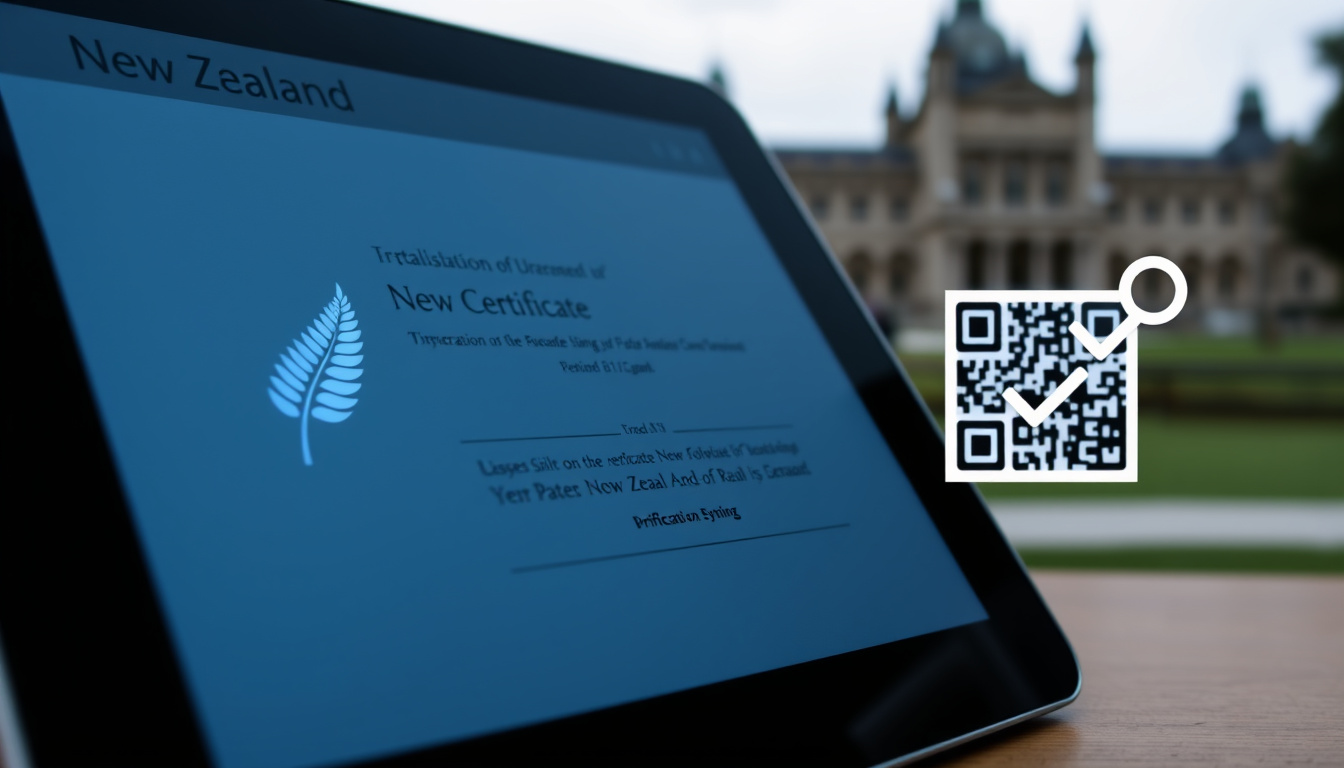
When you hand over your driver licence at a rental car counter, you’re sharing more personal data than you might realise. New Zealand’s new NZ Verify app flips this by letting a hotel or rental agency simply scan your phone to confirm you are who you say you are – without ever seeing your birth date or licence number. This guide explains how the app works, who can use it, and why it is not a compulsory digital ID.
NZ Verify app launches May 2025 • Digital licence holders in NZ over 1 million • Agencies accepting NZ Verify 12+ • Interoperable international jurisdictions 3
Four key facts about NZ Verify
- Confirms a digital credential is genuine, current, and hasn’t been tampered with
- Uses cryptographic signature matching against the issuer’s public key
- Only returns a pass/fail result—no personal data leaves your phone
- It does not store or collect personal data
- It does not issue or create new digital credentials
- It is not a digital ID card or mandatory identity system
- It does not replace physical documents for those who prefer them
- Anyone with a digital credential from a participating issuer (e.g., NZ digital driver licence)
- Businesses or agencies that need to verify a credential without storing personal data
- App is free to download from Apple App Store and Google Play
- It is not a national ID card or digital identity credential
- It does not replace passports, birth certificates, or other official documents
- It does not store or transmit personal data to any third party
- It is not linked to any government tracking database
What is NZ Verify?
NZ Verify is a free smartphone app released in May 2025 by New Zealand’s Public Service Commission. Its sole function is to let businesses or government agencies check that a digital credential – such as a mobile driver licence from another country – is genuine and currently valid. The app itself holds no personal information; it simply reads the cryptographic signature on a credential presented to it via a QR code or similar tap-and-verify flow.
The app is not a digital wallet or identity provider. It is a verification tool, akin to a barcode scanner but for secure digital documents. The New Zealand Government states the app “does not store or share any of your personal information” (official guidance).
How does the NZ Verify app work?
The workflow is simple: a person presents a digital credential on their phone (e.g., a mobile driver licence from a participating state or country). The verifier opens NZ Verify on their own device and scans the QR code presented. The app checks the credential’s cryptographic signature against the issuer’s public key, confirms it has not been tampered with, and reports only a pass or fail result.
Key technical points:
- Verification happens offline once the issuer’s public key is stored on the device.
- No personal data (name, address, birth date) is extracted or stored by the app.
- Each verification is a one-time check; no persistent record is kept by the verifier.
- ISO 18013-5 compliant credentials are supported, which includes mobile driver licences from participating jurisdictions.
- The app cannot issue or store credentials; it only validates them.
The government describes this as “a cryptographic handshake that proves the credential is real without revealing anything else about the holder.” (Public Service Commission).
Which credentials can NZ Verify check?
At launch, NZ Verify primarily supports mobile driver licences that comply with the ISO 18013‑5 standard. This currently covers licences from 19 U.S. states and several Australian states. The app does not yet verify passports, birth certificates, or other identity documents.
The support page lists the following credential types as compatible:
- Mobile driver licences from participating jurisdictions (ISO 18013‑5)
- Non‑driver identity credentials from the same standard (future scope)
The government expects the system to expand to cover professional licences and other official credentials once more issuers adopt the standard.
Launch: May 2025 (Apple App Store) • Android: rolled out shortly after via Google Play • Active users (estimated): tens of thousands in first month
Who can verify my identity with NZ Verify?
Any organisation that needs to check a digital credential can use NZ Verify—hotels, rental car agencies, bars, or border authorities that accept mobile driver licences. The app does not replace existing identity verification methods; it simply adds a digital channel for credentials that support it.
The Department of Internal Affairs runs the Identity Verification Service (IVS) which uses NZ Verify as one of its verification methods. Trusted referees, Justices of the Peace, and Public Trust also continue to offer in‑person verification for physical documents.
How to get a digital credential for NZ Verify
NZ Verify itself does not issue credentials. You need a digital credential from a participating authority—most commonly a mobile driver licence issued by the NZ Transport Agency (Waka Kotahi) or a participating state DMV. Once you have the credential on your phone, any verifier that runs NZ Verify can check its validity without seeing your personal details.
The process:
- Download NZ Verify from the Apple App Store or Google Play (free).
- Ensure you already have a digital credential loaded on your device (e.g., via the NZTA mobile licence app).
- When asked to prove your identity, present the credential’s QR code to the verifier’s NZ Verify app.
- The app confirms “Valid” or “Invalid” without revealing your name, address, or age.
The entire check is done offline after an initial public‑key download, so no personal data traverses the network during the transaction.
Can I use NZ Verify instead of a physical ID?
For many routine checks – proving you are over 18, verifying your identity when renting a car, or checking in at a hotel – NZ Verify can replace the need to hand over a physical licence or passport. The government advises that refusal is always an option; businesses must accept alternative forms of identification if the customer does not wish to use digital verification.
Note
The NZ Verify app is a verifier, not an identity wallet. It runs on the verifier’s device, not on your phone. You present a QR code from your digital credential app; the verifier scans it with NZ Verify to confirm it is genuine and current.
Who needs NZ Verify?
The app is designed for any business or government agency that needs to quickly check a digital credential. Typical use cases include:
- Car rental companies checking a digital driver licence
- Hotels verifying identity at check‑in
- Age‑restricted venues (bars, casinos) confirming proof of age
- Government services that accept verifiable credentials instead of physical documents
The app is not intended for individual consumers; they should use their credential-holding app (such as a digital driver licence app) to present the code that NZ Verify reads.
What NZ Verify does
- Cryptographically verifies the credential is genuine
- Checks the credential has not expired or been revoked
- Shows only a pass/fail result to the verifier
- Works offline after initial credential registration
What NZ Verify does NOT do
- Store or transmit personal identity data
- Issue any digital credential itself
- Create a central database of verifications
- Replace physical ID documents – it only checks them
How NZ Verify differs from a digital ID
Some coverage has mistakenly described NZ Verify as a “digital ID” system. The app is closer to a barcode scanner for digital credentials. The key difference:
- Digital ID system: creates and manages a central identity record (like RealMe).
- NZ Verify: is a reader that checks whether a credential presented to it matches the issuer’s cryptographic signature – it never stores or sends any personal data.
New Zealand does have voluntary digital identity programmes such as RealMe, which can be used for online services. But NZ Verify is simply a verification tool, not an identity provider.
What digital credentials can NZ Verify check?
At launch, NZ Verify supports mobile driver licences that comply with the ISO 18013‑5 standard. This currently includes:
- New Zealand digital driver licences issued by NZTA
- Mobile driver licences from 19 U.S. states (Arizona, Colorado, Georgia, Louisiana, Maryland, Mississippi, New York, Oklahoma, Texas, and others)
- Participating jurisdictions in Australia and Canada (ongoing agreements)
The app does not yet support passports, birth certificates, or professional licences from fields such as nursing or engineering, though these are in scope for future expansion.
How to use NZ Verify
- Download the free NZ Verify app from the Apple App Store (iOS) or Google Play (Android).
- Let the verifier scan the QR code that the credential holder displays from their digital wallet (e.g., the NZTA app or another ISO‑18013‑5 compliant wallet).
- Wait for the pass/fail result — the app shows a green tick or red cross within seconds.
- No data stored: the result is shown only on the verifier’s screen and is not recorded.
Required for the verifier:
- A smartphone running iOS 15+ or Android 10+
- The NZ Verify app installed
- Internet connectivity for the initial credential‑registry check (cached thereafter)
How does it compare with other verification methods?
NZ Verify vs. physical document check
| Method | What it reveals | Personal data collected | Speed |
|---|---|---|---|
| Physical licence inspection | Full name, address, date of birth, licence photo | All details seen by verifier | ~30 seconds |
| NZ Verify digital check | Only pass/fail result | None (no data collected) | ~5 seconds |
The pattern is clear: NZ Verify is designed to minimise data exposure while still proving a credential is valid.
wise.com, idtechwire.com, firstaml.com, youtube.com, play.google.com, fma.govt.nz, biometricupdate.com, archive.opengovasia.com, instagram.com
Frequently asked questions
Is NZ Verify the same as a digital ID?
No. NZ Verify is a verification tool that checks if a digital credential (e.g., a mobile driver licence) is genuine and current. It does not issue or store identity data. A digital ID is a portable credential you store on your phone; NZ Verify is the app a business uses to check that credential.
Do I need a smartphone to use NZ Verify?
To present a digital credential you need a smartphone with the credential app. To verify a credential (as a business), you run NZ Verify on any compatible device. If you don’t have a smartphone, physical ID documents remain fully valid.
What happens if my credential is expired?
The NZ Verify app will show the credential as invalid. You would need to present a current physical document instead. The app itself does not expire.
Is my personal data safe?
Yes. The app does not store or transmit any personal information. It performs a cryptographic check and shows only a pass/fail result. No data is sent to a central server.
Can I be forced to use NZ Verify?
No. The New Zealand government has stated clearly that digital credentials are entirely voluntary. Businesses may request a digital verification, but you are always free to present a physical document instead.
Will NZ Verify replace physical licences?
No. It is an optional verification channel that sits alongside physical documents. The government has said it will keep paper licences available for the foreseeable future.
Technical background
The app uses public‑key infrastructure (PKI) to verify credentials. When an issuer (such as a state DMV) creates a digital credential, it signs the data with its private key. NZ Verify holds the issuer’s public key on a secure server. When a user presents their credential, the app decrypts the signature and checks that the data has not been altered since issuance. The entire process takes about one second and uses only the credential’s cryptographic envelope — no personal data is exposed.
The government’s Trust Framework for Digital Identity, expected to be operational in 2026, will define the rules for how these credentials can be used across different services. NZ Verify is one of the first tools built on this framework.
Timeline
- May 2025 — NZ Verify launches on the Apple App Store.
- Mid‑2025 — Android version released via Google Play.
- 2026 (target) — New Zealand’s Trust Framework for Digital Identity becomes operational, expanding the range of credentials NZ Verify can check.
- Ongoing — Expansion to more U.S. states, Australian states, and eventually non‑driving credentials.
Clarity: facts vs uncertainty
Confirmed facts
- App was released in May 2025.
- Free to download and use.
- Does not store any personal data.
- Works only with ISO 18013‑5 credentials (currently mobile driver licences).
- Developed by the Government Digital Delivery Agency within the Public Service Commission.
- Already supports credentials from three Australian states and one U.S. state, with more expected by end 2025.
Unclear or unconfirmed
- How many credentials have been verified since launch – no public statistics.
- Whether the app will eventually verify passports or other travel documents.
- If there are any plans to tie verification to a government‑issued digital ID system.
“NZ Verify is a secure, easy way for businesses to check digital credentials while protecting people’s privacy.”
— Public Service Commission, official announcement
How NZ Verify fits into New Zealand’s identity landscape
New Zealand already has several identity‑verification services: the Department of Internal Affairs’ Identity Verification Service (IVS), RealMe, and physical document checks by JPs or Public Trust. NZ Verify is a new, complementary tool that targets the specific use case of checking a digital credential in‑person without retaining any data. It does not replace any existing system or create a national digital ID.
The government has emphasised that NZ Verify is strictly voluntary. “No one will be required to use NZ Verify or to carry a digital credential,” says the official guidance.
Future developments
The Public Service Commission has indicated that the Trust Framework, when operational in 2026, will allow broader use of NZ Verify across more credential types – passports, birth certificates, professional licences, and possibly even proof of age for online services. The framework is designed to be portable, so NZ Verify could become a standard way to verify any digital credential from a trusted issuer.
For now, the app remains focused on driver licence verification, but the architecture is credential‑agnostic. The same technology could later verify a digital work visa, a digital student ID, or a digital proof of vaccination.
Bottom line
NZ Verify is not a digital ID card or a mandatory system. It is a free, optional tool that lets organisations confirm a digital credential without seeing or storing personal information. If you prefer physical ID, nothing changes. The system is designed to give individuals more control over how their identity is checked, not less.
Key take‑away: NZ Verify is a privacy‑positive verifier, not a tracker or database. It shifts the verification model from “I show you my licence” to “I prove my licence is valid” – and that subtle difference keeps your personal data on your phone.
Best Ride On Mower NZ – Top Picks For Kiwi Properties
Choosing the right ride-on mower for a New Zealand property requires matching machine capabilities to specific section sizes, terrain challenges, and budget constraints. The New Zealand market offers a diverse range of options from international brands like Husqvarna and John Deere alongside locally available Masport models, each catering to different property types and mowing requirements. This guide examines the leading ride-on mower options currently available, providing practical comparisons to help property owners make informed purchasing decisions based on their individual circumstances.
Recent reviews and market analysis indicate significant variation in performance across different terrain types commonly found in New Zealand. From flat suburban sections to hilly rural properties, the suitability of each mower type depends heavily on factors including cutting width, transmission system, and traction capabilities. Understanding these specifications in relation to specific property characteristics ensures buyers select equipment that delivers reliable service over the long term.
What is the Best Ride On Mower in NZ?
The answer depends largely on property characteristics, though several models consistently emerge as top performers across different categories. Recent New Zealand reviews highlight options that balance performance, reliability, and value for typical section sizes found throughout the country.
Based on aggregated reviews and specifications, these models represent the strongest options currently available in the New Zealand market for typical residential and small rural properties.
| Category | Recommended Model | Cutting Width | Best Suited For |
|---|---|---|---|
| Overall Top Pick | John Deere ZTrak Z335E | 42 inches | Level sections with obstacles |
| Value Leader | Masport ZVT | 48 inches | Larger sections, budget buyers |
| Hillside Specialist | Husqvarna 500-series | Variable | Slopes and uneven terrain |
| Small Section | Masport S155 | 36 inches | Sections under 1 acre |
Key Takeaways for NZ Property Owners
- Tire selection significantly impacts performance on New Zealand’s varied terrain, particularly during wet conditions when standard turf tires provide inadequate traction and may cause the mower to slide or become stuck
- Zero-turn mowers offer superior maneuverability and cutting efficiency on flat properties with garden beds and trees, though they require careful operation on slopes due to their high-speed turning capability
- Husqvarna 500-series models feature 4-wheel drive and low centre of gravity, making them the preferred choice for properties with significant slopes and challenging topography
- For sections around one acre, a cutting width of 36 to 48 inches provides the optimal balance between maneuverability and mowing efficiency
- John Deere’s price-value ratio for zero-turn mowers ranks highly among New Zealand buyers seeking reliable performance without premium pricing
- Warranty coverage varies substantially between brands, with John Deere offering up to 4 years or 300 hours on higher-end models compared to 3 years for comparable Husqvarna products
- Hydrostatic transmission systems, found across premium models from all major brands, provide smoother operation and easier handling compared to traditional gear-driven alternatives
| Brand | Price Range (NZD) | Typical Engine | Warranty |
|---|---|---|---|
| Husqvarna | $5,550 – $16,675 | Up to 26.3 hp | 3 years |
| John Deere | Varies by model | 20-25 hp | 2-4 years |
| Masport | Entry to mid | 24 hp | Standard |
| Altoz | Premium | Commercial | Commercial |
What is the Best Value Ride On Mower NZ?
Value in ride-on mowers encompasses more than initial purchase price, extending to long-term operating costs, maintenance requirements, and resale potential. Several models stand out for delivering strong performance relative to their cost, particularly for property owners seeking practical solutions without premium pricing.
Budget-Friendly Options Under $5,000
Strict budget constraints limit options in the New Zealand market, as most premium ride-on mowers exceed the $5,000 threshold. However, entry-level models from established brands provide viable alternatives for smaller properties where advanced features are less critical.
When budget is the primary constraint, focusing on appropriate cutting width for your section size and ensuring local dealer support can prevent costly issues down the line. Checking the availability of spare parts and service support before purchasing any model is essential.
Masport’s range represents the most accessible entry point for New Zealand buyers, with models designed specifically for smaller sections where premium features would go underutilised. The Masport S155 tractor, featuring a 36-inch cutting width and 300L grass catcher, provides practical functionality for properties up to one acre without the complexity of larger machines.
Mid-Range Value Leaders
The mid-price segment offers the strongest value proposition for most New Zealand property owners, combining capable performance with reasonable acquisition costs. These models typically include hydrostatic transmission, adequate cutting widths, and sufficient engine power for typical residential and small rural applications.
Husqvarna 100-series tractors present a compelling value alternative to John Deere’s equivalent range, offering comparable specifications at similar price points. Features such as hydrostatic transmission with side-by-side pedals enhance operator comfort during extended mowing sessions, while engine outputs reaching 26.3 hp handle challenging grass conditions effectively. Husqvarna’s New Zealand distribution ensures ready access to parts and service support across the country.
Maximising Value Through Correct Sizing
Purchasing an inappropriately sized mower frequently results in either over-spending on unused capacity or frustration from inadequate performance. Matching cutting width to section size represents the most significant factor in achieving satisfactory value from a ride-on mower purchase.
For sections between one and three acres, a 42 to 48-inch cutting width provides the optimal balance between coverage efficiency and maneuverability. Properties exceeding three acres generally benefit from commercial-grade machines with cutting widths exceeding 50 inches, despite their higher acquisition cost.
Which Ride On Mower Brands Are Best for NZ?
The New Zealand market benefits from access to major international brands alongside locally distributed products, each bringing distinct strengths to different property requirements. Evaluating brand reliability requires considering both reported performance and the availability of local support infrastructure.
John Deere
John Deere maintains a strong presence in the New Zealand market, with the ZTrak zero-turn series particularly well-regarded for value and performance on relatively level lawns. The range spans cutting decks from 42 to 60 inches, accommodating properties of varying sizes while maintaining consistent quality standards.
Warranty coverage on John Deere products includes options ranging from 2 years or 120 hours on entry models through to 4 years or 300 hours bumper-to-bumper on higher-end variants, providing buyers with confidence in long-term reliability. The combination of established dealer networks and readily available parts makes John Deere a practical choice for property owners prioritising support accessibility.
Husqvarna
Husqvarna offers one of the broadest product ranges available in New Zealand, from entry-level tractors through to commercial-grade machines designed for demanding applications. The 500-series represents the upper tier of their residential offerings, featuring commercial-quality construction including 4-wheel drive capability and low centre of gravity for slope work.
Reported durability issues with engine belts on the S100 model warrant attention when evaluating used purchases, highlighting the importance of checking maintenance records and service history. New units benefit from full factory warranty coverage, though prospective buyers should confirm specific terms with authorised dealers before purchase.
Masport
Masport occupies a distinct position in the New Zealand market as a brand with deep roots in the country and products designed with local conditions in mind. The range spans from affordable entry-level tractors through to the more capable ZVT zero-turn models, providing options across multiple price points.
The ZVT zero-turn mower features a 48-inch cutting width, 24 HP engine, and 13 cutting height adjustments, offering practical capabilities for substantial lawn areas at a budget-conscious price point. Adjustable lap bars enhance operator comfort, while the 19-litre fuel tank supports extended mowing sessions without frequent refuelling stops.
Track-Drive Specialists
For properties with significant slopes or challenging terrain, track-drive mowers like the Altoz 766 provide superior performance compared to conventional wheel-mounted alternatives. The traction advantages of track systems become particularly apparent on wet grass and steeper gradients where traditional turf tires struggle for grip.
Standard ride-on mowers are not designed for steep slopes regardless of brand. Properties with significant gradients require specialised equipment such as track-drive mowers or dedicated slope machines. Operating standard mowers on steep terrain poses serious safety risks including loss of control and rollover hazards.
What to Consider When Buying a Ride On Mower in NZ?
Successful ride-on mower purchases depend on accurately assessing property requirements and matching them to available equipment capabilities. Several key factors determine whether a particular model will prove satisfactory over years of regular use.
Terrain and Traction Requirements
New Zealand properties frequently present terrain challenges that significantly impact mower performance. Standard turf tires, typically 18 inches tall, perform adequately on dry grass but provide poor traction in wet or muddy conditions, potentially causing the mower to slide and become stuck. For those looking to upgrade their lawn care, exploring the best sleeping bag New Zealand might offer a surprisingly comfortable solution for outdoor enthusiasts. best sleeping bag New Zealand
More aggressive tire configurations such as 20x10x8 models offer superior grip around wet areas but may damage lawn surfaces after rainfall due to their intensified ground engagement. Property owners in areas with clay soils or poor drainage should seriously consider upgrading to more capable tire configurations regardless of the mower brand selected.
Operator Comfort Features
Extended mowing sessions place significant demands on operator comfort, making suspension systems and ergonomic features increasingly important selection criteria. The Toro MyRide suspension system exemplifies advances in this area, providing fully adjustable firmness settings that accommodate different operator weights and preferences.
The floating suspension design reduces joint impact when traversing uneven ground, though maximum softness settings may result in bottoming out on particularly rough terrain. Finding the appropriate firmness balance requires experimentation based on individual conditions and operator preference.
Maintenance and Service Accessibility
Long-term ownership costs depend significantly on maintenance accessibility, making local dealer presence a critical factor in brand selection. Property owners in regional areas should verify authorised service centre locations before committing to any purchase, as distance to service facilities can transform minor issues into major inconveniences.
Checking spare parts availability for specific models provides valuable insight into long-term ownership experience. Brands with strong dealer networks in New Zealand, including John Deere and Husqvarna, offer advantages in parts accessibility compared to less established imports.
Timeline: Ride-On Mower Market Evolution 2020-2025
The ride-on mower market in New Zealand has undergone notable changes over recent years, with technology improvements, pricing shifts, and emerging categories reshaping buyer options. Understanding this evolution context helps property owners appreciate current offerings and anticipate future developments.
- 2020: Husqvarna expands zero-turn range with improved cutting deck designs and enhanced comfort features across residential product lines
- 2021: John Deere introduces updated ZTrak series with refined control interfaces and extended warranty options for New Zealand market
- 2022: Masport launches ZVT zero-turn models targeting budget-conscious buyers seeking zero-turn capabilities without premium pricing
- 2023: Industry-wide price increases reflecting supply chain pressures and commodity costs affect all major brands in New Zealand market
- 2024: Track-drive mower options gain attention following improved accessibility through specialist distributors; Toro introduces updated MyRide suspension
- 2025: Battery electric ride-on mowers begin appearing in New Zealand market, though adoption remains limited by range constraints and premium pricing
What We Know Versus What Remains Unclear
Transparency about the reliability of available information helps property owners set realistic expectations when researching ride-on mower purchases. Several factors influencing long-term ownership experience remain difficult to assess from publicly available sources.
| Established Information | Information Requiring Further Verification |
|---|---|
| Specifications, engine outputs, cutting widths, and features as listed by manufacturers | Long-term durability in New Zealand-specific conditions without comprehensive independent testing |
| Warranty terms and coverage durations provided by authorised dealers | Actual reliability rankings across brands based on representative sample sizes |
| Price ranges from authorised New Zealand retailers | Specific wet-grass durability comparisons under standardised New Zealand testing protocols |
| General traction differences between tire types on wet surfaces | Precise performance rankings for 2025 model year releases |
| Local dealer presence and service network coverage | Comprehensive cost-of-ownership comparisons including fuel, maintenance, and repair costs |
For the most current NZ-specific buying guidance and detailed reliability data, direct consultation with local dealers or Consumer NZ resources would provide additional insights beyond what is publicly documented.
Understanding the New Zealand Ride-On Mower Market
The New Zealand market for ride-on mowers reflects broader trends in outdoor power equipment while adapting to local conditions and buyer preferences. Understanding this context helps property owners navigate available options and identify the most suitable choices for their circumstances.
Major brands including Husqvarna, John Deere, and Masport maintain active distribution networks throughout New Zealand, with products available through both specialist dealers and major retail chains including Bunnings Warehouse. This accessibility ensures buyers can evaluate options in person, access demonstration units, and establish ongoing service relationships before completing purchases.
The shift toward zero-turn technology represents a significant market trend, with these machines increasingly preferred for properties with complex layouts, garden beds, and trees requiring navigation. While traditional tractor-style mowers remain relevant for certain applications, zero-turn designs offer compelling advantages in cutting efficiency and maneuverability on suitable terrain.
Local dealer relationships prove invaluable for New Zealand ride-on mower purchases, providing access to demonstration units, expert sizing advice, and ongoing maintenance support that catalogue-based purchasing cannot match.
Next Steps for Prospective Buyers
Armed with information about available options and key selection criteria, property owners can take practical steps toward identifying suitable ride-on mowers for their specific requirements. Systematic evaluation against actual property characteristics prevents costly mis purchases.
- Measure your section to determine appropriate cutting width requirements based on lawn area and accessibility constraints
- Assess terrain characteristics including slope angle and drainage quality to identify traction and stability requirements
- Visit local dealers to evaluate demonstration units and discuss specific property requirements with knowledgeable staff
- Request quotes that include delivery, initial setup, and first service costs for accurate total cost comparison
- Verify warranty terms, parts availability, and service centre locations for shortlisted models before committing to purchase
- Arrange test drives on comparable terrain to assess operator comfort and handling characteristics firsthand
For those researching property needs alongside mower requirements, comprehensive information about Warkworth property characteristics illustrates how section size and terrain factors influence rural and semi-rural lifestyle decisions that intersect with equipment purchases like ride-on mowers.
Frequently Asked Questions
What size ride-on mower do I need for a 1-acre section in New Zealand?
A cutting width of 36 to 42 inches typically provides optimal performance for sections around one acre in New Zealand. The Masport S155 with its 36-inch width represents a practical choice for properties at this size, offering maneuverability through tight spaces while maintaining efficient cutting coverage.
Are ride-on mowers worth the investment for New Zealand properties?
Ride-on mowers prove worthwhile for properties with lawn areas exceeding half an acre, where the time savings and reduced physical effort compared to walk-behind mowers justify the investment. Properties under this threshold may not fully utilise ride-on capabilities, making smaller equipment more appropriate.
What is the main difference between zero-turn mowers and tractor-style ride-ons?
Zero-turn mowers feature a pivoting rear axle design that enables tight turning circles and rapid direction changes, significantly improving efficiency on properties with obstacles. Tractor-style mowers offer greater stability on slopes but require wider turning circles. Zero-turn designs excel on flat terrain, while tractors prove safer for hillside work.
Which ride-on mower brand offers the best warranty in New Zealand?
John Deere provides the most comprehensive warranty coverage among major brands, offering up to 4 years or 300 hours bumper-to-bumper on higher-end ZTrak models. This coverage exceeds the 3-year warranties typically offered by Husqvarna and provides substantial protection for buyers seeking extended peace of mind.
Can I use a ride-on mower on steep slopes in New Zealand?
Standard ride-on mowers are not recommended for steep slopes regardless of brand. Properties with significant gradients require track-drive mowers such as the Altoz 766 or the Husqvarna 500-series with 4-wheel drive. Operating standard mowers on steep terrain presents serious safety risks including potential rollover accidents.
What should I look for when buying a used ride-on mower in New Zealand?
When evaluating used models, verify maintenance records, check engine belt condition on Husqvarna S100 models, inspect cutting deck for wear, test transmission operation, and confirm parts availability for the specific model. Establishing a service relationship with a local dealer provides valuable support regardless of whether purchasing new or used equipment.
How much should I budget for a quality ride-on mower in New Zealand?
Quality ride-on mowers in New Zealand typically range from approximately $5,000 for entry-level models through to over $16,000 for premium commercial-grade machines. Budget-conscious buyers should focus on appropriate sizing for their section rather than premium features that may go underutilised.
Are battery electric ride-on mowers a viable option yet in New Zealand?
Electric ride-on mowers have entered the market but remain limited by higher initial costs and runtime constraints compared to petrol alternatives. While technology continues advancing, most New Zealand buyers find current electric options insufficient for typical property sizes without premium pricing. Petrol-powered machines remain the practical choice for the majority of applications.
Liquor Store Open Near Me – Real-Time Hours and Rules
Locating alcohol outside standard retail hours requires navigating a complex intersection of mobile technology and Prohibition-era regulations. The search for immediate availability—whether at dawn on a Tuesday or midnight on a Saturday—depends less on store willingness than on state-specific statutory frameworks that strictly define when transactions can legally occur.
Digital mapping tools provide real-time proximity data, yet they often fail to distinguish between physical store hours and legal sales windows. This distinction proves critical in jurisdictions like California, where the Department of Alcoholic Beverage Control enforces uniform blackout periods that override business preferences.
Understanding these constraints requires examining specific regional examples. California’s regulatory environment, characterized by extended but bounded operating hours, illustrates how consumers can maximize access while remaining compliant with state law.
What Liquor Stores Are Open Near Me Right Now?
- California mandates a complete sales blackout from 2 AM to 6 AM daily under Business and Professions Code 25631
- Safeway Beer, Wine & Liquor in Sacramento operates from 5 AM or 6 AM until 2 AM, offering near-continuous availability
- Total Wine & More maintains stricter hours, typically 9 AM to 9 PM on weekdays
- Wholesale alcohol delivery faces Sunday prohibitions and 3 AM-8 PM restrictions on other days
- Nevada permits genuine 24-hour sales, while Utah enforces complete Sunday closures
| Fact | Details |
|---|---|
| California Blackout Period | 2 AM – 6 AM daily (no sales, delivery, or consumption) |
| Safeway Sacramento (Alhambra Blvd) | 6 AM – 2 AM (some locations 5 AM – 2 AM) |
| Total Wine Emeryville | 9 AM – 9 PM weekdays |
| California Delivery Window | 3 AM – 8 PM for wholesalers (no Sundays) |
| Sunday Sales Status | Legal in California; prohibited in Utah and select Texas counties |
| ID Requirement | Valid government-issued identification proving 21+ |
| Holiday Variations | California maintains standard hours; other states restrict Thanksgiving/Christmas sales |
How Do I Find a Liquor Store Open Near Me?
Digital Verification Protocols
Google Maps serves as the primary interface for location-based alcohol searches, aggregating business hours through owner-verified profiles and user submissions. However, the platform cannot override statutory prohibitions. A search conducted at 3 AM in Sacramento might display nearby Safeway locations as “open,” yet the California ABC regulations prevent actual alcohol transactions until 6 AM.
Third-party applications like Yelp provide supplementary verification through crowdsourced reviews, often highlighting discrepancies between posted and enforced hours. Users frequently note when specific locations card strictly or close registers early for inventory.
Navigating Sunday and Holiday Schedules
While California permits Sunday alcohol sales during standard licensed hours, other jurisdictions maintain “blue laws” that prohibit or severely restrict transactions. States like Utah and select counties in Texas and North Carolina enforce Sunday prohibitions rooted in religious observance traditions, creating geographic disparities that digital tools may not immediately signal.
Always confirm map results against official state ABC websites during holiday weekends or daylight saving transitions. Business listings often display standard hours that may not reflect temporary legal modifications.
What Are Typical Liquor Store Hours Near Me?
California’s Regulatory Framework
The California Department of Alcoholic Beverage Control enforces a uniform prohibition on alcohol sales, delivery, and consumption between 2 AM and 6 AM. This applies equally to off-sale retailers (dedicated liquor stores) and on-sale establishments (bars and restaurants). Violations constitute misdemeanors, compelling even 24-hour grocery operations to halt alcohol transactions during this window.
Extended Operations Models
Safeway locations in Sacramento represent the closest approximation to round-the-clock service legally permissible in California. Operating from 5 AM or 6 AM until 2 AM, these stores maximize accessibility while respecting the mandatory blackout. Conversely, Total Wine & More in Emeryville follows conventional retail patterns, opening at 9 AM and closing at 9 PM.
Interstate Variations
Nevada maintains the most permissive alcohol regime in the continental United States, with Las Vegas venues frequently selling spirits 24 hours daily. Utah presents the opposite extreme through its state-controlled distribution system, which closes entirely on Sundays and religious holidays. Pennsylvania’s state-operated stores enforce early Sunday closures, illustrating the patchwork authority granted to states under the 21st Amendment.
Do Liquor Stores Offer Delivery Near Me?
Curbside pickup and home delivery have expanded alcohol accessibility, though regulatory frameworks impose temporal constraints that technology cannot circumvent. California permits retailers to deliver directly to consumers, but wholesale distributors face strict limitations: no Sunday deliveries and restricted 3 AM-8 PM windows on weekdays.
Third-party logistics platforms incorporate these restrictions through geo-fencing algorithms. Services suspend alcohol ordering during the 2 AM-6 AM blackout period, regardless of whether the physical store remains open for other merchandise. This creates a gap between general store hours and alcohol-specific availability.
California prohibits wholesalers and manufacturers from delivering to retail licensees on Sundays entirely. On other days, deliveries may occur only between 3 AM and 8 PM, narrowing the window for inventory restocking.
All delivery and curbside pickup services require presentation of valid 21-plus identification at the point of exchange. Digital pre-verification through apps does not eliminate the requirement for physical ID inspection upon receipt.
How Do Liquor Store Hours Flow Throughout the Day?
- – Select Safeway locations in Sacramento open, allowing immediate alcohol purchases.
- – Standard legal sales resume across California following the 2-6 AM blackout; most convenience stores activate registers.
- – Dedicated liquor retailers like Total Wine & More commence operations.
- – Peak afternoon trading period with maximum inventory availability.
- – Standard closing time for specialty retailers in urban California markets.
- – Mandatory cutoff for all alcohol sales; registers lock until 6 AM regardless of store operating status.
What We Know vs. What Remains Uncertain
| Established Information | Information Requiring Verification |
|---|---|
| California prohibits alcohol sales 2 AM-6 AM daily under B&P Code 25631 | Real-time inventory levels at specific independent retailers |
| Safeway Sacramento operates 5/6 AM-2 AM consistently | County-level Sunday restrictions in states with local option laws |
| Nevada allows 24-hour sales; Utah prohibits Sunday transactions | Holiday hour modifications for individual chain locations |
| Wholesale delivery banned Sundays in California | Specific enforcement patterns for curbside alcohol pickup |
Why Do Alcohol Hours Vary by Location?
The fragmentation of American alcohol commerce traces directly to the 21st Amendment’s repeal of Prohibition in 1933. Rather than establishing federal standards, Congress delegated regulatory authority to individual states, creating the “local option” framework that persists today. This decentralization allows counties and municipalities to impose stricter controls than state baselines, producing the current environment where crossing municipal boundaries can alter legal availability.
Post-Prohibition legislation originally targeted public safety and moral concerns, yet contemporary enforcement focuses primarily on tax compliance and age verification. The resulting patchwork reflects eighty years of divergent state policies, from Utah’s teetotaling history to Nevada’s tourism-driven permissiveness.
Travelers navigating these variations should recognize that transportation logistics intersect with alcohol accessibility. Flights to Auckland from Queenstown – Schedules, Prices and Tips demonstrate how arrival times affect local purchasing options, just as domestic travelers must synchronize landing times with state-specific alcohol windows.
Where Does This Information Come From?
No sales, giving, or delivery of alcoholic beverages shall occur between the hours of 2 AM and 6 AM daily. Consumption on licensed premises is also prohibited during these hours.
California Department of Alcoholic Beverage Control, Hours of Sale Guide
Store Hours: 6:00 AM – 2:00 AM (Daily) … Beer, Wine & Liquor available during all open hours.
Safeway Sacramento, 1814 19th Street Location Information
Finding Open Liquor Stores Near You
Effective alcohol location strategies require synchronizing real-time mapping data with statutory constraints. While digital tools reveal physical proximity, only state-specific regulatory knowledge determines whether transactions can legally proceed. California residents benefit from extended hours at grocery chains like Safeway, which operate within minutes of true 24-hour availability, though the 2 AM-6 AM blackout remains inviolable. For those monitoring travel connections that affect arrival times and subsequent purchasing opportunities, Air New Zealand Flight Status – Live Tracking and Updates provides analogous real-time verification for transportation logistics.
Frequently Asked Questions
Can I purchase alcohol at 5 AM in California?
Yes, at specific Safeway locations in Sacramento that open at 5 AM. However, sales remain illegal between 2 AM and 6 AM regardless of store operating hours.
Are truly 24-hour liquor stores available nationwide?
No. Nevada permits 24-hour sales, but most states enforce blackout periods. California allows sales from 5 AM or 6 AM until 2 AM daily.
Why do delivery apps stop alcohol service at certain times?
Apps geo-block alcohol ordering during state-mandated blackout periods. In California, no alcohol delivery can occur between 2 AM and 6 AM.
Do all Safeway stores open at 5 AM?
No. Hours vary by specific address. Some Sacramento locations open at 5 AM, others at 6 AM, though all close alcohol sales at 2 AM.
Are Sunday alcohol sales legal everywhere?
No. While California permits Sunday sales during standard hours, Utah prohibits them entirely, and select counties in Texas and North Carolina enforce restrictions.
Does daylight saving time affect alcohol sales hours?
Yes. California adjusts the 2 AM-6 AM legal window to account for time changes, though most retailers maintain consistent posted schedules.