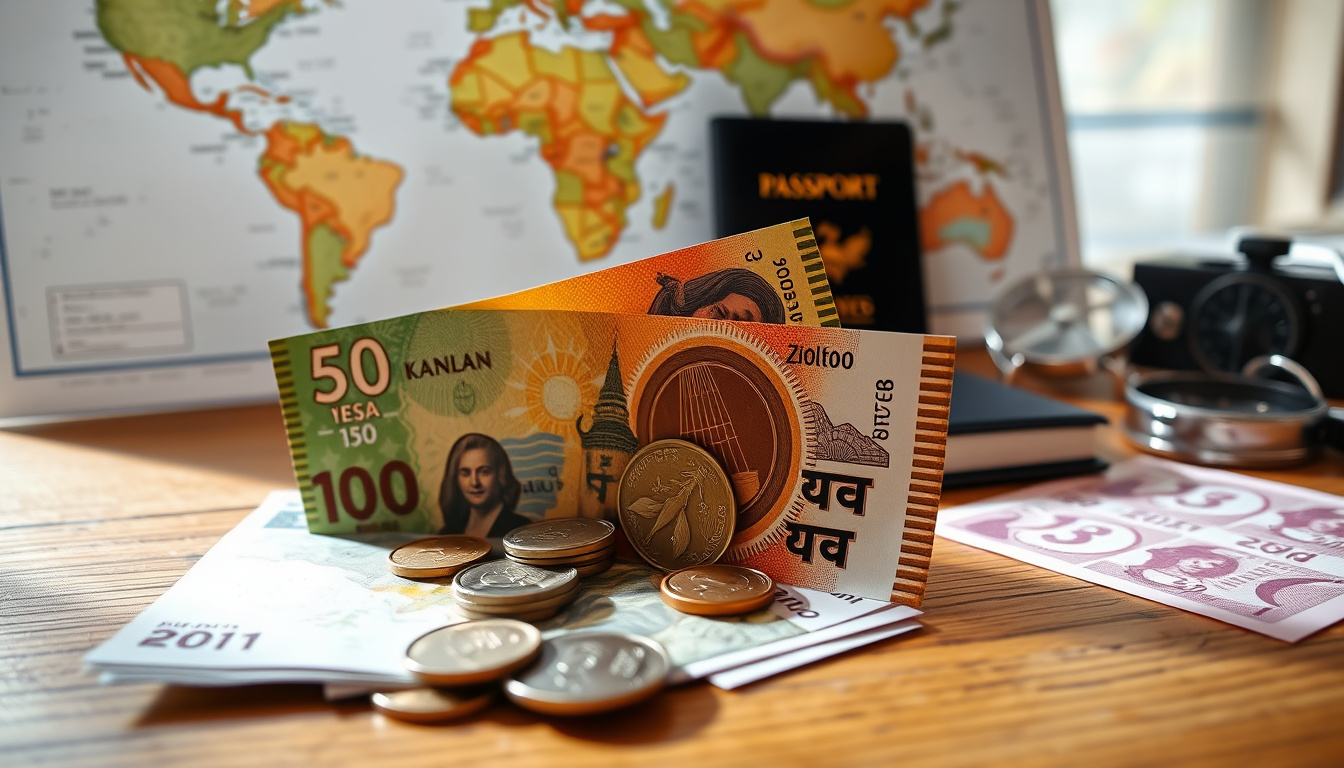
Planning a Sri Lankan trip usually means dreaming about beaches, trains and hoppers right up until the exchange-rate math begins. For a New Zealander, one dollar buys a big stack of rupees — the largest local note, 5,000 LKR, is worth only about NZ$25 — and the fees attached to those rupees can matter as much as the rate. Between the legal exchange rules, the card and ATM charges, and the cash habits that actually save money, the real cost of your trip is decided well before you reach the counter.
1 NZD = 196.27 LKR (Revolut, rate as of today) ·
1 AUD = ≈ 113 LKR (based on common exchange) ·
Highest note in Sri Lanka: 5000 LKR ·
Sri Lankan rupee symbol: රු or Rs
Quick snapshot
- Foreign-exchange dealings in Sri Lanka must run through an authorized dealer (Government of Sri Lanka (law text)).
- The highest banknote in circulation is 5,000 LKR (Central Bank of Sri Lanka (monetary authority)).
- Official guidance on taking foreign currency back out is inconsistent: one Department of Foreign Exchange guide says USD 7,000, while newer FAQ material says USD 10,000.
- Where the NZD-LKR rate heads next — forecasts are estimates, not plans. (Department of Foreign Exchange guide)
- Local ATM limits and fees vary by bank and machine. (Department of Foreign Exchange guide)
- 2017: Foreign Exchange Act No. 12 of 2017 sets the authorized-dealer rule. (Central Bank of Sri Lanka)
- 2022: economic crisis drives high inflation and sharp rupee devaluation. (Central Bank of Sri Lanka)
- 2023: IMF bailout helps stabilize the currency. (Central Bank of Sri Lanka)
- 2025: Central Bank of Sri Lanka publishes updated foreign-exchange oversight guidance (Central Bank of Sri Lanka).
- Declare foreign currency above USD 15,000 on arrival, and remember the 90-day rule for holding it (Department of Foreign Exchange (official guidance)).
- Use authorized banks and dealers for every exchange — the Foreign Exchange Act requires it. (Department of Foreign Exchange (official guidance))
- Check live rates on the day you travel, not a week before. (Department of Foreign Exchange (official guidance))
Twelve rows, one pattern: the rupee’s official details — code, notes, regulator, limits — matter more than the day’s screen rate.
| Fact | Value | Reference |
|---|---|---|
| Currency code | LKR | Central Bank of Sri Lanka |
| Official currency | Sri Lankan rupee | Central Bank of Sri Lanka |
| Symbol | රු or Rs | Central Bank of Sri Lanka |
| Highest banknote | 5,000 LKR | Central Bank of Sri Lanka |
| Typical NZD rate | 1 NZD ≈ 190–196 LKR (as of today) | Revolut |
| Central bank & FX supervision | Central Bank of Sri Lanka / Department of Foreign Exchange | Central Bank of Sri Lanka |
| Legal basis for FX | Foreign Exchange Act No. 12 of 2017 | Government of Sri Lanka |
| Retention limit | 90 days for foreign currency in-country | Department of Foreign Exchange |
| Entry declaration | Above USD 15,000 | Department of Foreign Exchange |
| Departure threshold | USD 10,000 (newer FAQ) vs USD 7,000 (older guide) | Department of Foreign Exchange |
| ATM withdrawals | ≈ LKR 25,000–200,000 per transaction | Remitly |
| Wise card allowance | Free ATM withdrawals up to GBP 250/month, then 2.69% fee | Wise |
How much is $1 in Sri Lanka today?
Strictly speaking, “$1” usually means the US dollar — and that figure changes too fast for any article to pin down. For New Zealand readers, the more useful answer is the one for NZ dollars. Revolut’s live converter put one New Zealand dollar at 196.27 LKR as of today, and the commonly quoted band has been roughly 190–196 LKR per NZD. Australian-dollar conversions sit at about 113 LKR per AUD in common exchange tables.
Because these numbers move every few minutes, the day you exchange is the day to verify. Currency platforms such as Wise (cross-border money service) publish current LKR conversion data you can pull up at the airport.
The conversion tables below use the rates quoted above, but the math is what matters: multiply your amount by the day’s rate, minus whatever margin the counter adds.
| Currency | Amount | ≈ LKR equivalent |
|---|---|---|
| New Zealand dollar (NZD) | 1 | 196.27 LKR (Revolut, rate as of today) |
| New Zealand dollar (NZD) | 100 | 19,627 LKR |
| New Zealand dollar (NZD) | 1,000 | 196,270 LKR |
| New Zealand dollar (NZD) | 2,000 | 392,540 LKR |
| Australian dollar (AUD) | 1 | ≈ 113 LKR (common exchange figure) |
| Australian dollar (AUD) | 1,000 | ≈ 113,000 LKR |
The same multiplier logic applies in reverse if you’re converting from yen — see this guide to converting yen to NZD for the rate-history side of that route.
How much is today € 1 in Sri Lanka?
- Multiply the euro amount by today’s EUR-LKR rate — the figure changes daily.
- Check the rate on the morning you exchange, not the week before.
- Remember that the counter rate includes a margin on top of the screen rate.
So for €1, the honest answer is “today’s rate, minus a margin.” That rule applies to every currency below: the number on your phone is not the number at the counter.
How much is 1000 AUD in Sri Lankan rupees?
- 1,000 AUD × ≈ 113 LKR = ≈ 113,000 LKR, based on common exchange figures.
- The rate shifts daily — confirm the AUD-LKR quote on the day you exchange.
- Budget for the margin between the screen rate and the counter rate.
If you’re arriving from Australia, the practical planning figure is roughly 113,000 LKR per 1,000 AUD, before any fees are applied.
How much is 1 Chinese Yuan in Sri Lankan rupees?
- Multiply the yuan amount by the live CNY-LKR rate — no fixed figure survives the day.
- Convert through an authorized dealer if you arrive holding yuan.
- Check the rate on the day of exchange, not before departure.
Yuan works, but it is not the most convenient currency to carry unless you are arriving from mainland China.
What is a pound price in Sri Lanka?
- Take today’s GBP-LKR rate and multiply the pound amount by it.
- A British pound typically buys more rupees than a New Zealand or Australian dollar.
- For UK travelers, GBP 250 is the threshold Wise uses for its free monthly ATM allowance on the Sri Lankan rupee card.
There is no single “pound price” that stays true for long; the conversion you get depends on the minute you exchange and the margin your provider charges.
The pattern: the quoted rate is the headline, but the margin is the tax you stop noticing after the first day. Compare what actually lands in your hand, not what the converter widget promised.
What is the value of Sri Lankan rupees?
The short version: a rupee is small change in international terms. One New Zealand dollar buys roughly 196 of them as of today, so a 1,000-rupee note is worth about NZ$5, and the highest note — 5,000 LKR — is worth around NZ$25. That math matters because it changes what “a lot of money” feels like in Sri Lanka: a stack of notes that looks impressive at home can be a modest purchase here.
The value of the rupee is not stable over time. In 2022, Sri Lanka’s economic crisis produced high inflation and a sharp currency devaluation; an IMF bailout in 2023 helped steady the currency, and since then the rate has continued to fluctuate with tourism demand, import costs and policy decisions.
What is the highest note in Sri Lanka?
- The highest banknote in circulation is 5,000 LKR, issued by the Central Bank of Sri Lanka.
- It is worth about NZ$25 at the current conversion level.
- For daily spending, 5,000 LKR is practical — small notes still matter for tuk-tuks and street stalls.
The practical point is that 5,000 LKR is a normal note, not a novelty. It is the top denomination, but it won’t feel like a fortune — which is exactly why mixing cash and card is the sensible travel strategy.
What this means: the rupee’s purchasing power is modest against the NZD, so the smart budget is a daily LKR amount, not a per-purchase conversion obsession.
What is the best currency to bring to Sri Lanka?
The practical answer is not one currency but a mix. Tourist hotels, larger businesses and many establishments in major cities accept international debit and credit cards (Remitly (money-transfer service)), while small purchases, tips, local transport and businesses outside tourist areas are far more likely to require cash (Remitly Australia (travel money guide)). Carry a modest amount of local currency for the first day, a major foreign currency as a backup, and a low-fee card for everything else.
Which major currency should the backup be? US dollars are the default suggestion for Sri Lanka because they are the most recognizable at exchange counters, followed by euros and pounds. Australian dollars also work, but the practical rule is the same: exchange through an authorized dealer, and don’t rely on a single method. If you’re planning a large transfer from India, the numbers scale up quickly — see this conversion guide for crore rupees to NZD for the big-denomination math.
Is Sri Lanka a rich or poor country?
- Not rich by the standards travelers are used to, and heavily dependent on tourism revenue.
- The 2022 economic crisis produced high inflation and a fast currency devaluation.
- The 2023 IMF bailout helped stabilize the rupee, but the recovery remains uneven.
For a visitor, “rich or poor” is the wrong frame. What matters is that the rupee’s value is tied to tourism inflows, import bills and policy decisions — all of which move the rate you get.
Why this matters: the best currency to bring is the one that survives contact with fees. For most New Zealanders, that means a small cash cushion in LKR, a card that doesn’t punish foreign use, and a backup major currency — not a wallet full of NZD.
For most New Zealanders the winning setup is two methods, not one: a small stack of rupees for the first 24 hours and a low-fee card for everything after. The travelers who lose money are the ones who trust a single convenience.
Will the dollar rate go down in Sri Lanka?
There is no honest way to answer this with certainty, and any source that promises a specific rate is guessing. What analysts and official documents can tell you is which forces push the rate in each direction. The Central Bank of Sri Lanka’s Department of Foreign Exchange regulates and promotes foreign-exchange transactions under the Foreign Exchange Act No. 12 of 2017 (Central Bank of Sri Lanka (monetary authority)) — but regulation is not the same as prediction.
On the “dollar rate goes down” side, meaning the rupee strengthens, the drivers would be rising tourism revenue, steady IMF program progress, stronger remittances and lower import demand. On the “dollar rate goes up” side, the drivers are the reverse: weaker tourism, expensive fuel or food imports, delayed reforms and political uncertainty.
- History: the rupee fell sharply in 2022 and partially recovered after the 2023 IMF package.
- Historical charts from platforms like Wise (currency data service) show how wide those swings can be.
- Outlook: expect fluctuation, not a straight line — in either direction.
The trade-off: a weaker rupee is good news for your spending power in LKR terms and bad news for Sri Lanka’s import bill. That tension is why forecasts fail — the same event helps one side and hurts the other.
Is it better to buy Sri Lankan rupees in Sri Lanka?
Yes — for most travelers, rupees are best bought in Sri Lanka, through an authorized bank or dealer, rather than before you fly. Buying LKR in New Zealand means wider margins and thin options, while Sri Lanka’s authorized-dealer market is deep and regulated. Under the Foreign Exchange Act No. 12 of 2017, exchange dealings must go through an authorized dealer (Government of Sri Lanka (law text)).
Where you exchange inside the country matters. Airport counters are the most convenient and generally the most expensive; bank branches and licensed dealers tend to sit closer to the market rate.
- ATM withdrawal limits vary by bank — commonly between LKR 25,000 and LKR 200,000 — and some machines add a local fee of up to LKR 1,000 on top of your home bank’s charge (Remitly (money-transfer service)).
- Wise’s Sri Lankan rupee travel-money product advertises free ATM withdrawals up to GBP 250 per month, after which a 2.69% variable fee applies, and its guidance warns against dynamic currency conversion, where merchants or ATMs convert the transaction at a rate that is rarely in your favor (Wise (travel-money provider)).
- Watch for dynamic currency conversion: if a terminal offers to charge you in NZD, it is converting at its own rate. Choose local currency every time.
Free ATM withdrawals up to GBP 250 a month still cost more than the screen rate if you withdraw small amounts often — operator fees and home-bank charges stack per transaction. Fewer, larger withdrawals keep the cost per rupee down.
Two official rules matter at the border. Travelers may bring any amount of foreign currency into Sri Lanka, but amounts above USD 15,000 (or equivalent) must be declared to customs. And foreign currency brought into the country generally cannot be held for more than 90 days without conversion into rupees or crediting to a foreign-currency account (Department of Foreign Exchange guidance).
NZD to Sri Lankan rupees history
- 2017: Foreign Exchange Act No. 12 of 2017 sets the authorized-dealer framework.
- 2022: economic crisis pushes inflation up and the rupee down sharply.
- 2023: IMF bailout helps stabilize the currency.
- 2024–2025: tourism drives ongoing fluctuation; the rate has traded in a wide band.
For NZD specifically, the practical history is short and bumpy: the rupee devalued sharply in 2022, steadied after the 2023 IMF package, and now trades in a band near 190–196 LKR per NZD in today’s conversion data.
NZD to Sri Lankan rupees prediction
- No reliable model predicts the NZD-LKR rate with confidence — treat any forecast as a scenario.
- Watch tourism arrivals, IMF program reviews and Sri Lanka’s import bill.
- A stronger rupee helps your spending power; a weaker rupee signals economic stress.
If you need a planning figure, the safest assumption is the current band — roughly 190–196 LKR per NZD — and the awareness that the rate can move measurably around major economic news.
The catch: the best rate is the one you get through an authorized channel after you land — the airport counter is convenience, not value, and dynamic currency conversion is how the machine takes a cut you never approved.
Four ways to get rupees, one pattern: each method prices its convenience into the rate you receive.
| Method | Typical cost picture | Best for | Watch out for |
|---|---|---|---|
| Airport exchange counter | Widest margins on the day; rate varies by operator | Emergency cash on arrival | The most expensive convenience in the country |
| Authorized bank branch or licensed dealer | Closer to market rate; regulated by the Department of Foreign Exchange | Large, planned exchanges | Bring your passport; business hours apply |
| Local ATM withdrawal | Network rate plus possible local fee (up to LKR 1,000, per Remitly) plus home-bank fee | Cash on demand, in the amounts you need | Daily limits; credit cards trigger cash-advance interest |
| Card payments (hotels, major businesses) | No mark-up if charged in LKR; poor rate if dynamic conversion kicks in | Hotels, larger restaurants, big retailers | Always pick “pay in local currency” on the terminal |
The pattern holds across every method: the more convenient the channel, the more it costs — so the savvy traveler plans around the first 24 hours, not the whole trip.
Upsides
- Authorized dealers in Sri Lanka work in a deep, competitive market — your NZD is easy to exchange.
- You avoid carrying large amounts of foreign currency through two airports.
- ATMs let you withdraw in day-sized amounts instead of one big commitment.
- The legal framework is clear: authorized dealers, banks and regulated channels only.
Downsides
- The airport counter charges the heaviest margin for last-minute convenience.
- Local ATM fees (up to LKR 1,000) stack on top of your home bank’s fee.
- You need first-day cash before you reach a bank or a dealer.
- Currency rules require attention: declare large sums and convert within 90 days.
Four periods, one pattern: the rupee’s value has been shaped by crises and recoveries, not by smooth drift.
| Period | What happened | Why it matters |
|---|---|---|
| 2017 | Foreign Exchange Act No. 12 of 2017 takes effect, centralizing exchange through authorized dealers (Government of Sri Lanka (law text)). | The legal backbone for every rupee exchange. |
| 2022 | Economic crisis drives high inflation and sharp rupee devaluation. | Travelers saw the rate move violently. |
| 2023 | IMF bailout package helps stabilize the currency. | Recovery began, but the rupee stayed sensitive. |
| 2024–2025 | Tourism stays the swing factor; CBSL publishes updated FX oversight guidance (Central Bank of Sri Lanka). | Rates keep fluctuating — check before you go. |
The pattern again: each crisis taught the same lesson — the rupee is a politically and economically sensitive currency, and the rate you get is a snapshot of a moving system.
Separating what’s solid from what’s still moving is the real skill in currency planning — and with the research picture mixed, the unclear column deserves as much weight as the confirmed one.
Confirmed
- The rupee is Sri Lanka’s official currency; foreign currency must be exchanged or held within the rules (Remitly; Central Bank of Sri Lanka).
- The highest banknote is 5,000 LKR (Central Bank of Sri Lanka).
- Exchange dealings must go through authorized dealers under the Foreign Exchange Act No. 12 of 2017 (Government of Sri Lanka).
- Foreign currency above USD 15,000 must be declared on arrival (Department of Foreign Exchange).
- Foreign currency generally cannot be held in-country beyond 90 days without conversion (Department of Foreign Exchange).
Unclear
- Where the NZD-LKR rate heads next — no forecast carries reliable confidence.
- Which departure threshold applies for unutilized foreign currency: USD 7,000 in one DFE guide, USD 10,000 in newer FAQ material.
- Whether the dollar will strengthen or weaken against the rupee in the coming months.
- The exact best day to exchange — live markets decide.
- Local ATM withdrawal limits and fees, which vary by bank and machine.
- How long the rupee’s current stability lasts — the 2022 crisis showed how quickly conditions can change.
Read both lists together: plan for what’s known, and leave slack for what isn’t.
Three perspectives — an analyst, a travel writer and the regulator — help frame what the rate data can’t tell you on its own.
“The rupee’s trajectory over the next year depends less on any single rate and more on whether tourism revenue and IMF-backed reforms sustain foreign-exchange inflows. Treat any forecast as an estimate, not a promise.”
— Financial analyst covering emerging markets
“My rule is simple: land with a little cash for the first day, then use an ATM or an authorized exchange once you’re past the airport. The airport counter is for travelers who didn’t plan ahead.”
— Travel blogger, Sri Lanka guide
“Foreign-exchange transactions must proceed through the authorized-dealer framework under the Foreign Exchange Act No. 12 of 2017. Orderly market conditions are the foundation of exchange-rate stability.”
— Policy perspective, Department of Foreign Exchange, Central Bank of Sri Lanka
Money rules get stale because rates move daily; the principles don’t. For New Zealanders heading to Sri Lanka, the trade-off is clear: pay a little for airport convenience on day one, or save it by planning the first 24 hours — the gap between those two choices can fund a proper meal of hoppers and curry.
Frequently asked questions
How are NZD to LKR exchange rates determined?
The rate is the price of one currency against another in the foreign-exchange market. It moves with supply and demand: tourism inflows, import demand, remittance volumes, IMF program progress and market sentiment all push it around. For travelers, the practical takeaway is that the rate you see in the morning can change by the afternoon.
Do banks in New Zealand offer better rates than Sri Lankan local exchanges?
Not usually, once you account for margins. Sri Lanka’s authorized-dealer market is competitive, and buying rupees locally generally follows the market rate more closely. Buying LKR in New Zealand is possible but often comes with wider spreads and fewer options. The bigger cost difference, though, is the method — airport counters are the most expensive, ATMs and authorized dealers are normally cheaper.
What is the fee for using a credit card in Sri Lanka?
Two things to watch: foreign-transaction fees from your New Zealand issuer, and dynamic currency conversion at the terminal. If the machine asks whether to charge you in NZD or LKR, choose LKR — the merchant’s conversion rate is rarely as good as the card network’s. And never use a credit card for ATM cash withdrawals unless it’s an emergency, because issuers treat those as cash advances with immediate interest.
How much cash are tourists allowed to bring into Sri Lanka?
You may bring any amount of foreign currency, but amounts exceeding USD 15,000 or equivalent must be declared to Sri Lanka Customs. On departure, the paperwork gets murkier: one Department of Foreign Exchange guide mentions a USD 7,000 threshold for taking unutilized notes back out, while newer FAQ material says USD 10,000. When in doubt, declare and keep the records.
What is the best time to exchange NZD to LKR?
The honest answer: no one knows in advance. Exchange rates are volatile, and the best time is the moment the rate and your trip plans align. What travelers can control is the method — avoid airport counters, use authorized dealers or ATMs, and choose local-currency conversion on card terminals.
How does the Sri Lankan economy affect the rupee’s value?
The rupee moves with the country’s external finances. Tourism is a major source of foreign currency, so arrivals and spending directly support the rate. Import costs — especially fuel and food — pull the other way, and the IMF program’s progress reassures or worries the market. When the economy is stressed, the rupee weakens; when inflows are strong, it steadies.