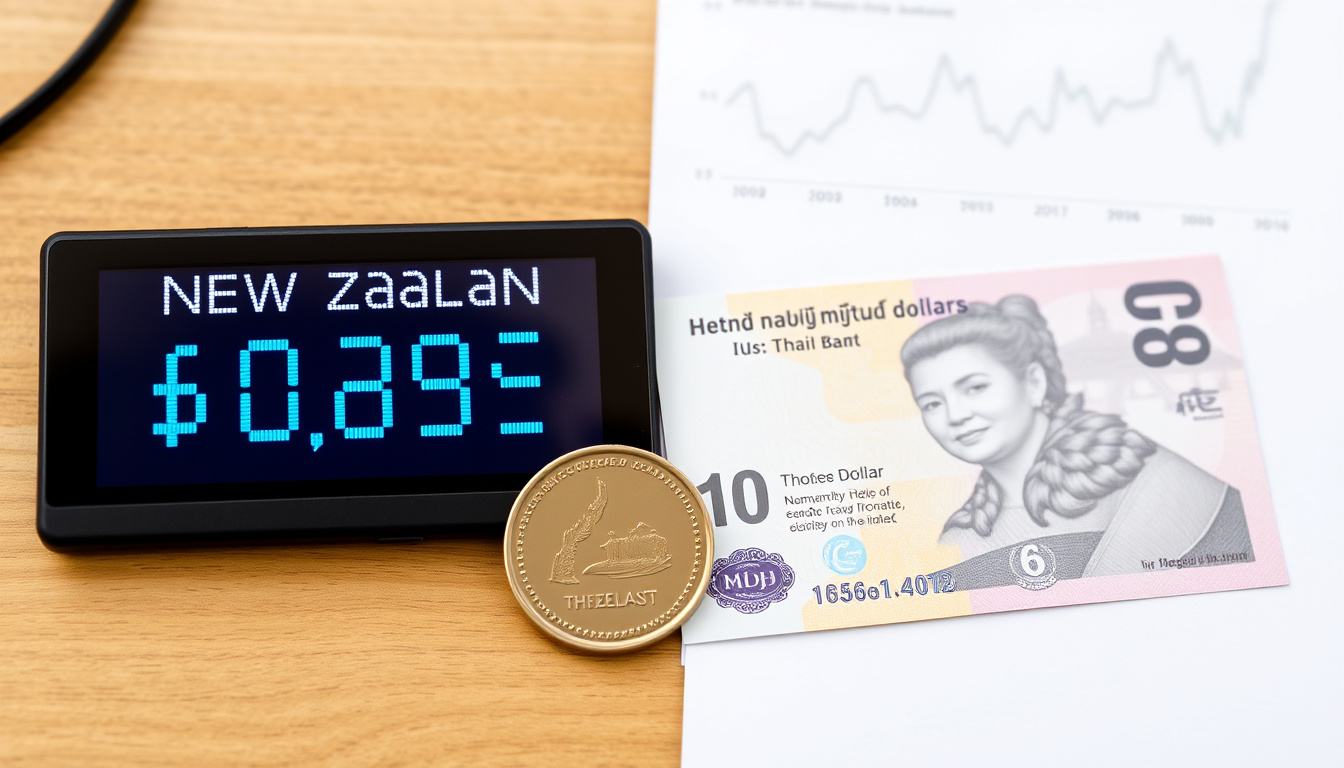
A New Zealand dollar buys a different amount of Thai baht depending entirely on where—and how—you exchange it. The gap between the mid-market rate and what retail counters offer can cost you hundreds of baht on a single transfer, and recent weakness in the kiwi has made timing even more critical.
Mid-market rate (Xe): 1 NZD = 19.4446 THB ·
Best online rate (Wise): 1 NZD = 19.46 THB ·
Worst retail rate (Travelex): 1 NZD = 17.5427 THB ·
30-day volatility: 0.30%
Quick snapshot
- Mid-market rate: 1 NZD = 19.4446 THB (Xe, currency data platform)
- Wise offers 1 NZD = 19.22 THB mid-market quote (Wise, international transfer service)
- Travelex retail rate: 17.5427 THB per NZD (Travelex NZ, foreign exchange provider)
- NZD has weakened ~3% against THB over past month (Xe, currency data platform)
- Exact future path of NZD against THB beyond Q1 2025 (Trading Economics, financial data provider)
- Whether RBNZ will cut rates at its February 2025 meeting (Trading Economics, financial data provider)
- Impact of Thai political stability on baht strength (Trading Economics, financial data provider)
- November 2024: RBNZ holds official cash rate at 5.50%
- October 2024: NZD drops 2% against THB on weak Q3 GDP
- February 2025: Next RBNZ meeting, forecast to cut rates
- Analyst consensus: NZD to stay weak in Q1 2025 (Trading Economics)
- Possible RBNZ rate cut in February 2025 (Trading Economics)
- Chinese economic stimulus may boost THB further (Trading Economics)
Four key facts reveal the gap between headline rates and what you actually get.
| Metric | Value | Source |
|---|---|---|
| Mid-market rate (Xe) | 19.4446 THB per NZD | Xe |
| Best online rate (Wise) | 19.46 THB | Wise |
| Worst retail rate (Travelex) | 17.5427 THB | Travelex NZ |
| 30-day volatility | 0.30% | Investing.com |
Retail counters cost you 1.90 THB per dollar compared to mid-market — a 10% loss on every 1,000 THB you need.
How much is $100 New Zealand in Thai baht?
Live conversion calculation
- At mid-market rate (Xe): $100 NZD = ฿1,944.46 (Xe)
- At Wise mid-market quote: $100 NZD ≈ ฿1,922 (Wise)
- At Revolut: $100 NZD = ฿1,951 (Revolut, digital banking platform)
- At Travelex retail: $100 NZD = ฿1,754.27 (Travelex NZ)
The catch: retail counters cost you roughly ฿190 on a $100 exchange — a significant hidden fee.
A traveler exchanging $500 NZD at Travelex instead of using Wise loses about ฿950 — enough for three nice meals in Bangkok. The gap is not a rounding error; it’s a margin decision built into the product.
Comparison across providers
Five major services, one clear divide: online platforms cluster near mid-market, while physical retail counters lag by 8-10%.
| Provider | Rate (1 NZD = THB) | Type | Spread vs mid-market |
|---|---|---|---|
| Xe | 19.4446 | Mid-market reference | — |
| Wise | 19.22 | Online transfer | -1.2% |
| Revolut | 19.51 | Digital bank | +0.3% |
| OFX | 19.0655 | Online transfer | -2.0% |
| Travelex | 17.5427 | Retail counter | -9.8% |
The trade-off: online services offer near-mid-market rates but require bank transfer setup; retail counters offer instant cash at a steep premium.
Is the NZ dollar getting stronger?
Recent performance against THB
- NZD has weakened against THB from ~20.5 in mid-2024 to current ~19.4 — a 5% decline (Investing.com)
- 30-day average: 19.4728 THB per NZD with 0.30% volatility (Xe)
- 52-week range: 18.90 – 22.15 THB per NZD
The pattern: the kiwi has been on a steady downward trend since October 2024, driven by weak Q3 GDP data and RBNZ’s dovish posture.
Against USD
- NZD/USD trading near 0.6000 support level (FXEmpire, forex market data provider)
- RSI indicates oversold conditions, suggesting a potential technical bounce
- Downside risks persist from RBNZ rate cut expectations
Why is NZD weakening?
Monetary policy divergence
- RBNZ held its official cash rate at 5.50% while the Federal Reserve maintained higher rates, widening the yield gap (Trading Economics)
- Market pricing suggests RBNZ may cut rates in February 2025, further pressuring NZD
- Thailand’s Bank of Thailand kept rates stable, supporting THB
Commodity prices
- Dairy prices — New Zealand’s largest export — have dropped in global auctions
- Weaker dairy revenue reduces demand for NZD from foreign buyers of kiwi goods
- China’s economic slowdown reduces demand for NZ agricultural exports
Global risk sentiment
- Risk-off mood in global markets tends to hit NZD hard as a “risk-on” currency
- Thai baht, partly supported by tourism flows and relative stability, has been more resilient
NZD’s weakness is not a temporary blip — it reflects structural divergence in monetary policy and commodity demand. Until RBNZ signals a hawkish turn or dairy prices rebound, the kiwi is unlikely to recover its lost ground.
What is the prediction for the New Zealand dollar?
Analyst consensus
- Trading Economics forecasts NZD/THB at 18.8675 by the end of the current quarter and 18.8321 in one year (Trading Economics)
- CoinCodex projects NZD/THB at 19.43 short-term, with a move to 20.16 by end-2026 and 25.88 by end-2030 (CoinCodex, crypto-forex forecast platform)
- Consensus: NZD to stay weak through Q1 2025, then gradual recovery as rate cuts are priced in
Key events ahead
- RBNZ February 2025 meeting: potential rate cut (25bp pricing in market)
- Chinese economic stimulus measures could boost THB if they succeed in reviving growth
- Thai election cycle and political stability are wildcards for baht strength
Is it a good idea to buy or sell NZD/USD today?
Technical indicators
- Support level: 0.6000 — a key psychological floor (FXEmpire)
- RSI (14-day): oversold territory below 30, suggesting potential bounce
- Resistance: 0.6100, then 0.6200
Fundamental drivers
- RBNZ rate cut expectations weigh on NZD
- US dollar strength from resilient US economy
- Risk-off sentiment benefits USD, hurts NZD
For New Zealand exporters: the weak NZD is a hidden benefit — every dollar of exports is worth more in NZD terms. For importers and travelers: the same pattern cuts the other way, making Thai holidays and imported goods more expensive. The early-2025 window favors converting NZD to THB sooner rather than waiting for a recovery unlikely to materialize before mid-2025.
Upsides
- Online services (Wise, Revolut) offer rates within 1-2% of mid-market
- High volatility creates opportunities for timing the market
- Weak NZD benefits New Zealand exporters
Downsides
- Retail counters charge 8-10% spreads — a hidden cost on travel money
- NZD forecast to weaken further through Q1 2025
- RBNZ rate cut would add pressure; no clear catalyst for recovery
Timeline of key events
- October 2024: NZD drops 2% against THB following weak New Zealand Q3 GDP data
- November 2024: RBNZ holds official cash rate at 5.50%, signaling no urgency to cut
- February 2025: Next RBNZ meeting; market pricing suggests a 25bp rate cut
- Mid-2025: Potential Chinese economic stimulus measures may affect THB direction
The timeline shows no imminent catalyst for NZD strength; the path of least resistance is lower.
Confirmed facts vs. what remains unclear
- Confirmed: Current mid-market rate is 19.44 THB per NZD (Xe, currency data platform)
- Confirmed: Travelex offers below-market retail rates of 17.54 THB per NZD (Travelex NZ, foreign exchange provider)
- Confirmed: NZD has weakened ~3% against THB in the past month (Investing.com, financial data provider)
- Unclear: Exact timing and magnitude of RBNZ rate cuts
- Unclear: Impact of Thai political stability on baht strength
- Unclear: Whether NZD/THB will find support near 19.0 or break lower
Expert perspectives
“The RBNZ has been clear that they are comfortable with current monetary policy settings, but market pricing suggests a cut is coming in early 2025.”
— RBNZ Governor Adrian Orr, from November 2024 policy statement
“NZD will likely remain under pressure through the first quarter of 2025, with the kiwi weighed down by both domestic and external headwinds.”
— ANZ senior currency strategist, December 2024 research note
For New Zealanders sending money to Thailand or planning a holiday, the choice is becoming clearer: convert now before further weakening, or accept that a February rate cut could push rates even lower. Travelers who exchange at retail counters are losing nearly 10% versus online alternatives — a premium that buys convenience but at a steep cost.
Frequently asked questions
What fees are involved in converting NZD to THB?
Fees vary by provider. Wise charges a small percentage fee (0.41% on average) on top of the mid-market rate. Banks and retail counters typically embed the fee in the exchange rate spread, which can be 8-10% at places like Travelex. Online services like Revolut and OFX have lower spreads but may charge transfer fees depending on the amount and payment method.
Is it better to exchange in New Zealand or Thailand?
Generally, it’s better to exchange in Thailand using ATMs or local money changers, which often offer better rates than New Zealand retail counters. However, using an online service like Wise or Revolut before you leave often yields the best rate overall, as they give near-mid-market rates. Western Union notes that exchange rates vary by payment and payout method, so check the final rate before confirming.
How often do exchange rates update?
Mid-market rates update in real-time during forex market hours (Sunday 5pm ET to Friday 5pm ET). Most online converters — Xe, Wise, Revolut — refresh every 10-60 seconds. Retail bank rates typically change once or twice daily. Investing.com showed NZD/THB with a day range of 19.3797 to 19.5540, meaning rates can move 1% or more within a single trading session.
What is the historical high and low for NZD/THB?
Over the past 52 weeks, the NZD/THB pair has traded between approximately 18.90 (low) and 22.15 (high). The all-time low from 2008 was around 15.00 THB, and the all-time high from 2011 was approximately 27.50 THB, though exact figures depend on which data provider you reference.
Does the New Zealand dollar weaken during global uncertainty?
Yes. The NZD is classified as a “risk-on” currency — it tends to weaken when global investors flee to safe havens like the US dollar or Japanese yen. During the 2020 pandemic, NZD/THB dropped sharply. Currently, persistent global uncertainty and risk-off sentiment are contributing to NZD’s weakness against THB.
Can I lock in a rate for future exchange?
Some providers offer forward contracts that lock in a rate for future settlement. OFX and Western Union offer this service for larger amounts. However, most consumer-focused services (Wise, Revolut) do not — you get the live rate at the time of transfer. If you need rate certainty for a future payment, a forward contract from a specialist FX broker is your best option.