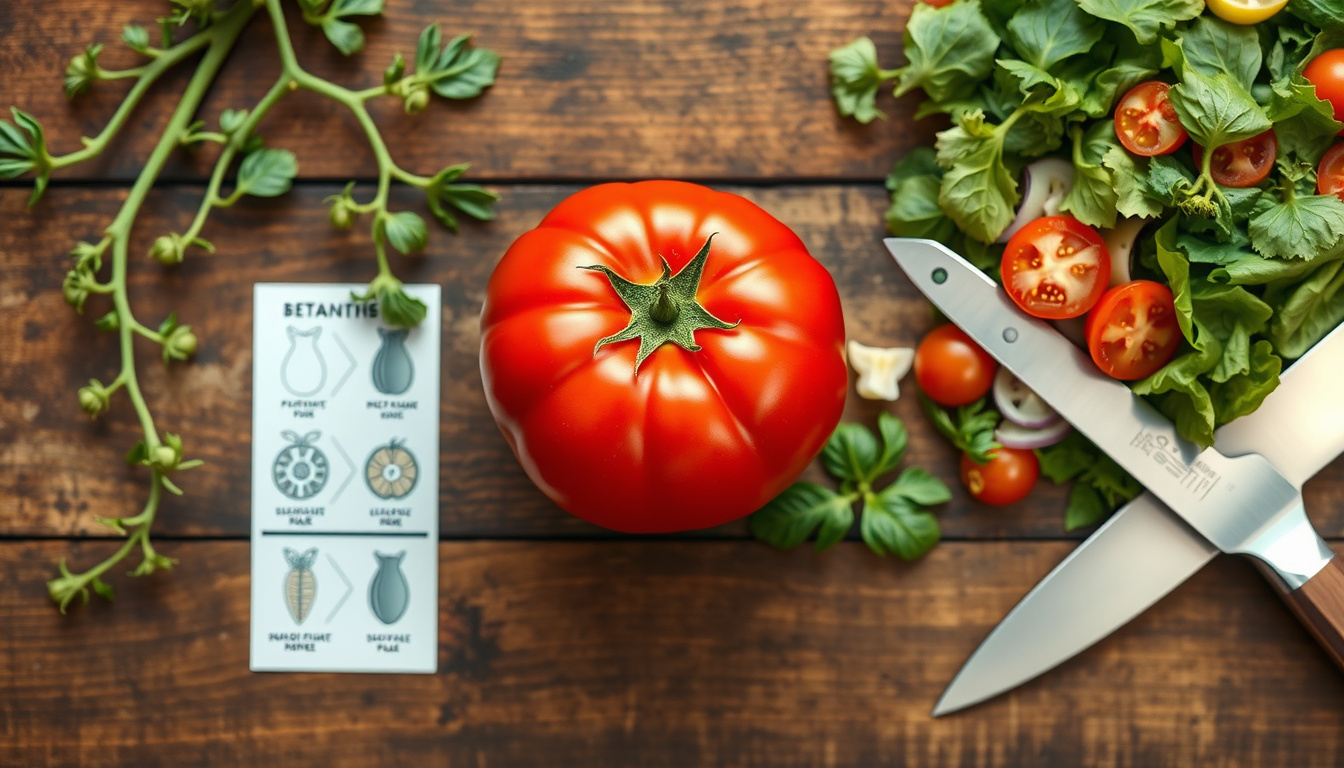
Few food debates have endured quite like the tomato’s identity crisis. Botanically classified as a berry fruit, legally declared a vegetable by the U.S. Supreme Court, and embraced as a savory staple in kitchens worldwide, the tomato occupies a uniquely contested position. Understanding why requires tracing both the science of plant reproduction and the economics of 19th-century trade policy.
The question “is a tomato a fruit or vegetable?” appears simple on the surface, yet it touches on definitions that shift depending on whether you speak with a botanist, a chef, or a customs officer. The answer is not either-or but rather a matter of perspective, and that distinction has shaped everything from import tariffs to dinner plates across the globe.
This article examines the evidence from multiple angles—the botanical classification that places tomatoes squarely in the fruit family, the culinary traditions that call them vegetables, and the landmark legal case that settled the matter for American trade law. The goal is to clarify where consensus exists and where cultural context continues to shape interpretation.
Is a Tomato a Fruit or a Vegetable?
The most direct answer comes from botanical science: the tomato is a fruit. Specifically, it is classified as a berry. However, culinary practice, common language, and legal precedent have all treated tomatoes as vegetables for centuries. This creates a persistent gap between scientific classification and everyday usage that shows no signs of closing.
- Tomatoes develop from the ovary of a flower, containing seeds—meeting the botanical definition of a fruit
- Linnaeus first formally named the species Solanum lycopersicum in 1753, later reclassified but returned to original genus based on genetic evidence
- The same botanical family (Solanaceae) includes potatoes, peppers, and eggplants—all similarly classified
- Twelve or more wild tomato species remain native to the Andes region, found at elevations up to 4,000 meters
- Domesticated by approximately 700 A.D. by Inca peoples in western South America
- Reached Europe in the late 15th to 16th century following Columbus’s voyages
| Attribute | Detail |
|---|---|
| Scientific Name | Solanum lycopersicum |
| Plant Family | Solanaceae (nightshade) |
| Order | Solanales |
| Chromosome Count | 2n=24 (diploid) |
| Origin Region | Western South America (Peru/Ecuador) |
| Domestication Period | Approximately 700 A.D. |
| European Introduction | Late 15th–16th century |
| Legal Classification (U.S.) | Vegetable (1893 Supreme Court) |
| Botanical Classification | Fruit (berry) |
What Is the Botanical Definition of a Fruit?
In botanical terms, a fruit is the mature ovary of a flowering plant, typically containing seeds. This definition encompasses the tomato in its entirety. When the ovary develops and matures—surrounding the seeds that will enable plant reproduction—the resulting structure is classified as a fruit, regardless of its culinary use or common name.
The tomato meets every botanical criterion for fruit classification. It develops from a single ovary, it contains seeds, and it forms from the flower of the plant. These biological facts place the tomato firmly within the fruit category, just as they do for peppers, eggplants, cucumbers, and squashes—all similarly seed-bearing structures that most people consider vegetables.
Why Is a Tomato Considered a Berry?
Within the fruit category, tomatoes receive an unexpected designation: they are berries. This classification stems from the botanical definition of a berry, which differs significantly from common usage. A botanical berry is any fruit that develops from a single ovary, has one or more seeds, and comes from a single flower with one ovary.
The tomato’s flesh develops from the ovary wall, encasing the seeds in a fleshy middle layer—the same structural pattern seen in other botanical berries like grapes and bananas. This contrasts with aggregate fruits (such as raspberries) or accessory fruits (such as apples) that develop from different flower structures.
Many foods called “berries” in everyday language are not botanical berries. Strawberries and raspberries are aggregate fruits. Blueberries are true botanical berries. The tomato’s classification as a berry follows botanical definition rather than culinary or commercial naming conventions.
How Does the Tomato’s Scientific Classification Work?
The tomato belongs to the genus Solanum, placing it alongside potatoes, peppers, and eggplants in the Solanaceae family. Carl Linnaeus originally assigned the name Solanum lycopersicum in 1753, reflecting what he saw as the plant’s relationship to other nightshade species. In 1768, another botanist proposed reclassifying it as Lycopersicon esculentum, treating it as a distinct genus.
Genetic research eventually resolved this taxonomic question, confirming that the tomato’s evolutionary relationships align it more closely with other Solanum species than to warrant separate genus status. The original Linnaean classification returned, establishing Solanum lycopersicum as the accepted scientific name that remains in use today.
Why Are Tomatoes Treated as Vegetables in Cooking?
Culinary classification operates on entirely different principles than botanical taxonomy. Where science focuses on plant reproduction, cooking groups ingredients by flavor profile, traditional usage, and how they interact with other foods in a dish. By these measures, tomatoes behave like vegetables regardless of their biological origin.
The fundamental distinction in most kitchens separates sweet fruits from savory vegetables. Tomatoes possess a savory, often acidic flavor that complements savory dishes rather than sweet ones. They appear in main courses, soups, sauces, and salads—not in desserts or breakfast pastries alongside fruits like berries or citrus.
What Defines a Vegetable Culinarily?
Culinary vegetables are typically characterized by their savory flavor profiles, their use in main dishes rather than desserts, and their combination with proteins and starches rather than sugars or dairy. They often have lower sugar content than fruits and contribute texture, body, and seasoning to savory preparations.
Tomatoes score highly on these vegetable criteria. Their low sugar content, high acidity, and ability to provide body to savory sauces and soups align them functionally with other culinary vegetables. Whether sliced into salads, simmered into pasta sauce, or roasted alongside meats, tomatoes fulfill the savory role expected of vegetables rather than the sweet role expected of fruits.
The way foods are prepared and served influences how people categorize them. Tomatoes cooked into a Bolognese sauce feel vegetable-like, while tomato jam or preserves feel fruit-like. Context determines perception even when the underlying ingredient remains the same.
What Was the Supreme Court Ruling on Tomatoes?
The legal dimension of the tomato debate emerged in 1893 when the U.S. Supreme Court addressed the question directly in Nix v. Hedden. This case arose from a customs dispute over import tariffs that differentiated between fruits and vegetables. An importer named Edward L. Nix challenged the classification of tomatoes as vegetables, arguing they should be taxed as fruits at a lower rate.
The case reached the Supreme Court in 1893, requiring the justices to determine whether tomatoes should be classified as fruits or vegetables for customs purposes. The botanical definition clearly favored Nix’s argument—tomatoes are fruits by any scientific standard. However, the Court took a different approach.
In the ruling, Justice Horace Gray acknowledged the botanical accuracy of Nix’s position but ultimately rejected it for legal purposes. The Court’s reasoning centered on common usage and trade practice rather than botanical classification. The opinion stated that for purposes of the tariff act, tomatoes were vegetables because they were commonly served at dinner rather than as desserts.
This ruling, grounded in the principle that botanical definitions need not govern commerce, established the legal framework that continues to influence how tomatoes are categorized in American trade and food regulation. The decision reflects the gap between scientific precision and legal practicality that persists in how we discuss and regulate food.
Other Fruits Commonly Used as Vegetables
The tomato is far from alone in occupying the ambiguous space between fruit and vegetable. Several other common foods share this dual identity, technically fruits by botanical definition while functioning as vegetables in culinary practice.
Bell peppers and chili peppers develop from flowers and contain seeds, making them fruits in botanical terms. Yet in kitchens worldwide, they are treated as vegetables—sliced into stir-fries, stuffed as main dishes, and incorporated into savory preparations where their savory, sometimes spicy flavor complements savory dishes.
Eggplants similarly qualify as fruits while being used as vegetables in virtually every culinary tradition that employs them. Their flesh is seed-bearing, but their savory, often meaty texture and flavor profile place them squarely in the vegetable category for cooking purposes. Cucumbers and squashes follow the same pattern, fruits botanically but vegetables in the kitchen.
All of these foods share one defining feature: they develop from the ovary of a flower and contain seeds. This single criterion determines their botanical classification as fruits, regardless of how they are used or perceived in culinary or commercial contexts.
A Timeline of the Tomato’s Journey and Classification
The tomato’s path from wild South American plant to global culinary staple spans thousands of years, with its classification as fruit or vegetable evolving alongside changing scientific understanding and cultural practices. The following timeline traces key moments in this history. The tomato’s classification as fruit or vegetable has evolved over thousands of years, a journey detailed in this article John 3.
- Approximately 700 A.D. — Indigenous peoples in what is now Peru and Ecuador domesticate wild tomato species, beginning cultivation as a food crop.
- Pre-Columbian era — Tomato cultivation spreads through Mesoamerica, with various indigenous cultures developing multiple varieties.
- Late 15th–16th century — Spanish explorers introduce tomatoes to Europe following Columbus’s voyages, marking the beginning of global spread.
- Early European period — Europeans initially distrust tomatoes, calling them “wolf peaches” (from lycopersicum) due to perceived toxicity from their nightshade family connections.
- 18th century — Tomato cultivation gradually increases in Europe as cooking applications expand and poison fears subside.
- 1753 — Carl Linnaeus formally names the species Solanum lycopersicum, establishing the original botanical classification.
- 1768 — Botanist Philip Miller proposes reclassifying the tomato as Lycopersicon esculentum, creating a separate genus designation.
- 1893 — The U.S. Supreme Court rules in Nix v. Hedden that tomatoes are legally vegetables for customs and trade purposes.
- Modern era — Genetic research confirms the tomato belongs in the Solanum genus alongside potatoes and peppers, resolving the 18th-century taxonomic dispute.
What Is Established Versus What Remains Uncertain
The tomato classification debate benefits from substantial factual grounding, though some aspects remain more settled than others. Understanding where scientific consensus ends and cultural interpretation begins helps clarify the nature of ongoing debates.
| Established Information | Context-Dependent or Uncertain |
|---|---|
| Botanically, tomatoes are fruits—specifically berries—developing from flower ovaries with seeds | Culinary classification varies by cuisine; some traditions incorporate tomatoes more like fruits in sweet preparations |
| The scientific name Solanum lycopersicum and family Solanaceae classification are universally accepted | Consumer perception continues to favor vegetable classification in most English-speaking countries |
| The 1893 Nix v. Hedden ruling legally classified tomatoes as vegetables for U.S. trade purposes | Regulatory approaches in other countries may differ from the U.S. legal precedent |
| Tomatoes originated in western South America, domesticated by approximately 700 A.D. | Specific routes of early trade and dissemination remain subject to ongoing historical research |
| Tomatoes are diploid with 24 chromosomes and self-fertilizing yellow flowers | Precise nutritional comparisons to other “vegetables” lack comprehensive peer-reviewed studies |
The Broader Context: Why Does This Classification Matter?
The tomato classification debate illuminates broader questions about how categories shape our understanding of the natural world. Science, law, commerce, and culture each impose their own categorical systems on shared objects, and these systems do not always align. The tomato serves as a convenient focal point precisely because it triggers conflict across all these domains.
From a scientific perspective, precise classification matters for understanding evolutionary relationships, reproductive biology, and genetic connections. The tomato’s placement within Solanaceae alongside potatoes, peppers, and eggplants reveals evolutionary relationships that inform research ranging from pest resistance to nutrition.
From a legal and commercial perspective, classification determines regulatory treatment, tariff rates, and marketing categories. The 1893 Supreme Court ruling emerged specifically from trade economics—determining whether tomato imports faced vegetable tariffs of 10 to 20 percent or lower fruit rates. Such economic stakes ensure that classification questions rarely remain purely academic.
Culinary classification influences how home cooks and professional chefs approach ingredient selection, flavor pairing, and recipe development. The widespread acceptance of tomatoes as vegetables reflects centuries of culinary tradition that treats them as savory ingredients rather than sweet ones, a usage pattern that shows no signs of changing despite botanical clarification.
Sources and Expert Perspectives on Tomato Classification
Multiple authoritative sources converge on the botanical facts while allowing room for cultural interpretation on culinary and legal matters. The scientific consensus regarding botanical classification rests on research from academic botanical sources, government agricultural departments, and peer-reviewed taxonomic studies.
“Botanically, a fruit is the mature ovary of a flowering plant, usually containing seeds. The tomato fits this definition perfectly—it develops from the ovary, contains seeds, and comes from a flowering plant.”
— Canadian Food Inspection Agency biological documentation
“For customs purposes, tomatoes must be regarded as vegetables, being used as vegetables, and usually grouped with vegetables in the United States.”
— Justice Horace Gray, Nix v. Hedden opinion, 1893
Primary sources include the original taxonomic literature from Linnaeus, the U.S. Supreme Court opinion in Nix v. Hedden, and contemporary botanical research confirming the Solanum classification. These sources establish the factual foundation while acknowledging that culinary and legal frameworks operate according to different principles than botanical science.
Summary: Understanding the Tomato’s Dual Identity
The tomato is both a fruit and a vegetable, depending on which framework you apply. Botanically, there is no ambiguity—tomatoes are fruits, specifically berries, developing from flower ovaries with seed-bearing structures. This scientific classification has been confirmed through modern genetic research and is accepted universally in botanical literature.
Yet culinary tradition, common language, and legal precedent have all treated tomatoes as vegetables for centuries. This reflects the practical reality that tomatoes function as vegetables in kitchens worldwide, appearing in savory dishes, main courses, and side preparations rather than in desserts or sweet courses. The 1893 Supreme Court ruling formalized this practical reality for American trade law, establishing a legal framework that continues to influence how tomatoes are regulated and discussed.
Both classifications are valid within their respective contexts. Acknowledging this dual identity rather than insisting on a single answer reflects the genuine complexity of the question. For more high protein lunch ideas that incorporate this versatile ingredient, explore related resources on the platform.
Frequently Asked Questions
What is the botanical definition of a fruit?
In botanical science, a fruit is the mature ovary of a flowering plant, typically containing seeds. This definition encompasses any seed-bearing structure developing from flower ovaries, including tomatoes, peppers, and eggplants.
Is a tomato a berry?
Yes, botanically speaking, tomatoes are classified as berries. This reflects the botanical definition of berry as a fruit developing from a single ovary with one or more seeds, not the common commercial usage of the term.
Why did the Supreme Court rule tomatoes were vegetables?
The 1893 Nix v. Hedden ruling prioritized common trade usage and practical categorization over botanical accuracy. The Court determined that tomatoes were vegetables for customs purposes because they were typically served at dinner rather than as desserts.
What other foods are technically fruits but used as vegetables?
Several foods share this dual classification, including peppers, eggplants, cucumbers, squashes, and pumpkins. All develop from flower ovaries and contain seeds, meeting the botanical definition of fruit while functioning as savory vegetables in cooking.
When did tomatoes arrive in Europe?
Tomatoes reached Europe in the late 15th to 16th century, following Columbus’s voyages that established contact between the Americas and European markets. Their spread was initially slow due to concerns about potential toxicity related to their nightshade family connections.
Where did tomatoes originally come from?
Tomatoes originated in western South America, most likely in the regions now comprising Peru and Ecuador. Wild relatives like Solanum pimpinellifolium provided the domesticates that indigenous peoples cultivated beginning around 700 A.D.
Are there nutritional differences between tomatoes as fruits versus vegetables?
Nutritional content remains constant regardless of classification. Tomatoes provide vitamins C and A, potassium, and lycopene—an antioxidant associated with various health benefits. These nutritional properties are inherent to the food itself and do not change based on how it is categorized.