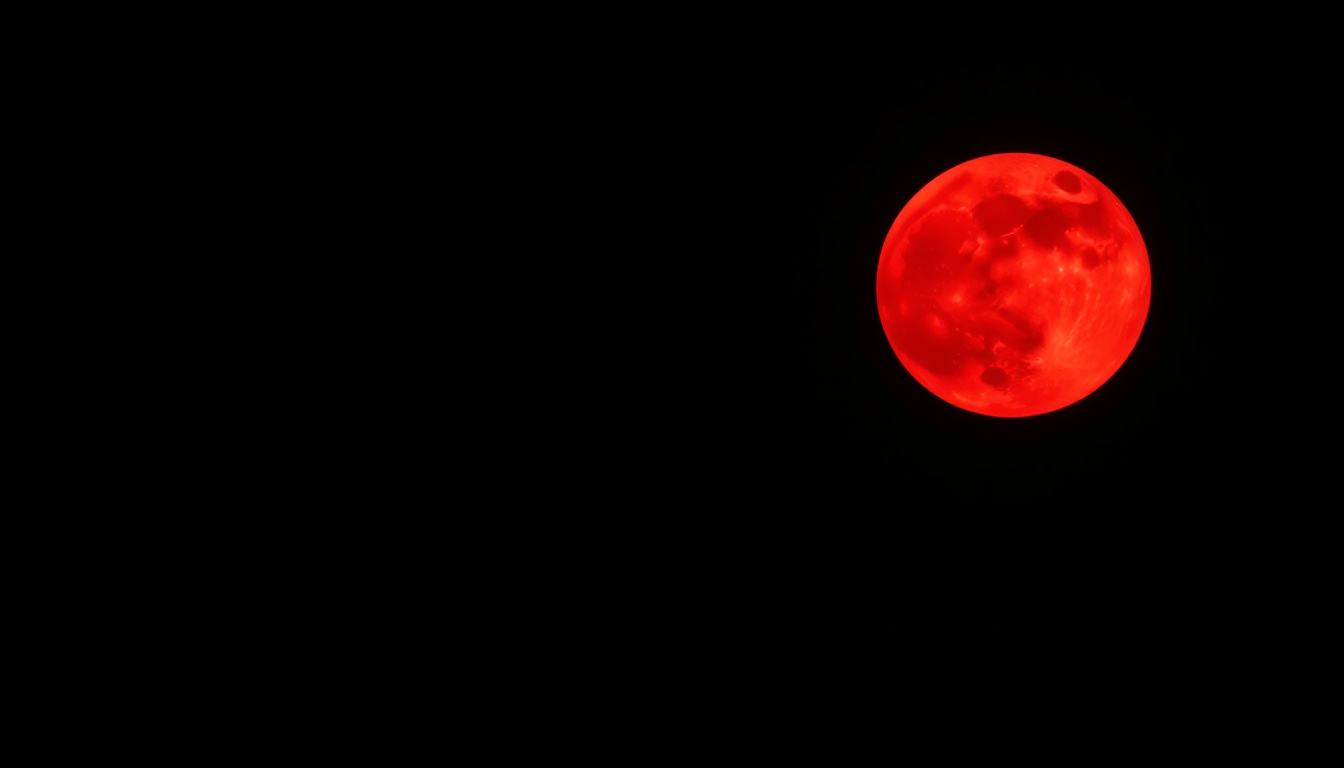
If you’ve ever wondered when the Moon takes on a deep red glow, the next chance is closer than you think. On August 27–28, 2026, a partial lunar eclipse will cover about 93% of the Moon’s surface in Earth’s shadow, creating a striking blood moon visible across the Americas, Europe, and Africa.
Next blood moon date: August 27–28, 2026 ·
Type of eclipse: Deep partial lunar eclipse (93% coverage) ·
Visibility: Americas, Europe, Africa ·
Average frequency: About every 2.5 years
Quick snapshot
- Date: August 27–28, 2026 (Royal Museums Greenwich)
- Type: Partial (93%) (BBC Sky at Night Magazine)
- Peak: ~05:12 BST / 04:12 UTC (Royal Museums Greenwich)
- Americas (BBC Sky at Night Magazine)
- Europe (BBC Sky at Night Magazine)
- Africa (BBC Sky at Night Magazine)
- Best in North America (BBC Sky at Night Magazine)
- About every 2.5 years (timeanddate.com astronomy calendar)
- Next total: 2032–2033 (timeanddate.com astronomy calendar)
- Reddish hue (Royal Museums Greenwich)
- Naked-eye visible (Royal Museums Greenwich)
- No special gear needed (Royal Museums Greenwich)
Six key facts about the August 2026 blood moon, drawn from official sources:
| Fact | Value | Source |
|---|---|---|
| Next blood moon date | August 27–28, 2026 | Royal Museums Greenwich |
| Eclipse type | Deep partial lunar eclipse (93% coverage) | BBC Sky at Night Magazine |
| Peak time (UTC) | 04:00 on August 28 | timeanddate.com astronomy calendar |
| Visible regions | East Pacific, Americas, Europe, Africa | BBC Sky at Night Magazine |
| Average frequency | Once every ~2.5 years | timeanddate.com astronomy calendar |
| Next total lunar eclipse | April 25/26, 2032 | timeanddate.com astronomy calendar |
When is the next blood moon?
What is the exact date and time?
The next blood moon occurs on the night of August 27–28, 2026. According to Royal Museums Greenwich (the UK’s leading astronomy institution), the partial lunar eclipse begins at 3:33 a.m. BST (02:33 UTC) on August 28. Maximum eclipse, when about 90% of the Moon is inside Earth’s umbra, happens at 5:12 a.m. BST (04:12 UTC). timeanddate.com astronomy calendar lists the penumbral phase starting even earlier, at 2:23 a.m. BST, with the partial phase beginning at 4:12 a.m. BST.
For UK observers, the Moon will be low in the western sky during the eclipse, so a clear view to the southwest is essential. Royal Museums Greenwich recommends finding a high point with an unobstructed horizon.
Where will it be visible?
- North America – best viewing in the western half (BBC Sky at Night Magazine)
- South America – entire continent
- Europe – western regions see the deepest stages (Star Walk)
- Africa – northern and western parts
- Eastern Pacific – islands and coastal areas
The pattern: this eclipse favours the Western Hemisphere. Observers in eastern Asia and Australia will miss it entirely. For those in the visibility zone, the Moon will be above the horizon during the entire partial phase.
How often is there a blood moon?
How many blood moons in 2026?
There is only one blood moon in 2026: the August 28 partial lunar eclipse. timeanddate.com astronomy calendar notes that lunar eclipses occur in pairs, but the other 2026 eclipse (a penumbral one in March) is not a blood moon because the Moon stays in Earth’s outer shadow.
Is a blood moon every 2 years?
Blood moons — total or deep partial lunar eclipses — happen roughly every 2.5 years on average. The next total lunar eclipse after 2026 is on December 31, 2028, followed by another on April 25/26, 2032 (timeanddate.com astronomy calendar). Not every lunar eclipse qualifies as a blood moon; only when the Moon passes through Earth’s umbra does the red colour appear.
The term “blood moon” is not scientific. While it’s a popular media phrase, astronomers prefer “total lunar eclipse” or “deep partial lunar eclipse.” The red colour is caused by Rayleigh scattering — the same physics that makes sunsets red.
The implication: the term may be popular, but the science behind the red colour is well understood and predictable.
What will happen on August 28, 2026?
What time does the eclipse start?
Key times for the UK (BST) and UTC:
- Penumbral phase begins: 2:23 a.m. BST / 01:23 UTC – Moon enters Earth’s faint outer shadow (timeanddate.com astronomy calendar)
- Partial phase begins: 4:12 a.m. BST / 03:12 UTC – Moon starts to darken noticeably
- Maximum eclipse: 5:12 a.m. BST / 04:12 UTC – 93% of the Moon’s disk covered (BBC Sky at Night Magazine)
- Partial phase ends: 6:13 a.m. BST / 05:13 UTC – Moon leaves Earth’s umbra
- Eclipse ends (moonset): ~6:15 a.m. BST – Moon sets below the horizon for UK observers (Daily Express)
What will the Moon look like?
At maximum, the Moon will appear a deep reddish-orange, often described as a “blood moon.” Royal Museums Greenwich explains that the red colour is caused by sunlight filtering through Earth’s atmosphere, with shorter wavelengths (blue) scattered and longer wavelengths (red) reaching the Moon’s surface. No special equipment is needed — the eclipse is visible to the naked eye, though binoculars or a small telescope will enhance the view.
The implication: this is an almost-total eclipse, so the red colour will be intense and the dark shadow will cover nearly the entire Moon. It’s the best lunar eclipse visible from North America and Europe until 2028.
When to see the blood moon in the UK?
Visibility across Europe
UK observers will see the Moon rise during the eclipse on the evening of August 27, but the key action happens in the early morning of August 28. Royal Museums Greenwich states that the eclipse will be visible from all of the UK if skies are clear, but the Moon will be setting during the later stages, so the best view is just after the partial phase begins at 4:12 a.m. BST.
BBC Sky at Night Magazine confirms that the eclipse will be visible across the UK, Europe, Africa, and the Americas. The deepest stage occurs when the Moon is low in the western sky, so a clear western horizon is essential.
Best viewing tips for UK observers
- Find a location with a clear view to the southwest and west
- Use a high vantage point, such as a hill or open field
- Check the weather forecast — cloud cover will ruin the view
- Arrive early; the Moon will be low and may be hidden by trees or buildings
- No telescope needed, but bring binoculars for a closer look
The catch: because the Moon sets around 6:15 a.m. BST, observers in the UK will miss the final stages of the eclipse. The partial phase ends at 6:13 a.m., but the Moon will be very low and may be hard to see. Star Walk warns that later stages may be cut off by moonset, so the window for viewing is narrow — about 1 hour from 4:12 a.m. to 5:12 a.m. BST.
What is a blood moon?
Why does the Moon turn red?
A blood moon is the colloquial term for a total or deep partial lunar eclipse. The red colour results from Rayleigh scattering: when sunlight passes through Earth’s atmosphere, the blue light is scattered away, and the red light is bent (refracted) onto the Moon’s surface. Royal Museums Greenwich describes this as the same process that gives us red sunsets.
Is it a sign of something?
No — a blood moon is a purely natural astronomical event. Throughout history, cultures have sometimes interpreted lunar eclipses as omens, but modern science confirms they are predictable orbital mechanics. The term “blood moon” was popularised in the 2010s by media and a few religious groups, but it has no accepted scientific meaning. BBC News reported in September 2025 that the next visible lunar eclipse from the UK would be on August 28, 2026, framing it as a routine celestial event.
What this means: the blood moon is safe to watch, carries no special significance, and is simply a beautiful natural phenomenon. It’s no more dangerous than a full moon.
Timeline of upcoming blood moons
Four key dates for lunar eclipse enthusiasts:
- August 27–28, 2026 – Deep partial lunar eclipse (93% coverage) – visible from Americas, Europe, Africa (BBC Sky at Night Magazine)
- December 31, 2028 – Total lunar eclipse – next total after 2026 (timeanddate.com astronomy calendar)
- April 25/26, 2032 – Total lunar eclipse – visible from Americas, Europe, Africa (timeanddate.com astronomy calendar)
- October 18/19, 2032 – Total lunar eclipse (timeanddate.com astronomy calendar)
Source: timeanddate.com astronomy calendar and Royal Museums Greenwich
What we know vs. what’s unclear
Confirmed facts
- The August 27–28, 2026 partial lunar eclipse is confirmed by multiple sources (Royal Museums Greenwich)
- Visibility across the Americas, Europe, and Africa (BBC Sky at Night Magazine)
- 93% coverage at peak (BBC Sky at Night Magazine) / 90% (Royal Museums Greenwich)
- Next total lunar eclipse after 2026 is December 31, 2028 (timeanddate.com astronomy calendar)
What’s unclear
- Exact minute-by-minute timings for every city (varies by time zone and altitude)
- Weather conditions that may affect local viewing – check forecasts closer to the date
- Exact visibility percentage varies between sources (90% vs 93%)
- Local horizon obstructions may affect urban viewing
The pattern: the eclipse date and broad visibility are well established, but precise local conditions will determine the actual viewing experience for each observer.
What experts say about the August 2026 eclipse
This is the best lunar eclipse anywhere on Earth for North America.
— BBC Sky at Night Magazine (quoting Space.com)
The partial lunar eclipse will be visible across the UK, Europe, Africa, North and South America.
— BBC Sky at Night Magazine
Find a high point with a clear view to the southwest to see the best of the event.
— Royal Museums Greenwich
For UK skywatchers, the trade-off is clear: the eclipse is visible but the Moon sets during the event, so the window is short. Plan to be outside between 4:00 a.m. and 5:30 a.m. BST on August 28, 2026, with a clear view to the southwest.
Related reading: Lunar Eclipse 2025 NZ: Times, Viewing Tips & Science
rmg.co.uk, timeanddate.com, uk.news.yahoo.com, sterngucker.de, dailymail.co.uk, news.sky.com
For those in the British Isles, a detailed guide covering UK visibility and timings for the August 2026 lunar eclipse is available from UK Insider.
Frequently asked questions
Is the blood moon dangerous to look at?
No, a lunar eclipse is completely safe to view with the naked eye. Unlike a solar eclipse, the Moon is not emitting harmful radiation. You can look at it directly without any eye protection.
What should you not do during a lunar eclipse?
There are no scientific restrictions. Some cultures have superstitions about eating, sleeping, or travelling during an eclipse, but these have no basis in astronomy. Enjoy the view.
When was the last blood moon?
The last total lunar eclipse visible from the UK was on May 16, 2022. The most recent blood moon globally was a total lunar eclipse on November 8, 2022, visible from Asia, Australia, and the Americas.
When is the next blood moon after 2026?
The next total lunar eclipse – which will also be a blood moon – is on December 31, 2028, followed by another on April 25/26, 2032. (timeanddate.com astronomy calendar)
Can you see the blood moon in the UK?
Yes, the August 27–28, 2026 partial lunar eclipse will be visible from the UK, but the Moon will be low in the western sky and setting during the later stages. The best viewing time is around 4:12 a.m. to 5:12 a.m. BST on August 28.
Why is the moon sometimes red even without a lunar eclipse?
A red or orange Moon can occur when the Moon is low on the horizon, due to the same Rayleigh scattering that creates red sunsets. Atmospheric dust, smoke, or pollution can also make the Moon appear reddish. This is not a blood moon – it’s a normal optical effect.
How many blood moons will there be in 2026?
Only one: the August 28 partial lunar eclipse. The other lunar eclipse in 2026 (March 3) is a penumbral eclipse, which is too faint to produce a noticeable red colour.
For UK observers, the August 2026 blood moon is a rare opportunity to see a deep red Moon without travelling far. The window is short, but the payoff is real: a 93% coverage eclipse that will be the best lunar show until 2028. Mark your calendars for the early morning of August 28, find a clear southwest horizon, and don’t forget to look up.