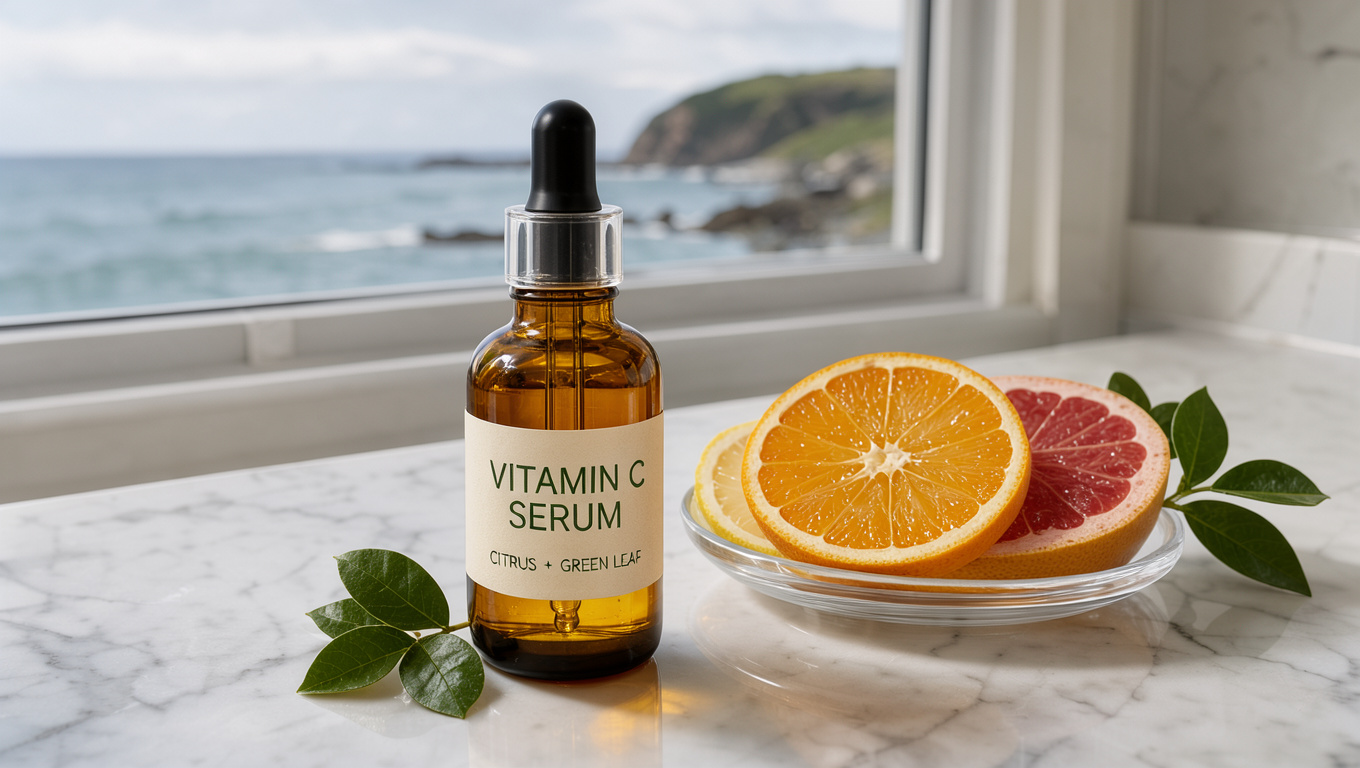
Standing in front of a shelf of vitamin C serums, it is hard not to wonder why one bottle lists at $185 in US retail and another at $26.95, with labels that look alike. The short answer starts with concentration: the benchmark, SkinCeuticals C E Ferulic, is built on 15% L-ascorbic acid, and the cheaper bottle can be the stronger one on paper, though the proof behind that number is thinner than the shelf suggests.
Benchmark serum: SkinCeuticals C E Ferulic · Benchmark L-ascorbic acid: 15% · Timeless 20% L-ascorbic acid: 20% · Duke pH requirement: below 3.5
Quick snapshot
- SkinCeuticals C E Ferulic contains 15% L-ascorbic acid, 1% vitamin E and 0.5% ferulic acid (SkinCeuticals, official product page)
- Timeless 20% C + E Ferulic Acid Serum lists 20% L-ascorbic acid and costs about 85% less than the benchmark (Wirecutter, NYT product testing)
- Duke Antioxidant Parameters call for a pH below 3.5 and 10% to 20% L-ascorbic acid (SkinCeuticals, brand’s official site)
- Whether the 41% oxidative-damage claim rests on independent trial data (SkinCeuticals, brand’s official site) (Dermondemand (skincare review site))
- Whether the patent-pending formula keeps the original’s active levels, which the brand says it does (Dermondemand (skincare review site))
- NZD prices and New Zealand stockists for the 10% and 20% dupes, which no retrieved source gives (Dermondemand (skincare review site))
- A lab study found ferulic acid doubled the photoprotection of the vitamin C and E solution (Dermondemand, skincare review site)
- A Dermondemand article dated reports a patent-pending SkinCeuticals reformulation (Dermondemand, skincare review site)
- Check whether a bottle carries the updated formula, which the brand says adds carnosine and Endophytol (Dermondemand, skincare review site) (Fortune (2026 expert review))
- Patch test a new serum before daily use, starting lower if your skin is sensitive, as Fortune (2026 expert review) suggests
Eight facts, one pattern: three come from the brand itself, and the rest come from reviewers and retailers, so the comparison rests on more than the manufacturer’s word.
| Item | Value |
|---|---|
| SkinCeuticals C E Ferulic, L-ascorbic acid | 15% (SkinCeuticals, official product page) |
| SkinCeuticals C E Ferulic, price (US, 30 ml) | $185 (Fortune, 2026 expert review) |
| Timeless 20% C + E Ferulic Acid Serum, L-ascorbic acid | 20% (Wirecutter, NYT product testing) |
| Timeless 20% C + E Ferulic Acid Serum, price | $26.95 (Healthline (health publisher)) |
| Timeless 20% cost compared with SkinCeuticals | About 85% less (Wirecutter, NYT product testing) |
| Duke Antioxidant Parameters, required pH | below 3.5 (SkinCeuticals, brand’s official site) |
| Duke Antioxidant Parameters, L-ascorbic acid range | 10% to 20% (SkinCeuticals, brand’s official site) |
| Yellowing by day 90, Timeless 20% vs SkinCeuticals | Slightly more (Evident (lab-tested review)) |
Which is better, 10% or 20% vitamin C serum?
Strength has a clear floor and a less clear ceiling. SkinCeuticals says effective topical vitamin C needs pure L-ascorbic acid, a pH below 3.5 and a concentration of 10% to 20% (SkinCeuticals, brand’s official site). Both strengths on the shelf sit inside that window, so the real split comes down to how much your skin tolerates.
Higher is not automatically better. Dermondemand reports that absorption peaked at 20% in a pigskin study and that higher strengths did not help (Dermondemand, skincare review site). Healthline places the most effective serums at 10% to 20% and warns that going over 20% can cause irritation without added benefit (Healthline, health publisher).
- Elle quotes an expert who calls around 10 percent ideal and warns that vitamin C can be irritating above 20 percent (Elle (fashion and beauty magazine)).
- Wirecutter says its 20% pick sits at the upper limit of concentrations dermatologists recommended to it, and it flags irritation risk for sensitive skin (Wirecutter, NYT product testing).
Four bottles, one pattern: the Timeless 20% is the strongest on paper and costs a fraction of the benchmark.
| Product | L-ascorbic acid | Reported price |
|---|---|---|
| SkinCeuticals C E Ferulic | 15% | $185 for 30 ml, US (Fortune, 2026 expert review) |
| Timeless 20% C + E Ferulic Acid Serum | 20% | $26.95 (Healthline, health publisher) |
| Timeless 10% Vitamin C + E Ferulic Acid Serum | 10% | About $28 for 1 oz, according to Dupe.com (product comparison site) |
| SkinCeuticals Phloretin CF | 10% | Not in retrieved sources (Adore Beauty NZ (BeautyIQ editorial)) |
What is the best dupe for SkinCeuticals vitamin C E Ferulic?
- Wirecutter points to Timeless 20% C + E Ferulic Acid Serum, which shares most ingredients with the benchmark and costs about 85% less (Wirecutter, NYT product testing).
- Evident describes a near-identical formulation at roughly $25 per bottle, and found slightly more yellowing than SkinCeuticals by day 90 in its testing (Evident, lab-tested review).
- Dupe claims need checking against concentration and pH, since the brand’s own targets are defined by those two numbers (SkinCeuticals, brand’s official site).
A 20% serum beats the 15% benchmark on value only if your skin tolerates it. For sensitive skin, the stronger label is the riskier buy, which is why Wirecutter’s sensitive-skin pick uses sodium ascorbyl phosphate, a milder derivative, and its testers reported no tingling or stinging (Wirecutter, NYT product testing).
The catch: the saving is real, but the 20% label is also the number that decides whether your skin tolerates the product. The price gap is easy to measure, and the tolerance gap is not.
Which is better for my skin, vitamin C or retinol?
The retrieved sources do not compare vitamin C with retinol head to head, so this section sticks to what they show about skin type and irritation. For most readers, the answer starts with their skin rather than the ingredient name.
Adore Beauty NZ’s BeautyIQ editors say C E Ferulic suits normal to dry skin best and warn that oily, combination or acne-prone skin can find it too irritating (Adore Beauty NZ, BeautyIQ editorial).
- Sensitive or reactive skin: Adore Beauty NZ reports that SkinCeuticals Phloretin CF contains 10% L-ascorbic acid and can be less irritating than the 15% C E Ferulic (Adore Beauty NZ, BeautyIQ editorial).
- Retinol users: no retrieved source tests layering retinol with vitamin C, so any routine on that question stays unverified here.
None of the retrieved sources tests retinol and vitamin C in the same routine. Treat any schedule you read about as unverified until a dermatology body or a clinical trial addresses it.
What this means: for this question, tolerance is the deciding variable, and the sources here do not settle which active suits your skin better. Start with the calmer product and add a second active only after your skin has settled.
Do brightening serums actually work?
The retrieved sources contain no trial that measures skin brightness over time, so the honest answer is that the evidence is thin. The brand’s strongest number is an oxidative-damage claim rather than a brightening result: SkinCeuticals says C E Ferulic reduces combined oxidative damage from UV, ozone and diesel exhaust by up to 41% (SkinCeuticals, brand’s official site).
Most of the lab evidence is about absorption and photoprotection. Dermondemand reports that absorption peaked at 20% in a pigskin study, and that a lab study found ferulic acid doubled the photoprotection of the vitamin C and E solution (Dermondemand, skincare review site).
- Absorption and photoprotection results come from lab work, not from measured changes in skin tone.
- Brand claims come with exact percentages, but the retrieved sources do not include the trials behind the headline claims.
Nine specs, one pattern: the brand publishes exact percentages for its formula, but the independent proof behind its headline claims is missing from these sources.
| Spec | SkinCeuticals C E Ferulic |
|---|---|
| Product size (US listing) | 30 ml (SkinCeuticals, official product page) |
| L-ascorbic acid | 15% (SkinCeuticals, official product page) |
| Vitamin E (alpha tocopherol) | 1% (SkinCeuticals, official product page) |
| Ferulic acid | 0.5% (SkinCeuticals, official product page) |
| Required pH (Duke Antioxidant Parameters) | below 3.5 (SkinCeuticals, brand’s official site) |
| Required L-ascorbic acid range | 10% to 20% (SkinCeuticals, brand’s official site) |
| Oxidative damage reduction claim | Up to 41% (SkinCeuticals, brand’s official site) |
| Updated formula | Patent-pending version adds carnosine and Endophytol; the brand says the original trio levels are kept (Dermondemand, skincare review site) |
| Updated formula date | Undated in source; the article is dated |
A brand can publish exact percentages and still leave the result unproven, and brightening claims live in that gap. Dermondemand’s absorption finding concerns how much vitamin C reaches the skin, not how much brighter the skin looks afterward (Dermondemand, skincare review site).
What are the mistakes while using vitamin C serum?
Most mistakes come from strength, pH and packaging rather than from the ingredient list. They are easy to miss because none of the three appears on the front of the bottle.
- Buying on strength alone. Elle reports a quoted expert who calls around 10 percent ideal, and warns that concentrations above 20 percent can be irritating (Elle, fashion and beauty magazine).
- Skipping the pH check. The brand’s Duke targets call for a pH below 3.5 (SkinCeuticals, brand’s official site), and Dermondemand reports that L-ascorbic acid needed that pH to enter skin in a pigskin study (Dermondemand, skincare review site).
- Ignoring the bottle. According to Dupe.com (product comparison site), SkinCeuticals’ dropper packaging is an oxidation risk.
- Assuming a dupe ages the same way. Evident’s testing found slightly more yellowing in the Timeless 20% serum than in SkinCeuticals by day 90 (Evident, lab-tested review).
Packaging and pH are the details most shoppers never see on the shelf, yet they decide how much active survives the bottle and reaches the skin (SkinCeuticals, brand’s official site).
The catch: each mistake feels small on its own, but together they change how much vitamin C is still active by the time it touches your face.
What is the best vitamin C serum for mature skin over 50?
No retrieved source tests vitamin C serums in people over 50, so this article cannot name a best pick for that age group. What the sources do show is that tolerance, not age alone, shapes the choice.
- Wirecutter considered 60 formulas, tried 34 over several months, and sent 20 contenders with hidden labels to testers of different ages and skin types (Wirecutter, NYT product testing).
- Fortune recommends looking for 10% to 20% vitamin C, starting around 10% if skin is sensitive (Fortune, 2026 expert review).
- Adore Beauty NZ says the 15% C E Ferulic suits normal to dry skin best (Adore Beauty NZ, BeautyIQ editorial).
Age does not set the strength, tolerance does. A reader over 50 with resilient skin can take the 20% route and save most of the cost, while one with reactive skin should begin near 10% and build up.
The pattern: product labels tell you the percentage, but only your own use can tell you whether the stronger label is worth the irritation risk.
Where the 20% dupe wins and loses
Upsides
- Costs about 85% less than SkinCeuticals C E Ferulic (Wirecutter, NYT product testing).
- Shares most of the benchmark’s ingredients, including the same trio of actives (Wirecutter, NYT product testing).
- Lists at $26.95 in Healthline’s review (Healthline, health publisher).
Downsides
- Sits at the 20% upper limit that dermatologists recommended to Wirecutter, with irritation risk for sensitive skin (Wirecutter, NYT product testing).
- Showed slightly more yellowing than the benchmark by day 90 in Evident’s testing (Evident, lab-tested review).
- The retrieved sources give no NZD pricing or New Zealand stockists, so local cost is unverified.
The trade-off: the savings are concrete, while the irritation and stability costs are the ones you pay on your own skin.
Confirmed facts and open questions
Confirmed facts
- Timeless 20% C + E Ferulic Acid Serum lists 20% L-ascorbic acid (Wirecutter, NYT product testing).
- Healthline says going over 20% can cause irritation without added benefit (Healthline, health publisher).
- Adore Beauty NZ carries the SkinCeuticals range for New Zealand shoppers (Adore Beauty NZ, BeautyIQ editorial).
- SkinCeuticals C E Ferulic contains 15% L-ascorbic acid, 1% vitamin E and 0.5% ferulic acid (SkinCeuticals, official product page).
What’s unclear
- Whether the patent-pending SkinCeuticals formula keeps the original’s active levels, which the brand says it does (Dermondemand, skincare review site).
- Whether the 41% oxidative-damage claim rests on independent trial data (SkinCeuticals, brand’s official site).
- NZD prices and New Zealand stockists for the 10% and 20% dupes; no retrieved source gives them.
- Whether independent New Zealand dermatologists back 10% over 20% for sensitive skin; no such opinion was retrieved.
- Whether retinol and vitamin C can share a routine; no retrieved source tests it.
This article covers the SkinCeuticals benchmark and its Timeless dupes because the retrieved sources document them. Trilogy, Jeuneora and Nuori are left out until a verifiable source covers them, and the missing New Zealand pricing is the biggest limit on this comparison.
Why this matters: the open list is as long as the confirmed one, so the buying decision rests on your own patch test as much as on the evidence.
What the experts and testers said
“Vitamin C can be irritating at concentrations above 20 percent.”
Lal, dermatologist quoted by Elle (fashion and beauty magazine)
“C E Ferulic is best suited to normal to dry skin types (oily, combo or acne-prone skin types may find it too irritating).”
BeautyIQ editorial, Adore Beauty NZ (BeautyIQ editorial)
“Timeless Skin Care’s 20% serum is the upper limit of concentrations that dermatologists recommended to us.”
Wirecutter testing team, Wirecutter (NYT product testing)
The implication: the shared concern is tolerance near 20%, and the skin-type caveat matters as much as the number itself.
What to do before you buy
Price and percentage tell only half the story, and the rest depends on how your skin reacts. For New Zealand shoppers with sensitive skin, the choice is clear: start with a 10% serum and patch test it before daily use, or buy the 15% benchmark only if its normal-to-dry skin fit matches yours, as Adore Beauty NZ (BeautyIQ editorial) advises. For a wider view of personal care buying, see the best shampoo and conditioner guide.
Related reading: best shampoo and conditioner guide
super-achiever.com, skinsort.com, nextbest.one, skinsort.com, mamamia.com.au
Frequently asked questions
How should I patch test a new vitamin C serum?
None of the retrieved sources sets out a patch-test method. The practical step they support is starting with a lower concentration if your skin is sensitive, as Fortune (2026 expert review) suggests.
Should I store vitamin C serum away from light?
According to Dupe.com (product comparison site), SkinCeuticals’ dropper packaging carries an oxidation risk, so the bottle itself matters. Keeping it capped and out of direct sun is a sensible precaution, although the retrieved sources do not test light exposure directly.
Which vitamin C serums are sold in New Zealand?
Adore Beauty NZ (BeautyIQ editorial) carries the SkinCeuticals range, including C E Ferulic and Serum 10 AOX+, which the retailer lists at 10% L-ascorbic acid with 0.2% ferulic acid. The retrieved sources do not confirm New Zealand stockists for the Timeless dupes.
Is the updated C E Ferulic the same as the original?
According to Dermondemand (skincare review site), the brand says the patent-pending version keeps the same vitamin C, vitamin E and ferulic acid levels and adds carnosine and Endophytol. The cited research tested the original trio, and the article is dated .
Does a dupe match C E Ferulic?
Evident (lab-tested review) calls Timeless 20% a near-identical formulation at roughly $25 per bottle. Its listed ferulic acid is 1%, twice the 0.5% in the SkinCeuticals formula on the brand’s page, so near-identical is an assessment rather than a match.
Are the 41% figures independently tested?
The retrieved sources do not include the trial behind SkinCeuticals’ claim that C E Ferulic reduces combined oxidative damage from UV, ozone and diesel exhaust by up to 41% (SkinCeuticals, brand’s official site). Treat it as the brand’s claim until an independent study is cited.