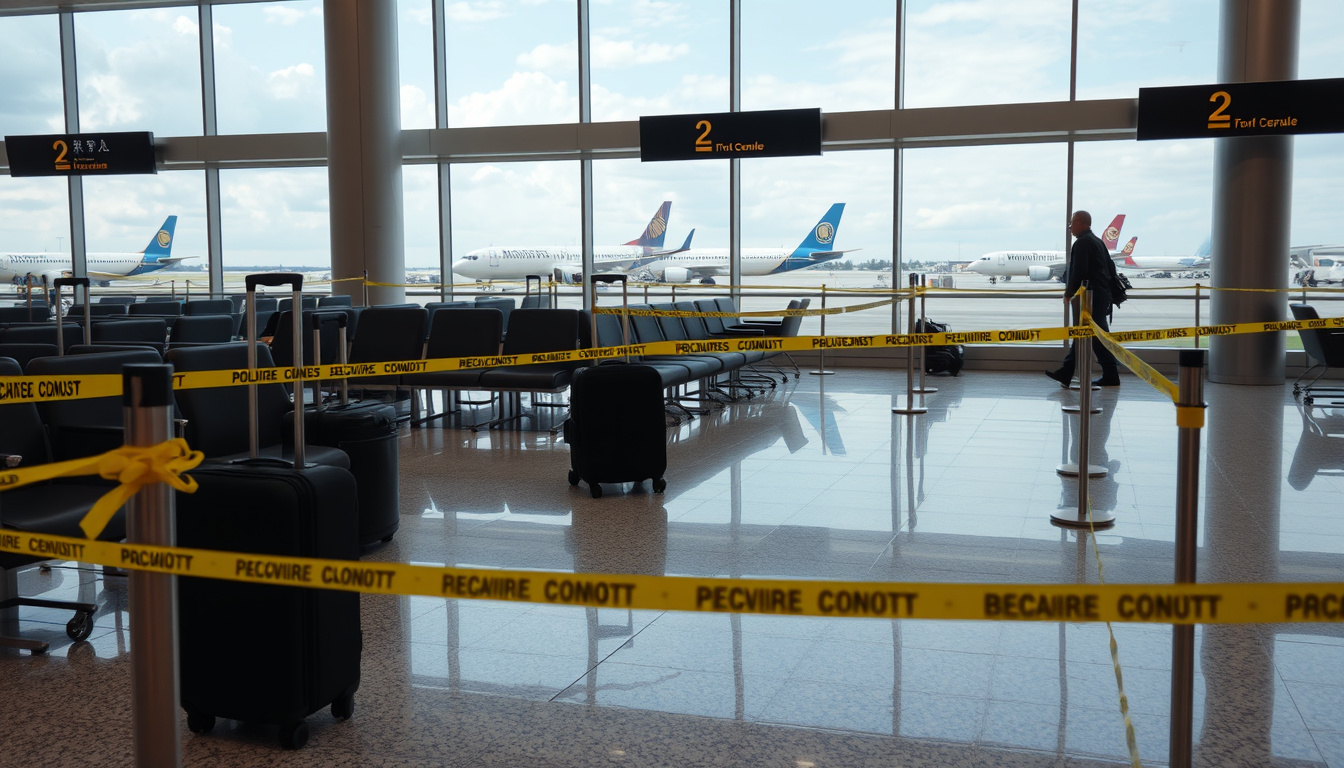
Imagine going through airport security and watching a military practice bomb slide out of someone’s bag onto the screening belt — then being told to keep working because the airport decided not to evacuate. That’s exactly what a Wellington Airport worker claims happened in late December 2025, and the story has since sparked a ministerial review of airport safety procedures.
Incident date: December 27, 2025 ·
Object found: Military practice bomb ·
Evacuation ordered: No ·
Claims: Safety rules ignored ·
Primary sources: NZ Herald, Newstalk ZB
Quick snapshot
- A military ‘Aircraft Practice Bomb’ was found in a passenger’s bag during screening (NZ Herald)
- Wellington Airport did not evacuate staff or the public (NZ Herald)
- Normal operations continued for nearly two hours before the Defence Force gave the all-clear (Newstalk ZB)
- Police confiscated the device (Newstalk ZB)
- Exact date of the incident beyond December 27, 2025
- Whether the passenger was aware of the practice bomb in their bag
- Official reasons from Wellington Airport management for not evacuating
- Dec 27, 2025: Practice bomb found in bag at Wellington Airport (NZ Herald)
- Same day: Airport contacts Defence Force; no evacuation ordered (Newstalk ZB)
- Jan 18, 2026: NZ Herald publishes story based on worker claims (NZ Herald)
- Associate Transport Minister James Meager ordered CAA to review (Newstalk ZB)
- Wellington Airport conducting internal evaluation to implement learnings (Newstalk ZB)
The following table summarises the key facts from the incident as reported by major news outlets.
| Field | Detail |
|---|---|
| Incident Type | Security breach — unexploded ordnance |
| Evacuation | No |
| Source of report | Worker’s claim to NZ Herald |
| Date of news report | 18 Jan 2026 |
| Object | Inert ‘Aircraft Practice Bomb’ filled with lead (Newstalk ZB) |
| Regulatory ban | Practice bombs banned on commercial aircraft (Newstalk ZB) |
What happened at Wellington Airport?
Details of the bomb discovery
- A military practice bomb was found in a passenger’s bag during screening at Wellington Airport on December 27, 2025 (NZ Herald).
- New Zealand Defence Force (NZDF) bomb squad assessed the device, which was an inert ‘Aircraft Practice Bomb’ filled with lead to match the weight of a live bomb (Newstalk ZB).
- The device had previously contained live components like a blasting cap, though it was inert at the time (Newstalk ZB).
- Police confiscated the device after assessment (Newstalk ZB).
Worker’s claims
A worker at Wellington Airport alleged that bosses ignored safety procedures by not evacuating staff and not halting screening and baggage loading after the practice bomb was discovered (NZ Herald). The incident occurred during the busy holiday period, raising concerns about prioritization of operations over safety.
Worker claims safety rules were ignored for operational convenience — a pattern that could undermine trust in airport security protocols during peak travel times. The unnamed worker’s allegations directly challenge Wellington Airport’s stated position that its processes were followed correctly.
The implication: the airport must now defend a decision that appears, on its face, to prioritise schedule over safety — regardless of whether the device was inert.
Why didn’t Wellington Airport evacuate?
Standard security procedures
Wellington Airport stated it followed its processes and that evacuation was not necessary because the device was assessed as inert (NZ Herald). The Civil Aviation Authority (CAA) assured Associate Transport Minister James Meager that the dummy bomb posed no threat and procedures were followed (Newstalk ZB). However, the worker claims operations continued normally for nearly two hours while the bomb sat on site.
- Aircraft Practice Bombs are banned on commercial aircraft (Newstalk ZB).
- The airport continued normal operations for nearly two hours before Defence Force all-clear (Newstalk ZB).
Local and international protocols
Risk assessments at airports typically weight the operational disruption of an evacuation against the assessed threat level. In this case, because the practice bomb was confirmed inert by the NZDF bomb squad, airport management determined no evacuation was needed. Critics argue this exposes a gap: a banned item still entered the airport, screening detected it, but the response stopped at notification rather than full precautionary evacuation.
Wellington Airport faces a credibility test: its internal risk assessment kept flights moving, but the worker’s allegations suggest the airport cut corners. For passengers, the question is whether the airport would react differently if a live device were found.
The pattern: the airport’s defence that the device was inert does not address the worker’s claim that the response was driven by convenience rather than established procedure.
What are the broader airport safety implications?
Past evacuations at Wellington Airport
Wellington Airport has experienced emergency evacuations before. In 2023, the terminal was evacuated after a fire alarm triggered by a suspected electrical fault (NZ Herald). That evacuation happened quickly; the contrast with the practice bomb incident — where no evacuation occurred despite an actual banned ordnance being found — highlights inconsistencies in threat response.
- 2023: Fire alarm triggered full terminal evacuation.
- 2025: Military practice bomb found; no evacuation ordered.
Security screening gaps
The incident raises questions about how a practice bomb — a banned item — got through to the screening point in the first place. While screening eventually caught the device, the fact that a piece of military ordnance made it into a passenger’s carry-on luggage suggests potential gaps in pre-screening awareness or bag-check protocols for certain flights. The CAA review ordered by Associate Transport Minister James Meager will examine these issues (Newstalk ZB).
“The worker alleged bosses ignored safety procedures by not evacuating staff and halting screening/loading.”
— Unnamed Wellington Airport worker, via NZ Herald
“CAA assured the Minister the dummy bomb posed no threat and procedures were followed.”
— Newstalk ZB reporting on CAA response
What this means: the incident reveals a fundamental tension between operational continuity and security precaution. Wellington Airport insists its procedures were adequate; the worker claims they were dangerously inadequate. The coming CAA review will determine which side the evidence supports, and whether New Zealand’s airport security rules need tightening.
Frequently asked questions
Was anyone injured during the incident?
No. The practice bomb was inert and no injuries were reported. Police confiscated the device without incident (Newstalk ZB).
How common are practice bombs in civilian airports?
Practice bombs are banned on commercial aircraft in New Zealand and extremely rare at civilian airports. This incident is among the first reported cases of an inert military ordnance being found during passenger screening at a New Zealand airport.
What is the difference between a practice bomb and a live bomb?
A practice bomb is an inert training device, typically filled with lead or concrete to replicate the weight of a live bomb. It lacks explosives but may have previously contained live components like a blasting cap (Newstalk ZB).
Has Wellington Airport faced similar incidents before?
Wellington Airport was evacuated in 2023 due to a fire alarm, but this is the first known incident involving military ordnance found in a passenger’s bag. No previous practice bomb discoveries have been reported at the airport.
What should passengers do if they see a suspicious item?
Passengers should immediately notify airport security or staff. Do not touch or attempt to move the item. Follow all instructions from security personnel.
Who is responsible for airport security in New Zealand?
Airport security is overseen by the Civil Aviation Authority (CAA) under the Ministry of Transport. Individual airports like Wellington Airport manage day-to-day screening operations, while the NZ Police and Defence Force respond to specific threats (Newstalk ZB).
What are the consequences of failing to evacuate?
If the CAA review finds Wellington Airport violated safety protocols, the airport could face regulatory penalties, operational restrictions, or mandated changes to its emergency procedures. The airport is already conducting an internal evaluation to implement learnings (Newstalk ZB).
For travellers flying through Wellington Airport, the implication is clear: trust the screening process, but recognize that the airport’s threshold for evacuating may be higher than you’d expect. The upcoming CAA review will determine whether that threshold needs lowering — or whether the whistleblower’s concerns were justified all along.