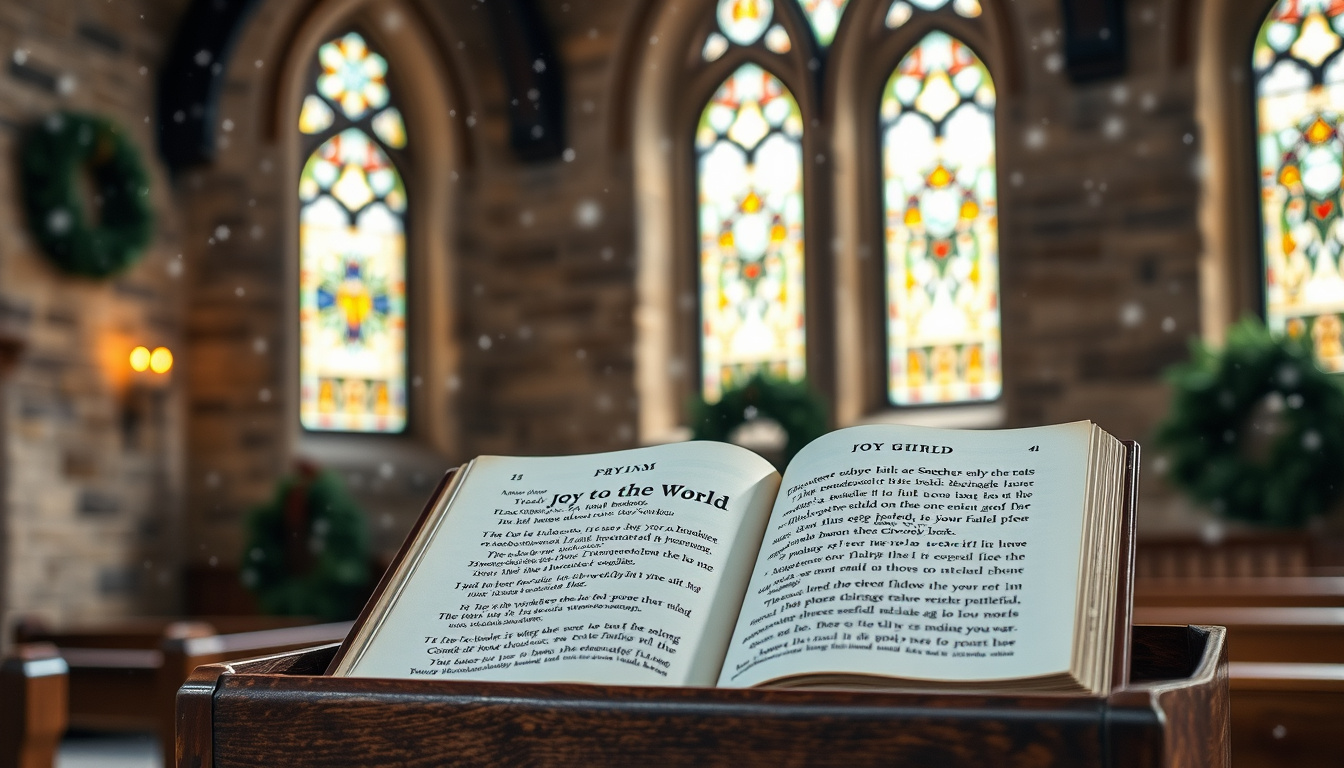
Every December, “Joy to the World” fills churches, shopping malls, and living rooms with its triumphant melody. Most listeners assume they’re hearing a Nativity carol — but the British minister who wrote it in 1719 had something very different in mind. The song’s journey from theological treatise to Christmas staple is stranger than most people realize, and along the way it picked up myths that obscure its real story.
Lyrics by: Isaac Watts · Year of lyrics: 1719 · Tune arranged by: Lowell Mason · Year of tune: 1848 · Common use: Christmas carol
Quick snapshot
- Isaac Watts wrote the lyrics in 1719 (First Naples Church)
- The poem is a paraphrase of Psalm 98 (The Gospel Coalition)
- Lowell Mason arranged the tune in the 19th century (Ann H. Gabhart)
- Extent of Catholic Church views on the carol
- Whether the 1833 date commonly cited is accurate
- Precise timeline of Mason’s musical discovery
- 1719: Watts publishes “The Psalms of David Imitated”
- 1848: Mason arranges tune “Antioch”
- Christmas release drives song into holiday canon
- “Joy to the World” remains most published Christmas carol in America
- Continue its cultural dominance through performances
- Misunderstanding of its original purpose persists
The key facts table below summarizes the essential data about this hymn’s origin and development.
| Label | Value |
|---|---|
| Author | Isaac Watts |
| Publication year | 1719 |
| Genre | Hymn |
| Bible basis | Psalm 98 |
| Original title | “The Messiah’s Coming and Kingdom” |
| Composer of tune | Lowell Mason |
| Tune name | Antioch |
Who wrote Joy to the World?
Isaac Watts, a British minister trained at a dissenting academy in London, published the lyrics in 1719 as part of his collection “The Psalms of David Imitated” (First Naples Church). Watts was one of the most prolific hymn writers in church history, and his work represented a bold break from Protestant tradition. Rather than having congregations sing directly from the Book of Psalms, Watts crafted poetic paraphrases that explicitly referenced Christ’s role as King and Redeemer.
Isaac Watts as lyricist
Watts wrote the poem while serving his congregational church in London, where worshippers followed the custom of singing only Psalm texts. His collection aimed to expand what congregations could sing by giving biblical content a more explicitly Christian voice. This approach was controversial at first — some church leaders viewed his religious poetry as heretical, while others celebrated it as a breath of fresh air (Branch Living).
Music attribution to Lowell Mason
More than a century passed before Boston music teacher Lowell Mason discovered Watts’s poem and set it to music. Mason chose a tune he called “Antioch” and released his arrangement at Christmastime, which helped the song quickly become a holiday favorite (Ann H. Gabhart). The timing of Mason’s release proved decisive — by associating the song with the Christmas season, he effectively repackaged a theological meditation on Christ’s return as a Nativity carol.
What’s the story behind Joy to the World?
The story behind “Joy to the World” begins with a psalm that celebrates God’s justice. Watts took Psalm 98 — specifically verse 4, which calls on all the earth to break into joyous song — and reworked it to point toward Jesus rather than simply the coming of God’s kingdom in general (The Gospel Coalition).
Paraphrase of Psalm 98
Watts worked primarily from the King James Version when composing his paraphrases, but he made deliberate adjustments to give the words a more explicitly Christian focus. Psalm 98 speaks of the Lord coming to judge the earth with righteousness, and Watts interpreted this as a celebration of Jesus’s role as King over both his church and the whole world (Crossway). The phrase “far as the curse is found” alludes to Genesis 3, where thorns and thistles became emblematic of the fall’s impact on creation — Watts was tracing redemption’s scope from the garden to Christ’s advent.
Intended as Christ’s second coming
Crucially, Watts intended his poem to celebrate the Second Coming of Christ, not the Nativity. The opening line — “Joy to the World, the Lord is come” — uses present tense in a prophetic sense, pointing forward to when Christ will return to establish justice (Branch Living). Watts understood that the judgment described in Psalm 98 was not merely a future event but was already present in Jesus’s ministry. With the aid of Psalm 98, Watts shows that Christ’s judgment will establish justice and therefore be cause for joy (The Living Church).
Watts’s hymn was never meant for Christmas. It was written as a meditation on Christ’s future return and the establishment of his kingdom — yet most people sing it without realizing its original theological focus.
Is Joy to the World a Catholic song?
The short answer is no, but the confusion is understandable given how the song has been adopted across Christian traditions.
Protestant origins
Isaac Watts was a Protestant Dissenter who wrote specifically within the context of Reformed church worship. His hymn collection “The Psalms of David Imitated” was designed to give English-speaking Protestant congregations access to more emotionally expressive and theologically rich songs than the plain Psalm texts that typically filled their services. Watts is often considered the forefather of modern praise and worship music because he introduced religious poetry into church songs at a time when most Protestant worship consisted primarily of singing the Psalms (Branch Living).
Catholic Church views
No credible sources document the Catholic Church formally condemning or endorsing “Joy to the World.” The carol’s Protestant origins have not prevented Catholic parishes from adopting it during the Christmas season, though theologians within Catholic tradition may note that its original focus on Christ’s return rather than his birth represents a theological emphasis that differs from some aspects of Catholic Christmas devotion.
Who wrote Joy to the World in 1833?
This date appears frequently in online searches and casual references, but it does not accurately reflect the song’s history.
Confusion with tune composer
The confusion around the 1833 date likely stems from conflation of the lyrics’ publication with when the tune was composed or when the song became widely known. Isaac Watts wrote the lyrics in 1719 — a date verified by multiple sources — so 1833 falls well over a century after the original composition (First Naples Church).
Lowell Mason’s role
Lowell Mason, the Boston music teacher who arranged the tune, was active throughout the early-to-mid 19th century. While research notes indicate Mason discovered and set Watts’s poem to music “more than a century” after the original composition, the precise year of Mason’s arrangement remains somewhat unclear in available sources. What is clear is that Mason’s Christmas-season release of the arranged song is what transformed it from a relatively obscure hymn into a beloved holiday carol.
Joy to the World lyrics
The lyrics most people know today differ slightly from Watts’s original in one important detail.
Full original lyrics
Watts’s original opening line was “Joy to the World, the Lord is come” — a present-future construction that looks ahead to Christ’s return. Over time and through various printings, this became “Joy to the World, the Lord has come,” shifting the tense to past. This change subtly alters the song’s meaning, transforming a prophetic statement about Christ’s future coming into a celebration of his incarnation. For Watts, who intended the hymn to address Christ’s Second Coming, the original phrasing was essential to his theological point.
The original title in Watts’s 1719 collection was “The Messiah’s Coming and Kingdom” (Biola University), which makes clear that Watts was writing about the establishment of Christ’s kingly rule — not about the Christmas story.
Common performances
Today, “Joy to the World” is performed by choirs, soloists, and congregations worldwide. Celtic Woman recorded a notable live version, and countless choir recordings and streaming tracks have contributed to its status as the most published Christmas carol in America (Ann H. Gabhart). The song’s triumphant melody, paired with its message of universal joy, makes it a fitting conclusion to Christmas services and a popular choice for holiday concerts.
Watts chose “the Lord is come” deliberately to point toward Christ’s future return. The shift to “has come” in popular versions reflects how the song was adopted without awareness of its original prophetic intent.
Timeline
Two dates anchor the history of “Joy to the World,” though the path between them is longer and murkier than many realize.
Watts died in 1748, nearly 30 years before his hymn would find its musical form. He never saw the transformation of his theological meditation into the Christmas standard it would become.
Confirmed facts and rumors
Research confidence for this topic is mixed. Some facts are well-documented; others rest on less certain ground or stem from sources that are harder to verify.
Confirmed
- Isaac Watts wrote lyrics in 1719
- Watts was a Protestant Dissenting minister
- The poem is based on Psalm 98
- Original intent was Christ’s Second Coming
- Lowell Mason arranged the tune
- Release at Christmastime drove adoption
- Most published Christmas carol in America
Unclear or uncertain
- Whether Catholic condemnation actually occurred
- Accuracy of 1833 date sometimes cited
- Precise year Mason arranged the tune
- Original reception of Watts’s hymn collection
The implication is that the historical record around this carol is solid for core facts but thin for peripheral claims about its reception and adaptation.
What experts say
Isaac Watts intended this hymn as a celebration of Christ’s return, not his birth. The opening line’s prophetic “the Lord is come” looks forward to when Christ will usher in his kingdom. Watts traced redemption’s story from Genesis to Christ’s glorious return, and the phrase “far as the curse is found” represents the scope of what Christ’s advent redeems.
Watts understood that the judgment spoken of in Psalm 98 was not merely a future event, but a present reality in the person of Jesus. He shows that Christ’s judgment will establish justice and therefore be cause for joy. (The Living Church)
Some church leaders initially viewed Watts’s innovations as controversial. His introduction of religious poetry into hymns was considered heretical by some, while others saw it as a welcome expansion of church music beyond plain Psalm singing.
Watts could be considered the forefather of “Praise and Worship” songs, introducing religious poetry into his songs when most Protestant church songs consisted primarily of singing the Psalms. His songs were a blend of personal reflection and emotional reaction based on theological convictions, and they gave new life to church worship. (Branch Living)
The intended function of the song was to inspire listeners to look forward to the future when sin and sorrow will no longer play a part in human life — a hope centered on Christ’s return rather than his birth.
Watts took Psalm 98 written with Messianic expectation and gave it a Christian perspective based on Jesus’ fulfillment of it. The lyrics catapult us into the time that Jesus will usher in his kingdom once and for all in its fullness. (First Naples Church)
The transformation from theological hymn to Christmas carol happened almost by accident. Mason’s timing in releasing the arrangement during the holiday season was decisive — the song’s triumphant message of joy and the coming of a king resonated so strongly with Christmas themes that it became inseparable from the season.
Watts died in 1748, nearly three decades before his most famous hymn gained its musical form. He never knew that a song written about Christ’s return would become one of the most beloved Christmas carols in America — a case study in how meaning shifts when context changes.
Related reading: How Many Letters in the Alphabet? 26 A-Z Explained
galaxymusicnotes.com, ourmissionpath.com, disciplenations.org, johncertalic.com
Similar misconceptions surround the Twelve Days of Christmas history, another festive carol whose gifts hide layers of religious symbolism beyond surface cheer.
Frequently asked questions
What is the original meaning of Joy to the World?
Isaac Watts wrote “Joy to the World” in 1719 as a meditation on Christ’s Second Coming, not his birth. The hymn was originally titled “The Messiah’s Coming and Kingdom” and was based on Psalm 98, which celebrates God coming to judge the earth with righteousness. Watts intended the song to point forward to when Christ would return to establish his kingdom.
Why is Joy to the World sung at Christmas?
The song became a Christmas staple because of timing. When Boston music teacher Lowell Mason discovered Watts’s poem more than a century after its composition, he set it to music and released the arrangement at Christmastime. The triumphant melody and the theme of a king coming resonated with Christmas themes, and the song quickly became associated with the holiday season.
What Psalm inspired Joy to the World?
Watts based the hymn on Psalm 98, particularly verse 4: “Make a joyful noise to the LORD, all the earth; break forth into joyous song and sing praises!” Rather than translating the psalm directly, Watts made subtle adjustments to give it an explicitly Christian focus, emphasizing Jesus as the King who comes to establish justice.
Is there a movie called Joy to the World?
There does not appear to be a widely known or critically noted film specifically titled “Joy to the World.” The phrase has been used in various films and television shows, often as a Christmas reference or in passing, but no major cinematic work has taken the Christmas carol as its central subject.
Who performs Joy to the World live?
Many artists and groups have recorded “Joy to the World.” Notable live performances include Celtic Woman’s version, and the song is a staple for church choirs and Christmas concerts worldwide. Streaming platforms host numerous recordings by various artists, from traditional choirs to contemporary Christian music artists.
What are variations of Joy to the World?
The most notable textual variation is in the opening line. Watts wrote “Joy to the World, the Lord is come” (prophetic present tense looking to Christ’s return), but this is often sung as “Joy to the World, the Lord has come” (past tense about the incarnation). Musically, the tune “Antioch” by Lowell Mason is the standard, though some arrangements use different melodic treatments.
How popular is Joy to the World today?
“Joy to the World” remains the most published Christmas carol in America, according to multiple sources. It appears on countless holiday albums, is sung in churches across denominations, and continues to be a fixture of Christmas concerts and services. Its enduring popularity reflects both its memorable melody and the universal appeal of its message of joy.
Related reading
- The Gospel Coalition — analysis of the hymn’s theological roots
- Biola University — examination of the Christmas-song myth
- The Living Church — theological perspective on original intent
- Crossway — brief history from a Christian publisher
For those who want to dig deeper into hymnology, the story of Isaac Watts and his revolutionary approach to church music offers rich material. Watts’s innovations laid groundwork for the modern praise and worship movement, even though he lived centuries before electric guitars and projection screens.