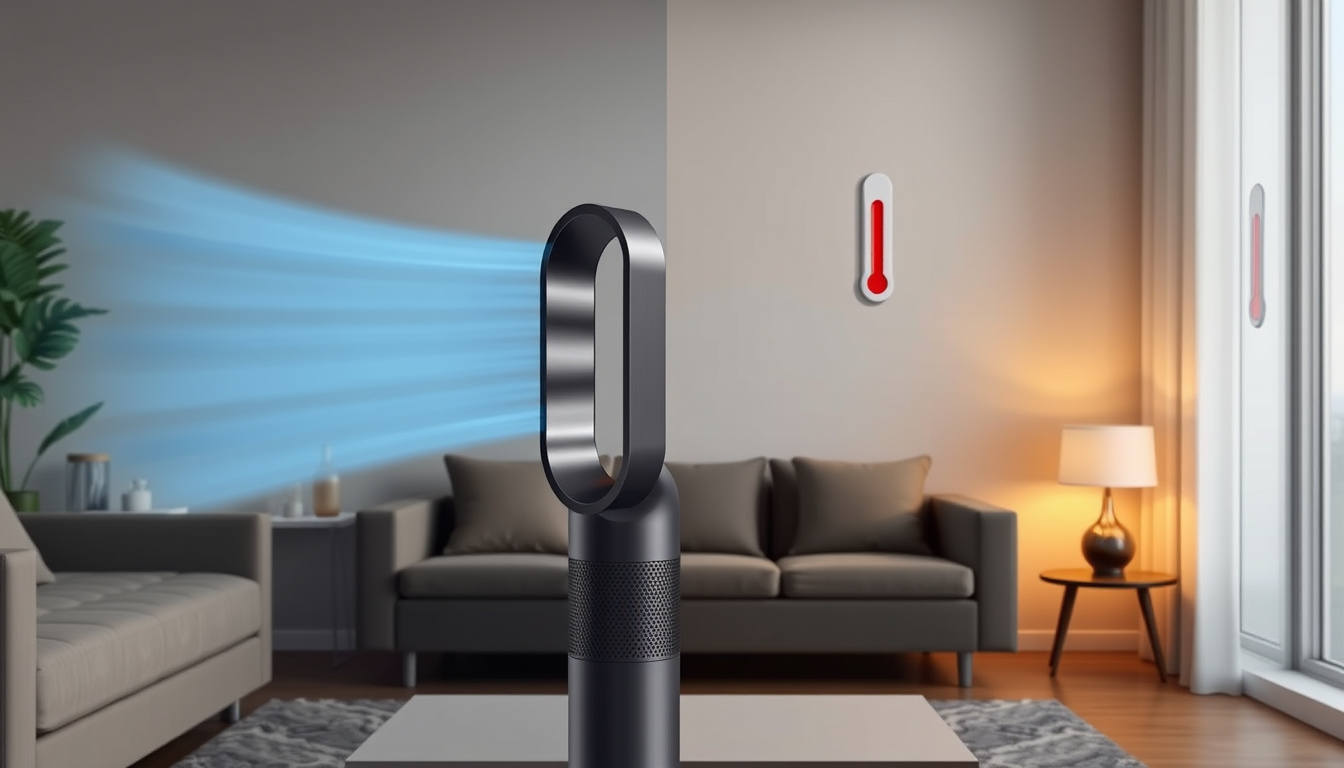
That slim tower in the corner promises to replace three appliances at once — a fan, a heater, and an air purifier. But for anyone living in an Irish semi-d with a drafty hallway, the real question is whether it actually works for our particular climate and electricity bills.
Heating power: 2000 W ·
Cooling airflow: 290 l/s ·
Filtration efficiency: 99.95% of ultrafine particles ·
Noise level (max): 64 dB ·
Weight: 5.65 kg
Quick snapshot
- 3-in-1 purifier fan heater (Dyson Ireland)
- Homeowners wanting year-round air treatment (The Irish Times)
- Heating: 2000 W · Cooling: fan only · Filtration: HEPA H13 (Dyson Ireland)
- €400 – €600 depending on model (The Irish Times)
| Specification | Value |
|---|---|
| Price range | €400 – €600 depending on model |
| Heater power | 2000 W |
| Airflow | 290 l/s on cooling |
| Filtration | HEPA H13, removes 99.95% of particles |
| Noise | Up to 64 dB on boost |
| Warranty | 2 years (UK/Ireland) |
Is Dyson Hot and Cold worth it?
What do owners say?
Consumer feedback on Irish retail sites like Curry’s and DID Electrical leans positive on heating speed and quiet operation, but several users note the fan doesn’t cool like an air conditioner — more on that below. The Irish Times described it as “a versatile fan and heater that blows hot and cold,” which matches the general sentiment: it’s a capable air circulator, not a replacement for AC.
How does price compare to value?
At €400–€600, the Dyson Hot and Cool sits well above a standard fan heater (€30–€80) or a standalone fan (€20–€50). The value proposition hinges on three factors: air purification (HEPA H13), year-round usability, and the claim of 30% running cost savings versus central heating in winter. Whether that saving holds across all Irish homes is not yet independently verified.
Does the Dyson Hot and Cool actually cool the air?
Cooling performance in different room sizes
The device moves air at up to 290 l/s using its Air Multiplier technology — no compressor, no refrigerant. In a standard Irish bedroom (12–15 m²), users report a noticeable draft that makes the room feel 2–4°C cooler. In a larger living room (25+ m²), the effect drops significantly because only ambient room air is circulated.
How does it compare to a dedicated fan?
A standard 16-inch pedestal fan moves roughly 140–200 l/s — the Dyson’s 290 l/s is stronger, but quieter at lower settings. The trade-off: the Dyson costs 10x more and still can’t lower the room’s actual temperature.
This is a circulator, not a cooler. On a 30°C Dublin summer day, it will make you feel cooler via wind chill, but the room will stay 30°C.
Does the Dyson Hot and Cool actually heat the air?
Heating power and thermostat control
The built-in 2000 W ceramic heater warms air as it passes through the bladeless loop — no exposed glowing elements, which is a safety plus for homes with children or pets. An integrated thermostat maintains the set temperature within ±1°C, according to Dyson Ireland. In practice, it can raise a small room from 15°C to 20°C in about 8–10 minutes.
Energy efficiency in heating mode
At full 2000 W output, running the heater for 1 hour consumes 2.0 kWh. Using Electric Ireland’s current rates (19.81 c/kWh daytime on dynamic plans, Electric Ireland), that’s roughly 40 cents per hour. Compared to central heating on gas (est. 8–12 c/kWh for equivalent heat), the Dyson is not cheaper per unit of heat — but Dyson claims 30% running cost savings versus central heating in winter because you heat only the room you’re in rather than the whole house.
Heating one room at 40 c/h vs. heating three rooms at 35 c/h via central heating: the Dyson wins only if you’re in a small flat or work from a single room. For a typical 3-bed semi-d, whole-house central heating still costs less overall.
Does the Dyson Hot and Cool use a lot of electricity?
Cost per hour of heating
At 2000 W max, the hourly cost ranges from roughly 30 to 45 cents depending on your supplier and plan — Selectra Ireland reported an average electricity price of 36.59 c/kWh in June 2026. Running it 4 hours daily in winter adds about €1.46 per day, or ~€44 per month.
Standby consumption
Dyson doesn’t publish official standby figures, but typical smart-connected appliances draw 1–3 W in standby. At average Irish rates, that’s less than €2 per year — negligible.
Comparison with space heaters and AC
Here’s how the Dyson stacks up against common alternatives for heating and cooling, using the average Irish electricity rate of 36.59 c/kWh from Selectra Ireland.
| Device | Power (W) | Cost per hour | Cooling mode? |
|---|---|---|---|
| Dyson Hot and Cool (heat) | 2000 | €0.73 | Yes |
| 1.5 kW fan heater | 1500 | €0.55 | No |
| Portable AC (cool) | 1000 | €0.37 | Yes |
| Central heating (gas, per room) | — | €0.20–0.30 | No |
| Electric oil radiator | 1000 | €0.37 | No |
The pattern: the Dyson is energy-efficient only if you use it to heat a single room instead of the whole house. On cooling, it consumes just the fan motor (~30–50 W), making it cheap to run.
Can Dyson Hot cool replace an AC?
Cooling capacity vs air conditioner
There is no refrigeration cycle inside this device. A portable air conditioner with a compressor can drop a room’s air temperature by 5–8°C. The Dyson simply circulates existing room air. For spot cooling — pointing the airflow directly at you — it works well. For lowering the actual temperature of a room, it cannot.
When it is a viable alternative
In Ireland, where high summer temperatures rarely exceed 28°C and humidity is moderate, many users find the Dyson’s cooling mode sufficient for comfort. On a 22°C day with 65% humidity, the moving air creates a feeling of 18–19°C — enough to work or sleep comfortably.
Limitations
For a 30°C heatwave, which is becoming more common in Irish summers, the Dyson will not provide relief comparable to even a modest portable AC. The irrelevance of the compressor is the dealbreaker at high ambient temperatures.
If you bought a Dyson Hot and Cool hoping to survive a 32°C Dublin summer without AC — you’ll be disappointed. It’s a circulator, not a chiller. Pair it with a cold-water spray mister for better effect.
Confirmed facts vs. what’s still unclear
Confirmed facts
- Dyson claims 30% running cost savings versus central heating (Dyson Ireland)
- Device removes 99.95% of ultrafine particles (HEPA H13)
- Heating output is 2000 W (Dyson Ireland)
- Price in Ireland ranges €400–€600 (The Irish Times)
What’s unclear
- Actual cooling effectiveness in hot Irish summers (no refrigeration)
- Long-term reliability of the motor and heater assembly
- Whether the 30% saving holds across all Irish home types
“The Dyson Pure Hot+Cool is a versatile fan and heater that blows hot and cold — a useful year-round appliance for many Irish homes.”
— The Irish Times review
“I bought it mostly for winter heating, but the fan mode is surprisingly quiet and keeps my small bedroom comfortable on warm nights.”
— Verified buyer review, Curry’s Ireland
energia.ie, smartermeter.ie, kovacor.com, saveonheat.ie, selectra.ie, selectra.ie, wattcharger.com, solarquotesireland.ie
Frequently asked questions
Does the Dyson Hot and Cool come with a remote control?
Yes, every Dyson Hot and Cool model includes a small, magnetised remote that attaches to the top of the unit. It controls power, temperature, fan speed, oscillation, and sleep timer.
How often should I clean or replace the filter?
The HEPA H13 filter should be replaced every 12 months under normal use. The outer mesh can be vacuumed every 2–4 weeks to maintain airflow. Dyson Ireland recommends annual filter replacement for optimal performance.
Is the Dyson Hot and Cool noisy when sleeping?
On the lowest fan speed (1–2), the unit produces around 28–35 dB — quieter than a typical PC fan or a refrigerator hum. On boost mode (10), it reaches 64 dB, comparable to a vacuum cleaner. The sleep timer lets you run it at a low speed for 1–9 hours.
Can I use the Dyson Hot and Cool in a damp bathroom?
Dyson advises against using the unit in wet environments. It is not IP-rated for bathroom use, and exposure to steam or water droplets can damage internal electronics. Use only in dry rooms.
What is the warranty period for Dyson Hot and Cool?
The standard warranty is 2 years (parts and labour) for purchases in Ireland and the UK. Registering the product on Dyson.ie extends coverage to 5 years on the motor and heater assembly.
Does the Dyson Hot and Cool connect to the Dyson Link app?
Only the “Smart” variants (e.g., Pure Hot+Cool Link) offer Wi-Fi connectivity for the Dyson Link app. The standard Hot+Cool models do not have app control — you get the remote control only.
How does the Dyson Hot and Cool compare to a Dyson Pure Hot+Cool?
The “Pure” prefix indicates the addition of a HEPA carbon filter for air purification. The basic Hot+Cool is a fan and heater only. The Pure Hot+Cool adds formaldehyde and VOC removal but costs roughly €100 more. For allergy sufferers, the Pure version is worth the extra.
For Irish buyers weighing a €400–€600 purchase that covers heating, cooling, and air quality in one slim tower, the decision isn’t about specs — it’s about honesty of expectation. The Dyson Hot and Cool is excellent at three jobs: circulating air in summer, providing quick warm air in winter, and filtering fine particles year-round. It is not an air conditioner, and it won’t replace a gas boiler in a 3-bed semi-d. For the renter in a Dublin apartment or the WFH professional in a spare bedroom, the one-room solution makes clear financial sense: €44 per month in winter heating cost beats heating the whole house for €70. For everyone else, the numbers demand a second look.