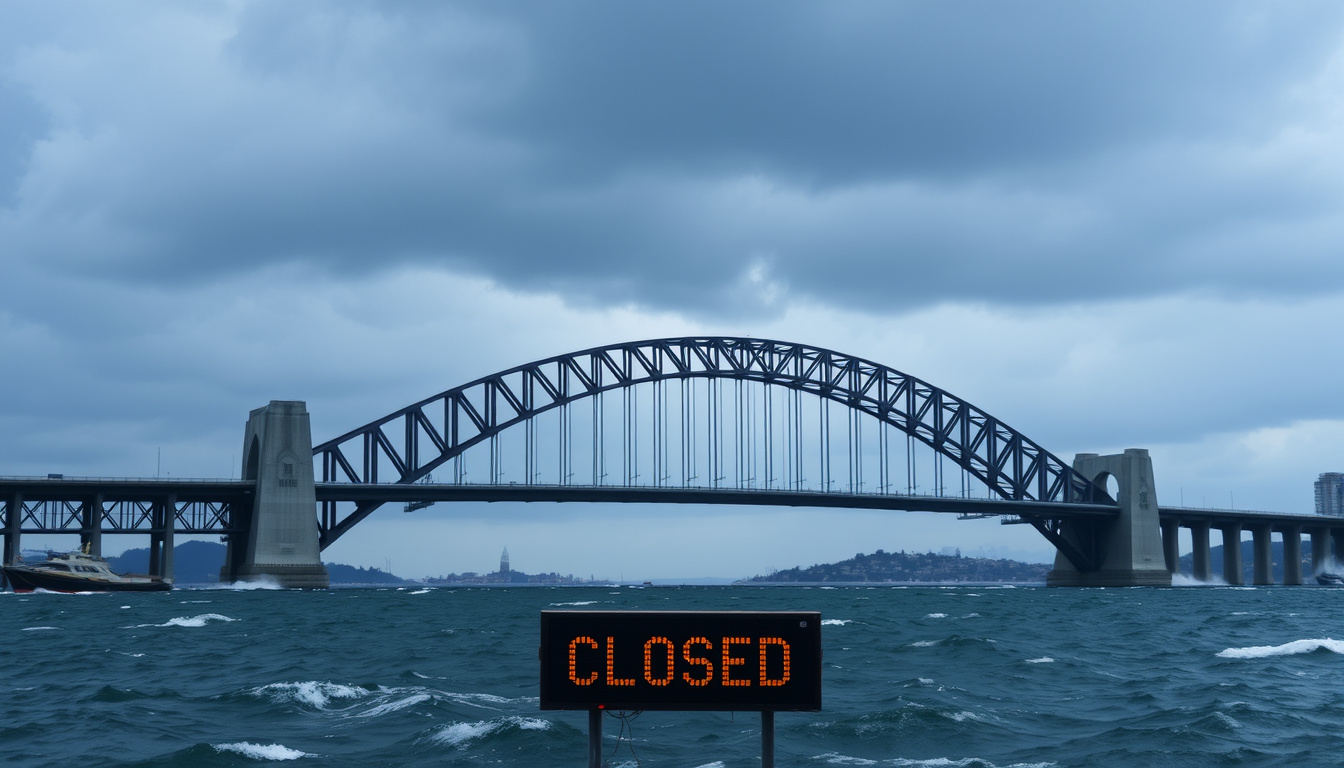
If you’ve ever driven across the Auckland Harbour Bridge and felt your steering wheel twitch in a sudden gust, you know wind is more than just a weather headline here. This guide pulls together the official closure thresholds, live weather resources, and practical safety tips so you can decide whether to cross or take the alternative route — no guesswork required.
Bridge length: 1,020 m ·
Number of lanes: 8 ·
Year opened: 1959
Quick snapshot
- Bridge closes to all traffic when wind gusts exceed 90 km/h (Auckland Transport)
- High-sided vehicles restricted at lower speeds (Newstalk ZB) (Auckland Transport)
- Exact escort thresholds vary by vehicle type and wind direction (Auckland Transport)
- Impact of 20 km/h gusts on all vehicles not equally understood
- MetService issues orange warnings for wind when sustained speeds exceed 60 km/h (MetService)
- Gusts up to 120 km/h possible during deep sub-tropical lows (Newstalk ZB) (MetService)
- Check MetService live observations before driving (MetService)
- Use western ring route (SH16/SH18) if high wind warning is active (Newstalk ZB) (MetService)
Five key numbers, one pattern: the bridge is engineered for everyday Auckland weather, but critical thresholds determine when it becomes unsafe for specific vehicle types.
| Fact | Value | Source |
|---|---|---|
| Bridge length | 1,020 m | Auckland Transport |
| Year opened | 1959 | Built data |
| Number of lanes | 8 | Design spec |
| Max wind speed before closure (gusts) | 90 km/h | Auckland Transport |
| Average annual rainfall in Auckland | 1,240 mm | MetService |
At what wind speed does the Auckland Harbour Bridge close?
The official threshold set by NZTA is clear: the Auckland Harbour Bridge is closed to all traffic when wind gusts exceed 90 km/h (about 56 mph). This decision is based on real-time readings from weather stations mounted directly on the bridge structure, monitored by the transport agency’s control room.
What is the official wind speed threshold for closure?
- Full closure: sustained winds above 90 km/h gust, or gusts exceeding that value (Auckland Transport)
- Partial closure or restricted lanes: winds between 60-90 km/h, depending on vehicle type (Newstalk ZB)
The implication: a 90 km/h gust is rare but not unheard of — during deep lows, gusts have been recorded above 120 km/h (Newstalk ZB).
Are there different restrictions for trucks and cars?
Yes. High-sided vehicles — trucks, vans, campervans, and motorcycles — face restrictions at lower wind speeds. Auckland Transport’s guidance states that escorts may be provided for light vehicles during high wind warnings, but heavy vehicles are often diverted or banned from the bridge when winds exceed 70 km/h sustained (Auckland Transport).
The pattern: lower thresholds for high-sided vehicles mean drivers of vans, trucks, and motorcycles must treat 70 km/h as their personal red line.
How does wind affect the Auckland Harbour Bridge?
Crosswinds are the main concern. The bridge runs roughly north-south, so westerly and easterly winds hit vehicles broadside. Strong crosswinds can push cars into adjacent lanes, especially lighter vehicles like hatchbacks and motorcycles.
How do wind gusts affect vehicle stability on the bridge?
- Gusts cause sudden lateral force, forcing drivers to overcorrect (Auckland Transport)
- High-sided vehicles act like sails, making them vulnerable at moderate wind speeds (Newstalk ZB)
Even a 40 km/h crosswind can shift a truck several feet in the lane. The bridge’s exposed position over the harbour amplifies wind effects — no buildings or trees to break the flow.
What is the role of bridge escorts in high winds?
When winds are high but below closure threshold, NZTA may use escort vehicles to lead light traffic across the bridge at reduced speed. This provides a safe buffer and clears the bridge faster if conditions worsen (Auckland Transport). Escorts are typically deployed for motorcycles and cars during amber-level wind warnings.
Why this matters: escorts reduce the risk but also slow traffic by 10-20 minutes. Allow extra time if you see warnings.
What’s the weather like right now in New Zealand?
For Auckland Harbour Bridge specifically, you need real-time wind data, not just a general forecast. Several sources offer live observations updated every hour or faster.
Where can I find real-time weather data for Auckland Harbour Bridge?
- MetService’s Auckland Central page — shows wind speed, gusts, and direction from automatic weather stations
- MetService 3-hourly observations map — interactive map of all reporting stations
- Windfinder (Auckland Airport) — detailed wind, swell, and tide data
- Windguru (Waitemata Harbour) — specialised wind forecast for the harbour
- Windy.app — spot forecast with hourly wind direction and gusts
What is the current temperature and wind speed?
As of the latest MetService data, the bridge area reported light southwest winds of 7 km/h with gusts of 13 km/h — well within safe limits (MetService). But conditions change fast. The MetService orange wind warning threshold kicks in when sustained speeds reach 60 km/h or gusts reach 80 km/h (MetService).
What this means: a quick 30-second check before leaving home can save you from getting stuck in unexpected lane closures.
Are 20 km wind gusts strong?
20 km/h (about 5.5 m/s) classifies as a moderate breeze on the Beaufort scale — Force 4. It moves small branches and raises light flags, but it’s unlikely to affect a standard sedan on the bridge.
How does 20 km/h wind compare on the Beaufort scale?
- Force 4: Moderate breeze, 20-28 km/h — small branches move, dust and loose paper raised (Auckland Transport)
- Force 5: Fresh breeze, 29-38 km/h — small trees sway, chances of crosswind effect increase
Can 20 km/h gusts affect driving?
For most cars, no. But for high-sided vehicles (vans, trucks, and especially motorcycles), 20 km/h crosswinds can cause slight steering corrections. Motorcyclists should hold the handlebars firmly and be aware of gust zones near bridge towers (Newstalk ZB).
The pattern: what feels mild to a sedan can be a white-knuckle moment for a biker. That’s why NZTA issues separate warnings for high-sided vehicles even when general traffic is cleared.
What wind conditions result in high wind warnings, escorts, or partial closures?
NZTA operates a tiered decision matrix. It starts with a high wind warning, then escalates to partial closures (restricting specific vehicle types), and finally a full bridge closure if conditions become dangerous.
What wind speeds trigger a high wind warning?
- High wind warning issued when sustained winds exceed 60 km/h or gusts exceed 80 km/h (MetService)
- Orange warning for wind: MetService criteria are 100+ km/h gusts in exposed places, but for the bridge, lowering thresholds are used (MetService)
What does a partial closure mean for drivers?
A partial closure means some lanes are closed, or certain vehicle types are banned. For example, during the deep low described by Newstalk ZB, NZTA said winds may force lane closures and additional short periods of full closure to ensure safety. High-sided vehicles and motorcyclists were advised to use the western ring route on State Highways 16 and 18 (Newstalk ZB).
If MetService issues an orange wind warning for Auckland, expect the bridge to switch to partial closures within hours. Check electronic signs on the motorway before you enter the on-ramp.
The implication: drivers of high-sided vehicles should treat an orange wind warning as a personal detour signal, not just a weather alert.
Safety is our priority, and closures are decided based on real-time wind readings. We advise drivers to pay attention to electronic signs on the motorway during severe weather.
— NZTA spokesperson, via Auckland Transport
Winds may force lane closures and additional short periods of full closure to ensure safety. Drivers of high-sided vehicles and motorcyclists should avoid the bridge and use the western ring route.
— Newstalk ZB report referencing NZTA advice, Newstalk ZB
Confirmed facts and what remains unclear
Confirmed facts
- Auckland Harbour Bridge closes when wind gusts exceed 90 km/h (Auckland Transport)
- MetService issues high wind warnings (MetService)
- High-sided vehicles are restricted at lower wind speeds (Newstalk ZB)
What’s unclear
- Exact threshold for escorts varies by vehicle type and wind direction (Auckland Transport)
- Whether 20 km/h gusts affect all vehicles equally — confirmed data is limited
For Auckland drivers, the choice is clear: check real-time wind data before leaving, especially if you drive a high-sided vehicle or a motorcycle. If MetService shows sustained winds above 60 km/h or gusts above 80 km/h, take the western ring route (SH16 and SH18) or delay your trip. The bridge will still be there when the wind drops — your safety isn’t worth the gamble.
Frequently asked questions
Can I drive a motorcycle over the bridge in high winds?
Motorcycles are particularly vulnerable to crosswinds. During high wind warnings (sustained winds >60 km/h or gusts >80 km/h), NZTA advises motorcyclists to avoid the bridge and use the western ring route (Newstalk ZB).
What should I do if I’m on the bridge during a wind warning?
Reduce speed, hold the steering wheel firmly, and avoid sudden movements. If conditions worsen, drive to the nearest exit and consider the alternative route (Auckland Transport).
Are there webcams showing bridge conditions?
Yes. NZTA operates traffic cameras at the bridge. You can view live images on the NZTA website or via the Auckland Traffic app. Webcams show current traffic density and weather visibility.
How often does the bridge close due to wind?
Full closures are rare — typically a few times a year when deep lows pass over the region. Partial closures and lane restrictions happen more frequently during winter storms (MetService).
What is the alternative route when the bridge is closed?
The western ring route uses State Highways 16 (Northwestern Motorway) and 18 (Upper Harbour Motorway) to bypass the bridge. It adds about 15-20 minutes to a typical trip from the North Shore to the city centre (Newstalk ZB).
Does the bridge close for rain or fog?
Rain alone rarely closes the bridge, but heavy rain combined with high winds can trigger restrictions. Fog reduces visibility but is managed with speed limits, not closures. The primary closure trigger remains wind.