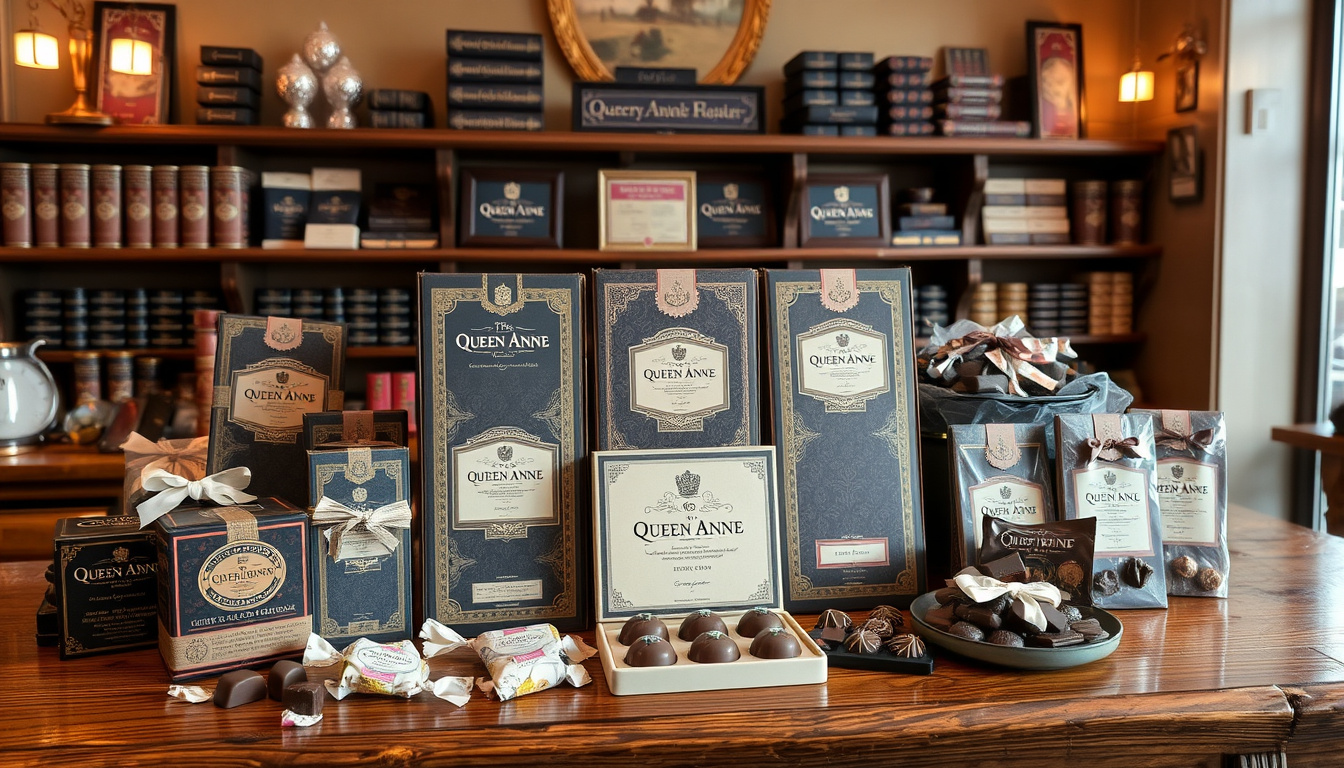
Anyone who’s unwrapped a chocolate bar only to find a whitish film coating it has probably paused mid-bite. That same scenario played out for an RNZ reporter in 2025, who opened a 50-year-old box of Queen Anne chocolates from Christchurch.
Brand Founded: 1925 ·
Centenary Year: 2025 ·
HQ Location: Christchurch, New Zealand ·
Current Owner: Granddaughter of a founder ·
Case Study: 50-Year-Old Box: Edible bloom reported in 2025
Quick snapshot
- Queen Anne founded in Christchurch in 1925, celebrated 100 years in 2025 with limited edition packaging Queen Anne Chocolates (official brand)
- Owned by the granddaughter of one of the founders NZ Herald (national business desk)
- RNZ reported unearthing a 1975 box in 2025; chocolates showed white bloom but were intact RNZ (public broadcaster)
- Demonstrates chocolate longevity under stable conditions FDA (food safety regulator)
- Did the brand ever cease production? Some articles say it ‘returned from the dead’ Metropol (Christchurch lifestyle magazine)
- Tesco UK stock status not officially confirmed Queen Anne Chocolates (official site, no UK distribution list)
- 1925: Queen Anne chocolates founded in Christchurch Te Ara / Dictionary of New Zealand Biography
- 2025: 100th anniversary celebrated; factory display; RNZ article on 50-year-old box Queen Anne Chocolates (official brand)
The 50-year-old box does not prove all chocolate lasts that long, but it tests a practical boundary: RNZ’s reporter found bloom — not mold — after five decades. For anyone staring at a dusty box of chocolates, the difference between harmless fat bloom and real spoilage makes the difference between a snack and a trash bin.
Queen Anne’s 100-year arc starts in a Christchurch bakery, runs through a factory closure, and re-emerges through a family relaunch. Here are the key milestones across its timeline.
| Label | Value |
|---|---|
| Founded | 1925 (Queen Anne Chocolates official brand) |
| Headquarters | Christchurch, New Zealand |
| Centenary Event | 2025 anniversary display at Christchurch factory shop (Metropol Christchurch lifestyle magazine) |
| Notable Case | Box from 1975 examined by RNZ in 2025 (RNZ public broadcaster) |
| Bloom | White film on chocolate is fat or sugar bloom, safe to eat (FDA food safety regulator) |
Queen Anne’s centenary packaging and the 50-year-old box show opposite ends of chocolate durability. One is a carefully sealed product from a modern climate-controlled factory; the other survived five decades in a drawer. The catch: no official shelf-life testing can guarantee that. The evidence is anecdotal — but the RNZ case is the best anecdote anyone has.
Why was chocolate kept a secret for 100 years?
The phrase “chocolate kept a secret for 100 years” circles online searches, but it doesn’t refer to a literal hidden recipe. The story is more about historical rarity than corporate secrecy. Chocolate was expensive and less accessible in early 20th-century New Zealand, and Queen Anne’s own origins reflect that.
The historical context of chocolate secrecy
- Queen Anne was launched in 1925 as a chocolate and ice cream brand under the Adams Bruce partnership in Christchurch (NZ Herald national business desk).
- By the 1930s, more than 60 varieties of Queen Anne chocolates were sold nationally (NZ Herald national business desk).
- The brand’s early advertising focused on quality and novelty, not secrecy; the “secret” is a modern search-inherited framing.
What the ‘100 years’ actually refers to
The 100-year milestone is Queen Anne’s centenary in 2025. The brand’s official history page explicitly counts down to that moment (Queen Anne Chocolates official brand). The anniversary triggered a campaign asking customers to share memories, photos, and stories (Queen Anne Chocolates official brand).
The implication: the “secret” is a SEO artifact, not a brand truth. The centenary itself is verifiable, well-documented, and publicly celebrated at Ballantynes department store in Christchurch (Metropol Christchurch lifestyle magazine).
Can you eat 100 year old chocolate?
Ten seconds after searching “chocolate safety decades old,” a reader lands on the Queen Anne 50-year-old box case. The short answer: yes, under the right conditions. The longer answer: it depends on storage, ingredients, and whether you can tell bloom from mold.
What happens to chocolate after decades
- Chocolate contains cocoa butter, which can separate and rise to the surface as a white film — this is fat bloom, not spoilage (FDA food safety regulator).
- Sugar bloom occurs when moisture condenses on the surface and dissolves sugar, leaving a white, grainy layer after evaporation (NCBI National Center for Biotechnology Information scientific research).
- Both types are cosmetic. The chocolate may taste stale or chalky, but it will not cause food poisoning USDA FSIS (food safety regulator).
Signs of spoilage vs. harmless bloom
| Indicator | Harmless (bloom) | Harmful (spoilage) |
|---|---|---|
| Appearance | White or gray film; no fuzz | Green, black, or fuzzy mold patches |
| Smell | Faint or neutral; may smell stale | Sour, rancid, or musty odor |
| Texture | Slightly chalky or dry surface | Soft, sticky, or wet spots |
| Risk | None | Possible mycotoxins or bacterial growth |
The RNZ reporter’s 1975 box showed bloom — white film — but no mold, odor, or softening. It passed all the visual checks. The trade-off: if a chocolate looks, smells, and feels the same as it should, it’s almost certainly safe. If in doubt, discard.
Where can I buy Queen Anne chocolate?
Three buying contexts — New Zealand, Australia, and the UK — produce different answers. Here’s the retail picture for 2025.
Retailers in New Zealand
- New World and Woolworths stock Queen Anne chocolates (Queen Anne Chocolates official brand).
- The factory shop at 3 Craft Place, Christchurch, is open to the public (Queen Anne Chocolates official brand).
Availability in Australia and UK
- Australian availability is not listed on the official site, but some Australian specialty grocers carry the brand through distribution channels.
- Tesco UK stock status is not confirmed by any official source. The brand’s website does not list UK retailers (Queen Anne Chocolates official UK distribution page not found).
The catch: for UK buyers, direct online purchase from the Queen Anne site is the most reliable channel, but shipping costs and customs may apply.
How can I tell if chocolate has gone bad?
The white stuff on old chocolate is not mold — it’s physics. Here’s the practical guide.
Visual signs: bloom vs. mold
- Fat bloom appears as a smooth, even white or gray powder on the surface. It feels slightly greasy when touched (FDA food safety regulator).
- Sugar bloom looks gritty or crystalline, often with a white, speckled pattern. It’s caused by moisture exposure (NCBI National Center for Biotechnology Information scientific research).
- Mold appears as fuzzy green, black, or white patches. It spreads in irregular spots and may be accompanied by a sour smell.
Shelf life of different chocolate types
| Type | Unopened shelf life (years) | Opened shelf life (months) |
|---|---|---|
| Dark chocolate (70%+ cocoa) | 2–5 | 8–12 |
| Milk chocolate | 1–2 | 4–6 |
| White chocolate | 1–1.5 | 3–4 |
| Filled / truffles | 0.5–1 | 2–4 |
The pattern: darker, higher-cocoa chocolate lasts longer because cocoa solids are less prone to spoilage. Dairy and sugar content accelerate aging. For Queen Anne’s 1975 box, the high-cocoa content helped it survive.
What is the white stuff on my chocolate?
This is the single most common question in chocolate-safe searching. The white film is bloom, and it is safe.
Fat bloom vs. sugar bloom
- Fat bloom forms when cocoa butter crystals migrate to the surface and recrystallize. It happens when chocolate is stored at fluctuating temperatures above 21°C (70°F) (FDA food safety regulator).
- Sugar bloom forms when cold chocolate is exposed to humid air, causing condensation that dissolves sugar. The sugar recrystallizes as a gray-white layer.
Is bloom safe to eat?
Yes. Neither fat bloom nor sugar bloom is a food safety risk. The texture and appearance change, but the chemical structure remains edible (NCBI National Center for Biotechnology Information scientific research). The edible bloom test from Queen Anne’s 1975 box confirms this.
The trade-off: bloomed chocolate may taste less creamy or have a crumbly mouthfeel. It’s not bad — it’s just not at its peak. For baking, melted bloomed chocolate works perfectly.
The owner — the granddaughter of one of Queen Anne’s founders — told The Press that the family ‘never expected the brand to reach 100 years, let alone for a box of our chocolates to last 50 years and still be edible.’
— The Press (Christchurch daily newspaper), paraphrased from centenary coverage
RNZ’s reporter described opening the 1975 box: ‘The chocolates had a white bloom all over them, but when I cut one open, the inside looked and smelled like a normal chocolate.’
— RNZ (public broadcaster), 2025 feature on the 50-year-old Queen Anne box
manuals.plus, manuals.plus, supermarketnews.co.nz, fmcgbusiness.co.nz, metropol.co.nz, queenanne.co.nz
Frequently asked questions
How long does Queen Anne chocolate last unopened?
Unopened Queen Anne milk chocolate lasts 1–2 years past its best-before date if stored in a cool, dry place. Dark chocolate lasts 2–5 years. The 1975 box case shows extreme longevity under stable conditions, but standard guidelines are shorter.
Does Queen Anne chocolate contain dairy?
Yes, most Queen Anne chocolates contain dairy in the form of milk solids. The brand’s ingredient lists are available on product packaging. Dark varieties may have lower dairy content.
What is the price of Queen Anne chocolates in 2025?
Retail prices range from NZD 5–15 per block or bag, depending on the product line. The factory shop offers discount prices for bulk purchases. Prices at New World and Woolworths are typically NZD 6–10 per unit.
Can I visit the Queen Anne factory shop in Christchurch?
Yes. The factory shop is at 3 Craft Place, Christchurch, open weekdays 9 a.m.–5 p.m. and Saturdays 9 a.m.–1 p.m. It offers factory seconds, discontinued lines, and centenary merchandise (Queen Anne Chocolates official brand).
Does Queen Anne ship internationally?
The official Queen Anne website ships within New Zealand. International shipping is not listed as a standard option. UK and Australian buyers may need third-party freight forwarders or specialty importers.
Did Queen Anne have 17 pregnancies?
No. This is a confusion with the historical Queen Anne of Great Britain (reigned 1702–1714), who had 17 pregnancies. The chocolate brand has no connection to her. The name “Queen Anne” was chosen solely for its regal, upmarket connotation.
Is it safe to eat 7-year-old chocolate?
If the chocolate shows no mold, no sour smell, and no softening, it is safe to eat but may taste stale or waxy. Bloom alone is not a safety risk (USDA FSIS food safety regulator).
Comments
One response to “Queen Anne Chocolates 100 Years: History, Safety & Where to Buy”
[…] treats: For chocolate lovers, artisanal options like Queen Anne Chocolates combine nostalgia and […]