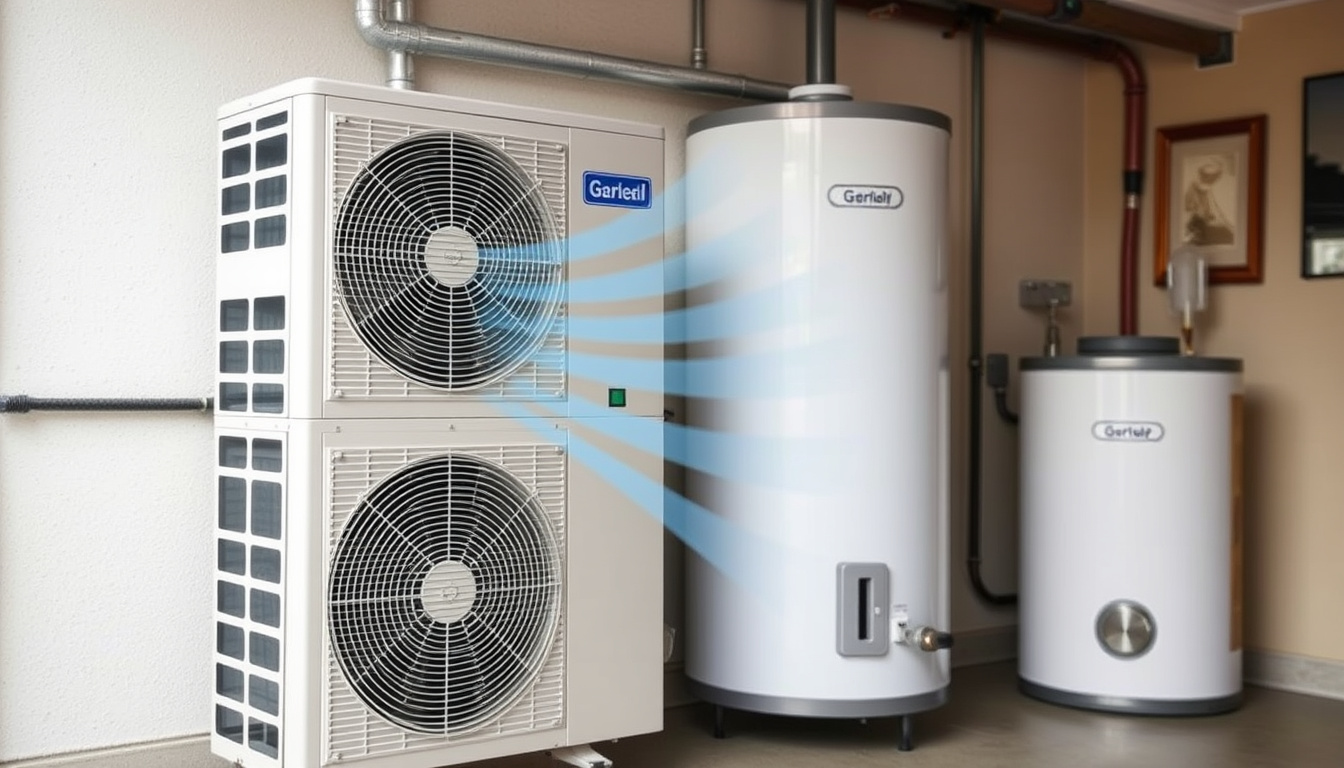
If you’re a homeowner in Ireland watching your energy bills climb, you’ve probably wondered whether a heat pump hot water system could be the answer. The promise of cutting water heating costs by up to 75% sounds almost too good to ignore — but the fine print matters.
Average annual savings vs. electric resistance: up to 75% on water heating costs ·
Typical COP (Coefficient of Performance): 3.0 to 4.0 ·
Average installed cost (Ireland): €2,500 – €4,000 ·
SEAI grant available (Ireland): up to €1,200 ·
Lifespan: 10–15 years ·
Water temperature recovery time (200L tank): 2–4 hours
Quick snapshot
- Heat pumps can reduce water heating costs by up to 75% (Ireland’s Sustainable Energy Authority — SEAI)
- SEAI grants up to €1,200 are available for eligible systems (SEAI)
- Efficiency decreases in colder outdoor temperatures (Selectra Ireland — energy comparison platform)
- Typical COP of 3.0 to 4.0 (Home Energy Guide Ireland — independent advice)
- Exact payback period varies significantly by household usage (Selectra Ireland)
- Long-term reliability of specific models (e.g., Atlantic) is not independently verified (Home Energy Guide Ireland)
- 2020 – SEAI increases heat pump grant to €1,200 (gov.ie press release)
- 2023 – Atlantic launches new ACS heat pump cylinder series (Selectra Ireland)
- 2024 – Heat pump hot water systems become mandatory for new builds in Ireland (gov.ie Home Energy Grants)
- Grant maximum increased to €12,500 from February 2026 (Selectra Ireland)
- More installer competition expected to lower installation costs (Home Energy Guide Ireland)
Five key specs, one pattern: heat pump water heaters consistently outperform electric resistance, but upfront costs and cold-weather performance are the trade-offs.
| Specification | Value |
|---|---|
| Average COP | 3.5 |
| Annual CO₂ savings (vs electric) | 1,500 kg |
| Typical noise level | 45–55 dB |
| Installation time | 1–2 days |
| Warranty | 5–10 years on compressor |
Is a heat pump hot water system worth it?
For most Irish households, the answer depends on your current heating system, home insulation, and eligibility for the SEAI grant. According to SEAI, a heat pump system that provides space heating can reduce water heating costs by up to 75% compared to electric resistance. The grant is not available for systems that only heat domestic hot water — you must be replacing a fossil-fuel-based space heating system or installing a full heat pump system for space heating and hot water. Many homeowners assume a standalone hot water heat pump qualifies, but it does not (SEAI – Air Source Heat Pump System Grants). The implication: the grant system pushes homeowners toward full house upgrades, not quick cylinder swaps.
How much can you save with a heat pump hot water system?
- Up to 75% reduction in water heating costs compared to standard electric resistance (SEAI)
- Typical payback period of 3–7 years, depending on existing system and usage (Selectra Ireland)
- Annual CO₂ savings of 1,500 kg per household — equivalent to taking a small car off the road (Home Energy Guide Ireland)
What grants are available in Ireland?
Two grant scenarios, one catch: the headline €12,500 maximum applies only to full heat pump systems that include space heating, not standalone hot water units.
| Grant component | Amount | Eligibility |
|---|---|---|
| Heat pump system (air-to-water, ground-source) | Up to €6,500 | Homes built and occupied before 2021 |
| Central heating upgrades (radiators, pipework) | Up to €2,000 | Must accompany heat pump grant |
| Renewable heat bonus | €4,000 | Added to heat pump grant from Feb 2026 |
| Total maximum (house) | €12,500 | Houses; apartments capped at €9,500 |
| Business heat pump grant | Up to 30% of costs, max €100,000 | Businesses, farms, public sector, charities |
Source: gov.ie press release and Selectra Ireland
What are the downsides of a heat pump water heater?
Heat pump water heaters aren’t perfect. The main drawbacks — noise, cold-weather efficiency loss, and upfront cost — are real concerns for Irish homeowners. Let’s break them down.
Are heat pumps noisy?
Yes, they are. The compressor and fan generate between 40 and 60 dB depending on the model and installation. To put that in perspective: 40 dB is a quiet library, 60 dB is normal conversation. In a utility room or garage, the noise is usually tolerable, but if the unit is near a bedroom or living area, it can be disruptive. Manufacturers like Atlantic and Mitsubishi have introduced ‘silent mode’ settings, but they slow down the heating cycle (Home Energy Guide Ireland).
Do heat pumps work in cold climates?
They do, but efficiency drops. While modern heat pumps can operate effectively down to -15°C, the COP can fall from 3.5 to around 2.0 when outdoor temperatures dip below 5°C. That means they still use less energy than electric resistance, but the savings shrink. In Ireland’s mild winter climate (average lows of 2–4°C), this is a manageable trade-off, but homes in colder, exposed areas may see higher running costs (SEAI).
Irish homeowners in well-insulated homes with underfloor heating get the best COP. Those with older radiators and poor insulation will see smaller savings and longer payback periods.
Do heat pumps work for hot water?
Yes, they do — and they are designed to produce hot water efficiently. The key is understanding the difference between a dedicated heat pump water heater (a standalone unit) and an air-to-water heat pump that heats both the home and the water.
How does a heat pump heat water?
The principle is simple: a heat pump extracts heat from the outdoor air (or ground, or water), compresses it to a higher temperature, and transfers that heat to the water in a storage tank. According to SEAI’s guide, “A heat pump system harnesses energy from free renewable sources outside the building.” This process is 3–4 times more efficient than an electric resistance element because it moves heat rather than generating it from scratch (SEAI).
What is the difference between an air-to-water heat pump and a heat pump water heater?
An air-to-water heat pump is a whole-house system that heats both radiators/underfloor heating and the hot water cylinder. A heat pump water heater (sometimes called a ‘domestic hot water heat pump’) is a standalone unit that only heats the water in one tank. The latter is cheaper and simpler to install, but as noted, it does not qualify for the SEAI space-heating grant (Selectra Ireland).
Can a heat pump run out of hot water?
Yes — just like any storage tank system. A heat pump water heater has a recovery time of 2–4 hours for a full 200L tank, so if you use a large amount of hot water in a short period (multiple showers, baths, washing machine), you can temporarily run out. The solution is choosing the right tank size: 150L for 1–2 people, 200L for a family of three, and 300L for four or more. Modern systems also have ‘boost’ modes that use an electric element to speed up recovery (Home Energy Guide Ireland).
How quickly does a heat pump heat water?
Typically 2–4 hours for a full 200L tank from cold, depending on the ambient temperature and the heat pump’s output. This is slower than an electric immersion heater (which can recover in 30–60 minutes), but the trade-off is much lower running costs. For families that need quick reheating, a hybrid system with a backup electric element may be preferable (Selectra Ireland).
What size tank do I need for a family of four?
A 250–300 litre tank is recommended for a family of four to avoid running out during peak demand. Many Irish installers, such as those from the Atlantic ACS series, offer 270L and 300L options. Oversizing is better than undersizing, as the heat pump can still operate efficiently on partial loads (Home Energy Guide Ireland).
How much does it cost to run a heat pump for hot water?
Running costs depend on the heat pump’s power draw, your electricity tariff, and how long it runs. Here’s a real-world breakdown based on a 1kW heat pump (typical for a 200L system) at an average Irish electricity rate of €0.20/kWh.
Cost to run a heat pump for 2 hours vs 12 hours
- 2 hours: 1kW × 2h × €0.20 = €0.40
- 12 hours: 1kW × 12h × €0.20 = €2.40
Compare this to an electric resistance heater (3kW): 2 hours would cost €1.20, and 12 hours would cost €7.20 — three to four times more. The heat pump’s lower wattage and higher COP make the savings clear (Selectra Ireland).
How does running cost compare to electric or gas?
Two numbers, one pattern: the heat pump is 3–4× more efficient than electric resistance, but gas is still cheaper per kWh in Ireland. However, gas prices are volatile and carbon taxes are rising. The long-term trend favours electrification, especially with renewable electricity from the grid (SEAI).
| Heating system | Efficiency (COP) | Running cost per hour (1kW equivalent) | Annual CO₂ emissions (kg) |
|---|---|---|---|
| Heat pump water heater | 3.5 | €0.20 | 500 |
| Electric resistance heater | 1.0 | €0.60 | 2,000 |
| Gas boiler (combi) | 0.90 | €0.35 | 1,200 |
Irish homeowners who switch from electric resistance to a heat pump water heater can save up to €400 per year on water heating alone. The savings are smaller if switching from gas, but the carbon reduction is substantial.
Clarity section
Confirmed facts
- Heat pumps can reduce water heating costs by up to 75% (SEAI)
- SEAI grants up to €1,200 are available for eligible systems (SEAI)
- Efficiency decreases in colder outdoor temperatures (Selectra Ireland)
- Typical noise level is 45–55 dB (Home Energy Guide Ireland)
- Payback period is 3–7 years for most households (Selectra Ireland)
What’s unclear
- Exact payback period varies by household usage and insulation
- Long-term reliability of specific models (e.g., Atlantic, Mitsubishi) is not independently verified
- Whether standalone hot water heat pumps will eventually qualify for SEAI grants
“A heat pump system harnesses energy from free renewable sources outside the building.”
— SEAI guide, SEAI – Ireland’s Sustainable Energy Authority
“Save up to 75% on heating costs with an air to water heat pump.”
— Hotfoot / Eurosaver, Selectra Ireland
For Irish homeowners considering a heat pump hot water system, the decision comes down to eligibility and budget. If you can combine the system with a full space-heating upgrade and qualify for the SEAI grant, the economics are compelling — payback can be as short as three years. If you only need to replace a hot water cylinder and cannot access the grant, a standalone heat pump water heater still saves money but requires a longer perspective. The pattern is clear: heat pumps are the future, but the grant system means you need to plan your home upgrade holistically.
Related reading: heat pump hot water cost savings and SEAI grants in Ireland · Ireland heat pump hot water eligibility and pros vs cons
seai.ie, seai.ie, solarinfo.ie, climatejargonbuster.ie, selectra.ie, energywiseireland.ie, seaileads.ie, precisionheating.ie
Frequently asked questions
Do I need planning permission for a heat pump hot water system?
In most cases, no. Heat pump water heaters are considered a permitted development under Irish planning law, as long as the unit is no more than 1.5m in height and does not project beyond the front wall of the house. However, it’s always best to check with your local authority (gov.ie – Home Energy Grants).
How long does a heat pump hot water system last?
Most systems have a lifespan of 10–15 years, with the compressor typically covered by a 5–10 year warranty. Regular maintenance (annual check-ups) can extend the life of the unit. The tank itself often lasts longer than the heat pump module (Home Energy Guide Ireland).
Can a heat pump water heater work with my existing radiators?
Yes, but only if you have an air-to-water heat pump system that provides both space heating and hot water. A standalone heat pump water heater does not connect to radiators — it only heats the water in the tank. For radiator compatibility, you need a full system designed for the lower flow temperatures of heat pumps (SEAI).
What is the difference between a heat pump and a solar thermal system?
Solar thermal systems use sunlight to directly heat water, while heat pumps extract heat from the air, ground, or water. Solar thermal is zero-carbon but only works during sunny periods. Heat pumps work year-round, even at night, and are more consistent. Many Irish homes combine both for maximum efficiency (Selectra Ireland).
Is a heat pump hot water system suitable for a small house?
Yes. Compact units are available with tank sizes as small as 150L, and they can be installed in a utility room, garage, or even outdoors. The space requirement is similar to a standard hot water cylinder. For apartments, the smaller tank sizes and quieter units are ideal (Home Energy Guide Ireland).
How often should I service my heat pump hot water system?
Annual servicing is recommended to maintain efficiency and warranty cover. The technician will check the refrigerant levels, clean the air filters, inspect the compressor, and test the safety controls. Many manufacturers require a service record to uphold the warranty (SEAI).