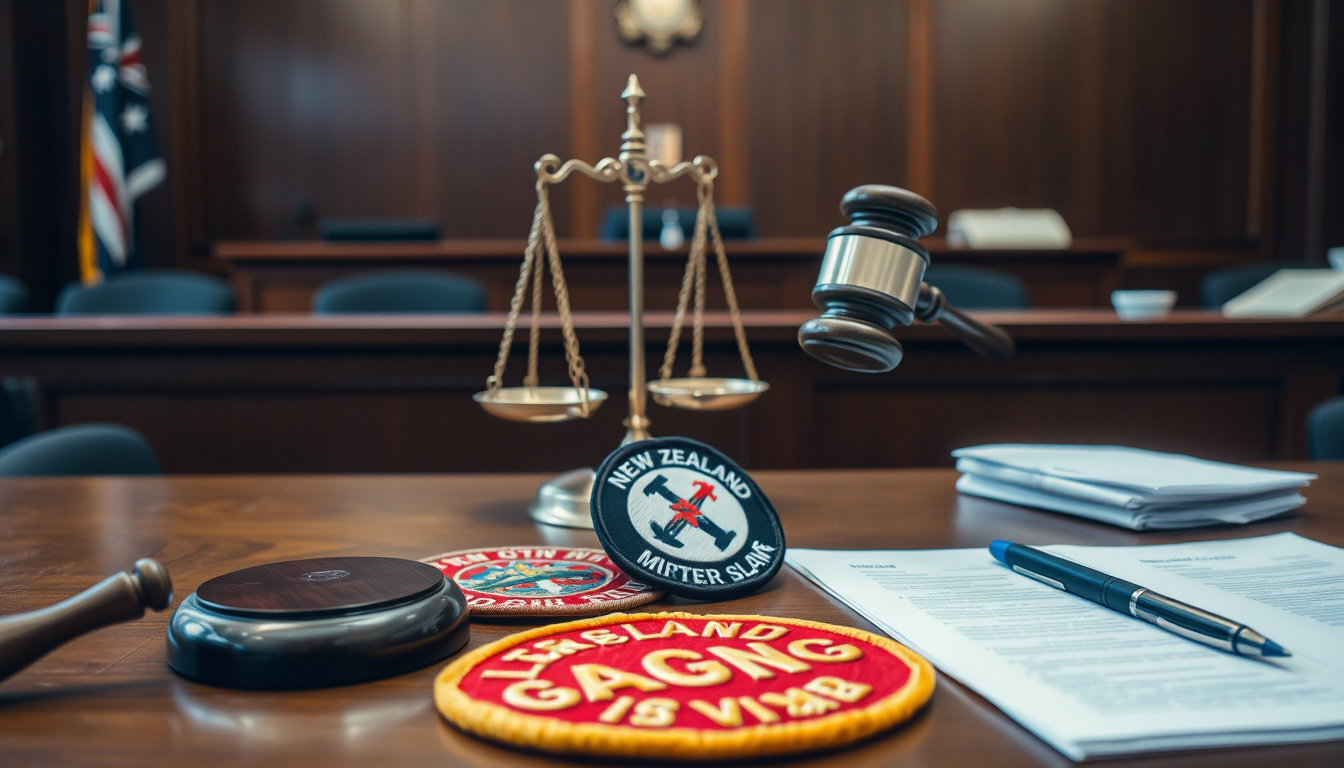
New Zealand’s gang patch ban has survived multiple courtroom tests since taking effect in November 2024, but the legal fight over whether the law should exist at all continues. A landmark conviction against Mana Brown has now exhausted three levels of court review, while police appeals over returned patches keep the enforcement boundaries in flux.
Legislation Enacted: Gangs Act 2024 · Key Challenge Date: 4 Mar 2025 · Court of Appeal Ruling: Upholds conviction (2 Mar 2026) · Police Appeal Announced: On two decisions returning patches · First Patch Ban Conviction Appeal: Failed (31 Mar 2025)
Quick snapshot
- Gangs Act 2024 bans public display of patches from 35 identified gangs (Klaut Media)
- Mana Brown convicted, High Court upheld ruling on 31 December 2024 (Courts of NZ)
- Court of Appeal refused leave to appeal on 2 March 2026 (NZ Herald)
- Long-term ban effectiveness across different regions
- Whether Supreme Court will hear further appeals
- Consistency of enforcement nationwide
- High Court judgment: 31 March 2025
- Court of Appeal decision: 2 March 2026
- Police announcing appeals on patch returns
- Police appealing two patch return decisions
- Additional constitutional challenges may follow
- Ongoing monitoring of enforcement patterns
The key facts table below summarises the core data around New Zealand’s gang patch ban and its legal challenges.
| Label | Value |
|---|---|
| Legislation Name | Gangs Act 2024 |
| Primary Prohibition | Wearing gang patches |
| Notable Challenge | Lawyer cites Nazi Germany (RNZ, 4 Mar 2025) |
| Court Outcome Example | Mana Brown conviction upheld (NZ Herald, 2 Mar 2026) |
| Police Response | Appealing two patch return decisions |
What is the new gang law in New Zealand?
The Gangs Act 2024 came into force on 21 November 2024, prohibiting the public display of gang patches and insignia across New Zealand. The legislation targets 35 identified gangs, making it illegal to wear, display, or possess gang insignia in public places—including inside vehicles where the items are visible to others. The official purpose of the law, according to the NZ Police enforcement policy, is to reduce gangs’ ability to cause fear, intimidation, and disruption in communities.
Parliament passed the legislation by a margin of 68 to 55, reflecting deep divisions over its constitutionality. Attorney-General Judith Collins had publicly noted the patch ban “appears to be inconsistent with the rights to freedom of expression, association, and peaceful assembly under the New Zealand Bill of Rights Act 1990.” (Klaut Media analysis) Justice Minister Paul Goldsmith admitted the law breaches human rights but argued those rights could be “justifiably limited” to “achieve a social benefit such as the prevention of crime.” (Wikipedia overview)
Gangs Act 2024 overview
The Act grants police sweeping new powers beyond the patch ban itself. Under the legislation, police can issue dispersal notices ordering gang members to leave public areas for seven days, and courts can issue non-consorting orders preventing gang members from associating for three years. Repeat offenders can receive Gang Insignia Prohibition Orders (GIPOs) prohibiting possession of insignia, including in private homes, for five years. Gang membership also became an aggravating factor in sentencing under the Sentencing Amendment Act 2024. (Ministry of Justice guidance)
Police can act against gang visibility even before any criminal conduct occurs—the Act treats gang insignia itself as a threat to public order.
Key provisions on patches
The definition of “gang insignia” under the Act is broad, covering patches, emblems, colours, and any marking that identifies a person as a member of a listed gang. The ban applies to all public places and extends to vehicles visible from outside. The New Zealand Law Society raised concerns that non-consorting orders represent an unprecedented incursion into private life, potentially criminalizing association between family members who happen to be gang affiliates. (The Spinoff criticism)
The pattern emerging from courts suggests judicial caution about applying the law too broadly. Mana Brown’s case involved no intimidation, no public complaints, and occurred at a community event—a context courts appear reluctant to treat as equivalent to gang intimidation in crime-affected neighbourhoods.
What are the rules around wearing gang patches in New Zealand?
Under the Gangs Act 2024, displaying gang insignia in any public place is a criminal offence. This includes wearing patches on clothing, displaying them on vehicles, or showing them in windows or on property visible from the street. The law applies regardless of whether the display is intended to intimidate others. (NZ Police enforcement policy)
Prohibitions under the law
The Act creates three categories of offences: displaying insignia in public (the core prohibition), failing to comply with a dispersal notice, and violating non-consorting or GIPO orders. Police can seize any insignia they encounter during enforcement. In the first 24 hours after the law took effect, 11 to 12 people were arrested for violating the patch ban, including a Mongrel Mob member in Napier and the Head Hunters West president. (Wikipedia timeline)
Enforcement by police
Enforcement began almost immediately. Within three minutes of the Gangs Act 2024 taking effect on 21 November 2024, police had arrested a man with gang insignia displayed on his vehicle dashboard in Auckland. Head Hunters West gang members were among the first targeted. (Jurist news report)
However, enforcement has faced complications. In at least two cases, judges have returned confiscated patches to defendants, prompting police to announce appeals. The tension between judicial discretion and legislative intent remains a point of contention. (Klaut Media analysis)
The law gives police power to act before any harm occurs—but courts retain discretion over how seriously individual cases should be treated, creating patchy enforcement.
What is the penalty for wearing a gang patch in New Zealand?
The penalties for displaying gang insignia under the Gangs Act 2024 are substantial. Offenders face fines of up to $5,000 or up to six months imprisonment for a first offence. Repeat offenders face significantly harsher consequences, including GIPOs that can prohibit possession of insignia—even in private homes—for five years. (Klaut Media analysis)
Fines and convictions
The first major test case involved Mana Apiti Brown, a patched member of the Bad Company chapter of the Nomad’s gang from Lower Hutt. Mana Brown was convicted and discharged after pleading guilty on 12 December 2024 to displaying prohibited gang insignia—a cap bearing his uncle’s name in gang writing and colours—at a Naenae community event in 2024. The District Court declined his application for discharge without conviction, ruling that even this lowest-level offence carried sufficient public interest to warrant a recorded conviction. (Courts of NZ PDF judgment)
Examples from cases
The High Court in Brown v Police [2025] NZHC 708 upheld Mana Brown’s District Court conviction on 31 March 2025, with Justice Grice determining that the offence was at its lowest level—no intimidation was alleged and no members of the public complained. Nevertheless, the court found the conviction was appropriate. Mana Brown’s subsequent application for leave to appeal to the Court of Appeal was refused on 2 March 2026, marking the final appellate avenue closing in his case. (Courts of NZ case page)
Are gang tattoos illegal in NZ?
Gang tattoos are not explicitly prohibited under the Gangs Act 2024. The legislation targets patches, insignia, and identifiable markings that are visible to the public—not tattoos that may identify gang membership. This distinction is important because while a patch can be removed, a tattoo cannot. (Ministry of Justice guidance)
Distinction from patches
The law focuses on displayable items rather than permanent body markings. However, tattoos could potentially be relevant in two scenarios: first, if they constitute evidence of gang membership for aggravated sentencing under the Sentencing Amendment Act 2024; and second, if they are visible in public and qualify as “gang insignia” under an expansive interpretation. (NZ Police enforcement policy)
Legal status
Unlike the gang patch ban—which is a standalone criminal offence—tattoo-related provisions operate within existing criminal law frameworks. Gang membership can increase penalties for other offences but does not create a new offence by itself. This means tattoos occupy a legally ambiguous space: they may be evidence of gang affiliation but are not independently prohibited. (The Spinoff criticism)
Courts have shown discretion in individual cases, particularly where no intimidation or public harm is alleged, which may extend to how evidence of gang tattoos is weighed in enforcement decisions.
Does banning gang patches work?
The effectiveness of New Zealand’s gang patch ban remains contested. Proponents argue the law reduces gang visibility and intimidation in public spaces. Critics point to the law’s Bill of Rights implications and question whether targeting symbols rather than criminal conduct addresses underlying violence and organized crime. (NZ Police enforcement policy)
Effectiveness debates
The Police Minister has expressed disappointment when courts have returned confiscated patches, suggesting the executive branch views such rulings as undermining enforcement. In contrast, defence lawyers like Chris Nicholls have argued the ban resembles laws from “Nazi Germany and Taliban” regimes—regimes known for restricting individual expression in the name of public order. (NZ Herald legal report)
Legal challenges evidence
The 2010 Hells Angels case provides relevant precedent: the High Court then invalidated a gang bylaw for failing to specify public places adequately and for insufficiently considering freedom of expression. The Gangs Act 2024 was drafted with this criticism in mind, which may explain why courts have been more willing to uphold it—though Bill of Rights concerns remain formally unresolved. (Klaut Media analysis)
If the Supreme Court agrees to hear a challenge, the outcome could determine whether New Zealand’s patch ban survives or joins the Hells Angels bylaw as a rights-invalidated precedent.
Related reading: Jill Gardiner Parking Fine Dispute · Fringe Benefit Tax NZ
Frequently asked questions
What triggered the gang patch ban legal challenges?
The legal challenges began immediately after the Gangs Act 2024 came into force on 21 November 2024. Defence lawyers, including Chris Nicholls representing Mana Brown, argued the ban violates the New Zealand Bill of Rights Act 1990—particularly rights to freedom of expression, association, and peaceful assembly.
Has any court struck down the Gangs Act 2024?
No court has struck down the Gangs Act 2024. The High Court upheld Mana Brown’s conviction on 31 December 2024, and the Court of Appeal refused leave to appeal on 2 March 2026. However, the Bill of Rights compatibility question remains theoretically open if a stronger case reaches the Supreme Court.
What happens if police seize a gang patch?
Police can seize gang insignia encountered during enforcement. Defendants can contest seizures in court, and in at least two documented cases, judges ordered patches returned. Police have announced appeals in those cases, keeping the seizure question litigiously alive.
Are there exceptions to the patch ban?
The law does not contain explicit exceptions for private property where insignia is visible only to household members. However, courts have shown discretion in individual cases, particularly where no intimidation or public harm is alleged. The law is still being tested across different factual scenarios.
How does the gang patch ban differ from gang tattoo laws?
The patch ban creates a standalone criminal offence for displaying insignia in public. Gang tattoos are not independently prohibited but can be used as evidence of gang membership for aggravated sentencing purposes. The two legal mechanisms operate differently and target different types of conduct.
What is the status of police appeals on patch returns?
Police have announced appeals against two decisions where judges returned confiscated patches to defendants. These appeals could clarify the scope of police seizure powers and whether courts have authority to override Act enforcement in individual cases.
Who is Chris Nicholls in gang law cases?
Chris Nicholls is a Lower Hutt lawyer who represented Mana Brown throughout his case, challenging the conviction at the High Court level and arguing the ban violates fundamental rights under the NZ Bill of Rights Act 1990.
“The proposed patch ban appears to be inconsistent with the rights to freedom of expression, association, and peaceful assembly under the New Zealand Bill of Rights Act 1990.”
— Judith Collins, Attorney-General (Klaut Media)
“The law breached the human rights of gang members but that their rights could be justifiably limited to achieve a social benefit such as the prevention of crime.”
— Paul Goldsmith, Justice Minister (Wikipedia)
The Police Minister has said he was “disappointed” when a judge ordered the return of a confiscated patch, signaling ongoing tension between enforcement priorities and judicial discretion under the new law.
— Radio New Zealand reporting
For New Zealand courts, the Mana Brown ruling establishes that the Gangs Act 2024 can survive Bill of Rights scrutiny at the summary offence level—but only barely. The Police Minister’s public disappointment over patch returns hints at a government unwilling to accept judicial limits on enforcement. Whether higher courts eventually accept that tension or draw a clearer line remains the unresolved question.