Ever watched an ETF price tick up and down during a lunch break and wondered why it never sits still like a savings account? That constant movement is the first clue to how these funds differ from the mutual funds most people already know, and the index equity ETF average expense ratio of 0.14% for 2025 (Fidelity citing Investment Company Institute (industry data)) is the first number to check.
Where ETF shares trade: Stock exchanges, intraday, at market-determined prices (U.S. Securities and Exchange Commission (federal regulator)) · US regulator: U.S. Securities and Exchange Commission (SEC) (U.S. Securities and Exchange Commission (federal regulator)) · Main ongoing cost: Expense ratio, charged annually as a percentage of assets (Vanguard (fund manager investor education))
Quick snapshot
- ETFs pool investor money into a portfolio of securities that trades like a stock (Fidelity (brokerage investor education))
- The SEC defines the expense ratio as total annual operating expenses relative to average net assets (U.S. Securities and Exchange Commission (federal regulator))
- Expense ratios are deducted from fund returns, not billed separately (Vanguard (fund manager investor education))
- The 7% rule that appears in common search questions has no definition in the sources reviewed
- No supplied source forecasts which ETF will boom in 2026
- The newest index-fund cost figures in the research cover 2025 (Fidelity citing Investment Company Institute (industry data))
- The asset-weighted average expense ratio for all U.S. funds fell to 0.34% in 2024 from 0.36% in 2023 (Western & Southern Financial Group (financial services data))
- Check each fund’s most recent prospectus for its current expense ratio (Fidelity (brokerage investor education))
- Compare the 0.58% median ETF expense ratio with the 0.90% median for index mutual funds (State Street Global Advisors (asset manager research))
Nine data points, one pattern: the lowest fees in this set sit near 0.03% to 0.05%, far below the 0.58% median for ETFs as a whole.
| Item | Detail |
|---|---|
| Structure | Pooled fund holding a basket of securities (Fidelity (brokerage investor education)) |
| Where shares trade | Stock exchanges, intraday, at market-determined prices (U.S. Securities and Exchange Commission (federal regulator)) |
| US regulator | U.S. Securities and Exchange Commission (SEC) (U.S. Securities and Exchange Commission (federal regulator)) |
| Index mutual fund pricing time | 4 p.m. ET close (Fidelity (brokerage investor education)) |
| Creation unit example | 50,000 ETF shares (U.S. Securities and Exchange Commission (federal regulator)) |
| Index equity ETF expense ratio, 2025 | 0.14% (Fidelity citing Investment Company Institute (industry data)) |
| Index mutual fund expense ratio, 2025 | 0.05% (Fidelity citing Investment Company Institute (industry data)) |
| Median ETF expense ratio | 0.58% (State Street Global Advisors (asset manager research)) |
| Vanguard S&P 500 ETF (VOO) expense ratio | 0.03% (Investopedia (financial reference)) |
Can you explain what an ETF is in a simple way?
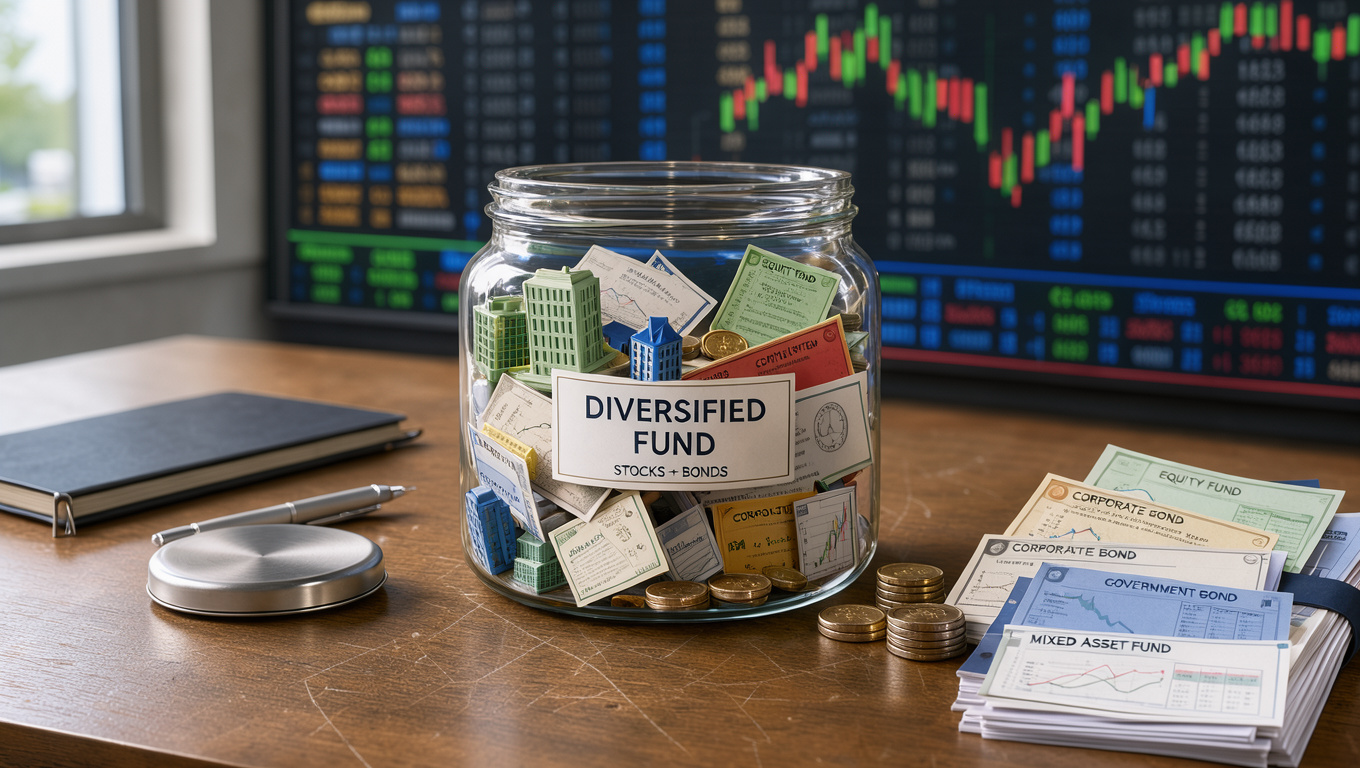
An exchange-traded fund, or ETF, is a pooled portfolio that trades like a stock. It gathers investor money into a professionally managed set of securities such as stocks, bonds, or other assets, and you can buy or sell it at any point during the trading day (Fidelity (brokerage investor education)).
Vanguard describes an ETF as built like a mutual fund, investing in potentially hundreds or thousands of securities, yet trading on an exchange throughout the day like a stock (Vanguard (fund manager investor education)).
What does an ETF hold?
- Stocks, bonds, or other assets, depending on the fund’s stated strategy (Fidelity (brokerage investor education))
- Potentially hundreds or thousands of securities in a single fund (Vanguard (fund manager investor education))
- Holdings that often track a market index, such as the S&P 500 (U.S. Securities and Exchange Commission (federal regulator))
Why is an ETF described as a basket of securities?
- Pooling means one purchase spreads your money across the whole portfolio (Fidelity (brokerage investor education))
- Large institutions swap a basket of underlying stocks for ETF shares, which is how the basket structure stays intact (Vanguard (fund manager investor education))
The implication: for a beginner, the ETF is less a single bet than a container, and the contents matter more than the wrapper.
How does an ETF work?
The mechanism most people miss is creation. Authorized participants, typically large broker-dealers, deal directly with the fund, buying and redeeming ETF shares only in large blocks called creation units, commonly 50,000 shares (U.S. Securities and Exchange Commission (federal regulator)).
In creation, the participant hands over a basket of underlying stocks in exchange for a creation unit of ETF shares, and redemption runs the same process in reverse (Vanguard (fund manager investor education)).
Why does an ETF price change during the trading day?
- ETF shares trade throughout the day at market prices, which can differ from the fund’s net asset value (U.S. Securities and Exchange Commission (federal regulator))
- Mutual fund orders settle at one price per day, while ETF prices move in real time (State Street Global Advisors (asset manager research))
- Creation and redemption give the market a way to keep the ETF price close to the value of its holdings (Vanguard (fund manager investor education))
A buyer at 10 a.m. pays the screen price at that moment, not the end-of-day net asset value that mutual fund buyers receive (U.S. Securities and Exchange Commission (federal regulator)).
The catch: intraday pricing gives you control over timing, but it also invites trading on short-term noise.
How is an ETF different from a mutual fund?
Four rows, one pattern: ETFs lower the cost of getting in, while mutual funds keep a simpler once-a-day price.
| Feature | ETF | Mutual fund |
|---|---|---|
| How shares are priced | Intraday at market prices (U.S. Securities and Exchange Commission (federal regulator)) | Once daily at net asset value; index mutual funds price at the 4 p.m. ET close (Fidelity (brokerage investor education)) |
| Minimum to start | The price of one share (State Street Global Advisors (asset manager research)) | A few hundred to several thousand dollars (State Street Global Advisors (asset manager research)) |
| Median expense ratio | 0.58% (State Street Global Advisors (asset manager research)) | 0.90% for index mutual funds (State Street Global Advisors (asset manager research)) |
| Sales loads | Most ETFs charge none (Western & Southern Financial Group (financial services data)) | About 8% of mutual funds charge load fees (Investopedia (financial reference)) |
Is an ETF the same as an index fund?
- An index fund aims to track a market index, while an ETF is a fund structure rather than a strategy, so it can be managed passively or actively (Fidelity (brokerage investor education))
- Index funds aim to replicate index performance rather than beat it, which keeps management fees lower (Vanguard (index fund education))
The trade-off: the wrapper decides how you trade, while the index decides what you own.
How can I invest in ETFs?
Vanguard lays out four basic steps, and each one shapes the costs you pay later (Vanguard (fund manager investor education)).
- Open a brokerage account.
- Fund the account.
- Research and choose ETFs that match your investing goals.
- Place a trade using the fund’s ticker symbol.
How much money do I need to start investing in ETFs?
- An ETF needs only the price of one share, with no minimum beyond that (State Street Global Advisors (asset manager research))
- Vanguard notes that ETFs can start with as little as one share price (Vanguard (fund manager investor education))
Which ETF is best for beginners?
- No single fund suits every investor, because the right choice depends on goals, costs, and risk tolerance (Vanguard (fund manager investor education))
- The Vanguard S&P 500 ETF (VOO) carries a 0.03% expense ratio, and the Vanguard 500 Index Fund Admiral Shares (VFIAX) carries 0.04% (Investopedia (financial reference))
- Each fund’s most recent prospectus lists its expense ratio (Fidelity (brokerage investor education))
Beginners who pick a fund by its name or its recent run miss the one number known in advance: the expense ratio, printed in the prospectus.
The implication: the first purchase is the easy part, and the expense ratio decides how much of the return you keep.
What is the downside of ETFs?
ETFs carry market risk, because their prices move with the market in real time rather than with a once-daily calculated value (U.S. Securities and Exchange Commission (federal regulator)).
What costs reduce ETF returns over time?
- The expense ratio is deducted from fund assets before returns reach you (Vanguard (fund manager investor education))
- Index equity mutual funds averaged a 0.05% expense ratio and index equity ETFs averaged 0.14%, which works out to about $5 versus roughly $14 per year on $10,000 (Thrivent (investment adviser analysis))
- 12b-1 fees are marketing and distribution fees, typically 0.25% to 1%, embedded in mutual fund expense ratios (Western & Southern Financial Group (financial services data))
- Most major online platforms offer commission-free ETF trading, which removes one cost that once applied to every order (Investopedia (financial reference))
The cheapest fund in a lineup can still lose money, so low cost is a return lever, not a safety net for investors.
The catch: a low fee cannot shield you from a falling market, and that trade-off is easy to forget when a cost table looks reassuring.
Confirmed facts
- ETF shares trade intraday on exchanges at market prices (U.S. Securities and Exchange Commission (federal regulator))
- Expense ratios are deducted from fund returns before investors receive them (Vanguard (fund manager investor education))
- Index mutual fund shares price once a day at 4 p.m. ET (Fidelity (brokerage investor education))
What’s unclear
- The 7% rule that appears in common search questions has no definition in the sources reviewed
- No supplied source makes a forecast about which ETF will boom in 2026
- Expert statements about ETFs, including those attributed to Warren Buffett, are not verified in the research set
- Regional expense ratio patterns outside the United States are not established by the research set
ETF shares are traded throughout the day on national stock exchanges at market prices, which can differ from the fund’s net asset value.
U.S. Securities and Exchange Commission (federal regulator)
Expense ratios are deducted from fund returns rather than paid separately by the investor.
Vanguard (fund manager investor education)
Index mutual fund shares can be bought or sold only once at the close of each trading day, at the price set at 4 p.m. ET.
Fidelity (brokerage investor education)
The gap between an ETF and a mutual fund is less about labels than about what each order costs and when it fills. Intraday prices, creation units, and expense ratios decide how much of a return stays with the investor, and the all-fund average of 0.34% in 2024 shows how small fee gaps add up (Western & Southern Financial Group (financial services data)). A first-time investor in the United States who buys a broad, low-cost ETF and checks its expense ratio each year keeps more of every year’s return, while one who accepts a higher yearly cost pays for an extra return that is not guaranteed.
Related reading: Goodman Group Share Price, Dividends & Shareholders · United Health Share Price Drop: Dividends & Forecast 2026
investor.vanguard.com, investor.vanguard.com, etf.com, investor.vanguard.com, investopedia.com, investopedia.com, sec.gov
Frequently asked questions
Can ETFs be bought and sold during the trading day?
Yes. ETF shares trade throughout the day on national stock exchanges at market prices (U.S. Securities and Exchange Commission (federal regulator)).
What is an example of an ETF?
The Vanguard S&P 500 ETF (VOO) is one example, with an expense ratio of 0.03% (Investopedia (financial reference)).
What is an expense ratio on an ETF?
It is a fund’s total annual operating expenses divided by its net assets, and it appears in the fund’s most recent prospectus (Fidelity (brokerage investor education)).
Who regulates ETFs in the United States?
The U.S. Securities and Exchange Commission regulates ETFs (U.S. Securities and Exchange Commission (federal regulator)).
What is a creation unit?
A creation unit is a large block of ETF shares, such as 50,000 ETF shares, that authorized participants exchange for a basket of underlying securities (U.S. Securities and Exchange Commission (federal regulator)).
What is the minimum needed to buy an ETF?
The price of one share, since ETFs have no minimum beyond that (State Street Global Advisors (asset manager research)).